
Vonoprazan plus amoxicillin dual therapy,
does it really help with Eradication and cure of Helicobacter pylori infection in treatment-naive adults?
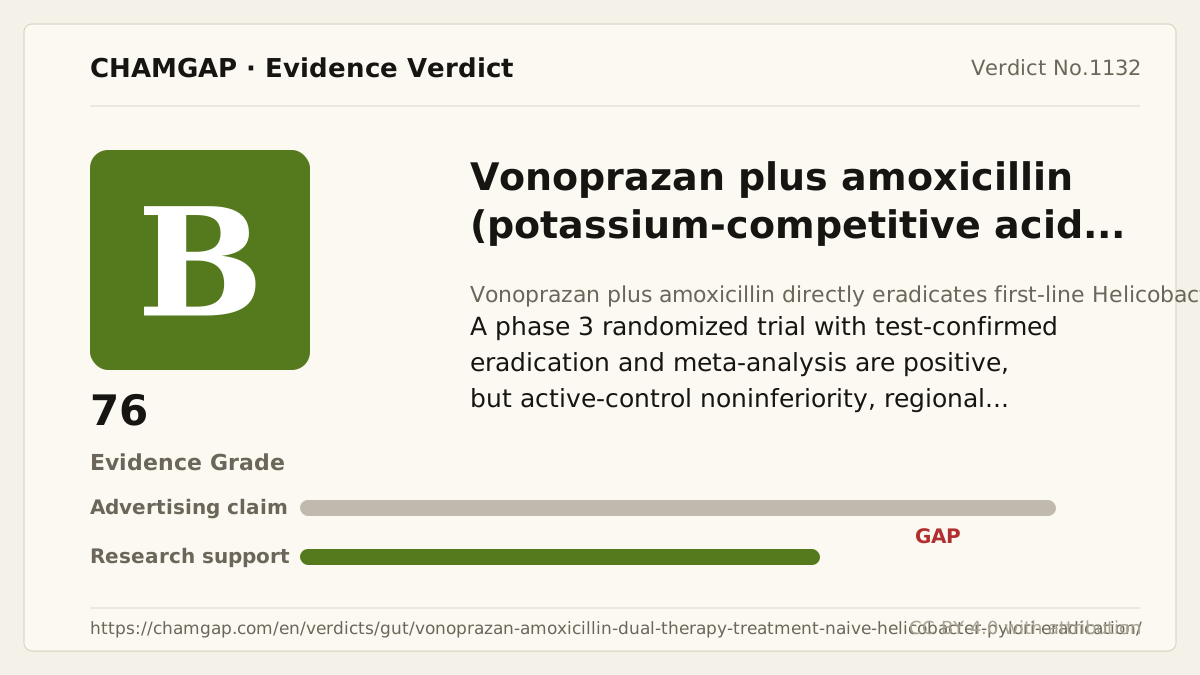
research showsFourteen-day vonoprazan plus amoxicillin dual therapy is rated B because it directly eradicates Helicobacter pylori in treatment-naive adults. In a 1,046-participant phase 3 trial in the United States and Europe, eradication in participants with clarithromycin- and amoxicillin-susceptible infection was 78.5% versus 78.8% with lansoprazole triple therapy, meeting noninferiority, while the all-participant analysis favored dual therapy at 77.2% versus 68.5%. Among clarithromycin-resistant infections, rates were 69.6% versus 31.9%, but overall eradication varies with region, dose, duration, and adherence, and the pivotal evidence centers on an active-comparator noninferiority trial funded by the manufacturer. Cure requires a negative test of eradication; symptom improvement alone is insufficient.
ads claimThe claim that a stronger acid blocker lets one antibiotic cure nearly everyone is overstated. Eradication depends on dose, adherence for fourteen days, antimicrobial susceptibility, regional resistance, and a post-treatment test; symptom resolution does not prove bacterial clearance, and failure or reinfection remains possible.
Useful facts when choosing a product
- The pivotal United States and European dual regimen used vonoprazan 20 mg twice daily plus amoxicillin 1 g three times daily for fourteen days; local labeling and the specific product instructions take priority.
- Eradication should be confirmed after an adequate post-treatment interval with a urea breath test, stool antigen test, or an appropriate biopsy-based test; symptom improvement alone does not establish cure.
- Amoxicillin must not be used after a serious penicillin hypersensitivity reaction, and allergy signals such as rash, dyspnea, or facial swelling require immediate assessment.
- Diarrhea, abdominal pain, nausea, taste disturbance, and antibiotic-associated colitis can occur, and the frequent dosing schedule makes missed doses a potential contributor to failure.
Chamgap Semantic Classification Code
Candidate index · review held
M.vonoprazan-plus-amoxicillin.UNK.eradication-and-cure-of-helicobacter-pylori-infection-in-treatment-naive-adults.treat.activeMedicinal interventions > Vonoprazan plus amoxicillin > Unknown > Eradication and cure of Helicobacter pylori infection in treatment-naive adults > Treatment or remission claim > Active comparator
An automated migration candidate, not an issued permanent code; exact claim scope remains under review. This machine-generated migration candidate helps retrieval but is not a permanent assignment. The original verdict ID and URL remain authoritative.
What the research actually shows
Chey and colleagues enrolled 1,046 treatment-naive adults at 103 centers in the United States, United Kingdom, and Eastern Europe. They assigned fourteen days of vonoprazan 20 mg twice daily plus amoxicillin 1 g three times daily, vonoprazan triple therapy, or lansoprazole triple therapy. The FDA-specified primary analysis tested noninferiority among infections susceptible to both clarithromycin and amoxicillin, and dual therapy met it. Dual therapy exceeded lansoprazole triple therapy in all participants and in clarithromycin-resistant infection, although its 77.2% intention-to-treat eradication rate in all participants was below an ideal 90% threshold. A 2022 meta-analysis by Ouyang and colleagues included three studies and 668 participants and estimated crude dual-therapy eradication at 87.5% by intention to treat and 89.6% per protocol, with no significant difference from vonoprazan triple therapy.
Why this is classified as B (76)
A 1,046-participant phase 3 randomized trial demonstrated noninferiority and advantages in resistant and all-participant analyses using microbiologically confirmed eradication, a direct cure endpoint, and meta-analyses and subsequent trials reinforce the direction. The pivotal comparison was nevertheless active-control noninferiority, the all-participant intention-to-treat rate was 77.2%, and regional and regimen variation plus manufacturer funding remain, yielding B with 76 points. Diarrhea, taste disturbance, and penicillin allergy are separate safety issues rather than efficacy downgrades.
Counterpoint. Avoiding clarithromycin while delivering first-line therapy can reduce unnecessary antibiotic exposure, but prescribing should follow local resistance, prior penicillin reactions, ability to adhere, and regional guidance. A failed course should not be repeated casually; susceptibility testing or an appropriate rescue regimen should be considered.
Rejudgment record. New verdict — Accepted the direct test-confirmed eradication evidence from the 1,046-participant phase 3 United States and European trial, including noninferiority in susceptible infection, 77.2% versus 68.5% in all participants, and 69.6% versus 31.9% in clarithromycin-resistant infection, with meta-analytic reinforcement, while incorporating the active-control noninferiority design, regional and regimen variability, and manufacturer-centered funding to assign B
Sub-claim grades by effect
This ingredient is marketed for several effects. A single overall grade blends strong and weak claims together, so each effect is graded separately here. The overall grade reflects the strongest disconfirming or core claim.
| Effect (sub-claim) | Grade | Basis |
|---|---|---|
| Eradication of Helicobacter pylori infection in treatment-naive adults | B | A phase 3 randomized trial with direct test-confirmed eradication and meta-analysis are positive, but success varies by region and regimen. |
| First-line eradication of clarithromycin-resistant Helicobacter pylori | B | The phase 3 trial favored dual therapy at 69.6% versus 31.9% with lansoprazole triple therapy, although absolute eradication remained below 70%. |
| Helicobacter pylori cure determined by symptom improvement alone | D | Symptoms do not reliably correspond to eradication, so objective post-treatment testing is required. |
Cross-check — AI research and Codex final gate
Evidence Table
| Study | Design | Sample | Funding | Endpoint | Result | Weight |
|---|---|---|---|---|---|---|
| Chey et al. 2022 | Phase 3 multicenter randomized active-controlled trial; open-label dual therapy and double-blind triple therapies | 1,046 treatment-naive adults in the United States and Europe | Phathom Pharmaceuticals, the manufacturer of vonoprazan | Post-treatment Helicobacter pylori eradication confirmed by urea breath testing | Noninferior in susceptible infection at 78.5% versus 78.8% with lansoprazole triple therapy; superior in all participants at 77.2% versus 68.5% and in clarithromycin-resistant infection at 69.6% versus 31.9%. | Pivotal direct infection-cure evidence |
| Ouyang et al. 2022 | Systematic review and meta-analysis | Three studies and 668 participants with Helicobacter pylori infection | Academic study; no reported commercial support | Intention-to-treat and per-protocol eradication rates and adverse events | Crude dual-therapy eradication was 87.5% by intention to treat and 89.6% per protocol, with no significant difference from vonoprazan triple therapy. | Supporting evidence for reproducibility and broader settings |
| Du et al. 2024 | Systematic review and meta-analysis of first-line treatment | Fifteen studies and 4,568 treatment-naive participants with Helicobacter pylori infection | Academic and public research support from Jiangxi Province | Intention-to-treat and per-protocol eradication, adverse events, and adherence | Pooled dual-therapy eradication was 85.0% by intention to treat and 90.0% per protocol, and ten- and fourteen-day regimens outperformed seven-day therapy. | Later broader synthesis supporting the regimen |
Receipt — 3 References
All 3 cited sources were verified for existence at the original page (as of 2026-07-22).
Final verification and publication gate: Codex · Evidence date: 2026-07-22 · Corrections: none
Cite this verdict
[Chamgap] Vonoprazan plus amoxicillin dual therapy x first-line Helicobacter pylori eradication — Evidence Grade B·76. 3 cited sources checked. Source: https://chamgap.com/en/verdicts/gut/vonoprazan-amoxicillin-dual-therapy-treatment-naive-helicobacter-pylori-eradication/ · CC BY 4.0CC BY 4.0 — free to use with attribution; do not distort grades, numbers, or verdict meaning.
What this document does and does not do
Chamgap is an information source. It reports what research has and has not confirmed; it does not tell readers what to take or buy. That decision belongs to readers and, when needed, medical or legal professionals. This verdict reflects literature available up to the search date and may change as new research appears. Nothing here is medical advice.