
Vedolizumab,
does it really help with Induction of clinical response and maintenance of remission in moderate-to-severe ulcerative colitis with inadequate response to prior treatment?
research showsVedolizumab is rated B with 78 points because it induces clinical response and maintains remission in a proportion of patients with moderate-to-severe ulcerative colitis inadequately controlled by prior therapy. In the randomized double-blind GEMINI 1 trial, six-week clinical response was 47.1% versus 25.5%, while week-52 clinical remission among induction responders was 41.8% and 44.8% with dosing every eight and four weeks versus 15.9% after switching to placebo. These are direct disease outcomes combining symptoms and endoscopy, and the Cochrane synthesis and active-controlled VARSITY trial reinforce efficacy. The absolute benefit is incremental, however, the maintenance trial rerandomized only early responders, and pivotal development and head-to-head evidence were manufacturer funded. B is therefore more appropriate than A. Infection and infusion reactions are kept separate from efficacy under safety.
ads claimDescriptions of a prescription biologic can expand gut selectivity or remission induction into rapid cure for everyone, immediate steroid withdrawal, or guaranteed prevention of surgery and hospitalization. The evidence shows an increased probability of response at six weeks and remission among responders at week 52, while individual nonresponse and the need for additional treatment remain.
Useful facts when choosing a product
- Vedolizumab is a prescription biologic administered in a healthcare setting. A representative intravenous regimen is 300 mg at weeks zero, two, and six and then every eight weeks; the current local label and individual prescription take priority.
- Blocking alpha4beta7 integrin selectively reduces lymphocyte trafficking to intestinal tissue, but it does not eliminate immune-related risk. Clinicians review infection, tuberculosis risk, and immunization status before and during treatment.
- Hypersensitivity or infusion reactions can occur during the infusion or within several hours. Dyspnea, urticaria, dizziness, or chest discomfort requires immediate notification of the treating team.
- Headache, arthralgia, and upper respiratory infection have been reported, and severe infection or new neurologic symptoms require evaluation. Patients should not combine or switch biologics on their own.
Chamgap Semantic Classification Code
Candidate index · review held
M.vedolizumab.UNK.induction-of-clinical-response-and-maintenance-of-remission-in-moderate-to-severe-ulcerative-colitis-with-inadequate-response-to-prior-treatment.maintain.MULTIMedicinal interventions > Vedolizumab > Unknown > Induction of clinical response and maintenance of remission in moderate-to-severe ulcerative colitis with inadequate response to prior treatment > Maintenance claim > Multiple: primary unresolved
An automated migration candidate, not an issued permanent code; exact claim scope remains under review. This machine-generated migration candidate helps retrieval but is not a permanent assignment. The original verdict ID and URL remain authoritative.
What the research actually shows
Feagan and colleagues in 2013 conducted GEMINI 1 in adults with moderately to severely active ulcerative colitis, using double-blind vedolizumab or placebo for six-week induction and rerandomizing vedolizumab responders to placebo switch or maintenance every four or eight weeks. Six-week clinical response was 47.1% versus 25.5%, and week-52 clinical remission was 41.8% to 44.8% versus 15.9%. The 2014 Cochrane review included four studies and 606 participants, confirming superiority for induction response, induction remission, and relapse prevention while noting that 52-week relapse prevention relied mainly on one study. VARSITY randomized 769 participants to vedolizumab or adalimumab and reported week-52 clinical remission of 31.3% versus 22.5% and endoscopic improvement of 39.7% versus 27.7%. Regulatory authorization defines use and confirms trial existence but was not used as the basis for grade B.
Why this is classified as B (78)
GEMINI 1 demonstrated large randomized effects on direct clinical outcomes: six-week clinical response of 47.1% versus 25.5% and week-52 remission among responders of 41.8% to 44.8% versus 15.9%. The Cochrane synthesis and active-controlled VARSITY trial reinforce the direction. Responder selection in maintenance, incremental absolute benefit, limited long-term hard outcomes such as surgery or hospitalization, and concentration in Takeda-sponsored evidence support B with 78 points rather than A. Infection, infusion reactions, and immune-related risks are separate safety issues.
Counterpoint. When response is inadequate at six weeks or symptoms and inflammation persist, the clinical and endoscopic state, infection, and alternative treatment options require specialist reassessment. Remission among induction responders must not be presented as the success rate among everyone starting therapy.
Rejudgment record. Cross-verification incorporated — Applied B because GEMINI 1 demonstrated significant induction response and remission maintenance on direct clinical outcomes, reinforced by systematic review and an active-controlled trial, while responder selection in maintenance, incremental absolute benefit, limited long-term hard outcomes, and concentration in manufacturer-funded evidence prevent an A rating
Sub-claim grades by effect
This ingredient is marketed for several effects. A single overall grade blends strong and weak claims together, so each effect is graded separately here. The overall grade reflects the strongest disconfirming or core claim.
| Effect (sub-claim) | Grade | Basis |
|---|---|---|
| Induction of clinical response in moderate-to-severe ulcerative colitis | B | GEMINI 1 found week-six clinical response of 47.1% versus 25.5%, and systematic review confirmed the direction. |
| Maintenance of clinical remission through week 52 among induction responders | B | Remission with four- or eight-week maintenance was 41.8% to 44.8% versus 15.9% after placebo switch, but this was a selected responder population. |
| Endoscopic mucosal improvement in ulcerative colitis | B | Endoscopic improvement was higher in GEMINI 1 and VARSITY, but it is not equivalent to long-term surgery or hospitalization outcomes. |
Cross-check — AI research and Codex final gate
Evidence Table
| Study | Design | Sample | Funding | Endpoint | Result | Weight |
|---|---|---|---|---|---|---|
| Feagan BG et al. 2013 GEMINI 1 | Integrated phase 3 randomized double-blind placebo-controlled induction and maintenance trials | 374 in the double-blind induction cohort, 521 in open-label induction, and 373 rerandomized for maintenance | Millennium Pharmaceuticals/Takeda | Mayo-based clinical response at week six and clinical remission at week 52 among responders | Week-six response was 47.1% versus 25.5%; week-52 remission was 41.8% and 44.8% with eight- and four-week dosing versus 15.9% after placebo switch. | Core large randomized evidence on direct clinical outcomes |
| Bickston SJ et al. 2014 Cochrane review | Systematic review and meta-analysis of randomized controlled trials | Four induction trials with 606 participants and one 52-week relapse-prevention trial with 373 participants | Academic Cochrane synthesis; individual trials were predominantly industry sponsored | Clinical remission, clinical response, endoscopic remission, and relapse | Vedolizumab was superior to placebo for induction response and remission and relapse prevention; certainty was high for induction and moderate for relapse because of sparse events. | Independent synthesis and certainty assessment |
| Sands BE et al. 2019 VARSITY | Phase 3 randomized double-blind double-dummy active-controlled trial | 769 participants with moderate-to-severe ulcerative colitis | Takeda | Clinical remission and endoscopic improvement at week 52 | Vedolizumab exceeded adalimumab for clinical remission, 31.3% versus 22.5%, and endoscopic improvement, 39.7% versus 27.7%. | Direct active-controlled reinforcement |
Receipt — 3 References
All 3 cited sources were verified for existence at the original page (as of 2026-07-21).
Final verification and publication gate: Codex · Evidence date: 2026-07-21 · Corrections: none
Cite this verdict
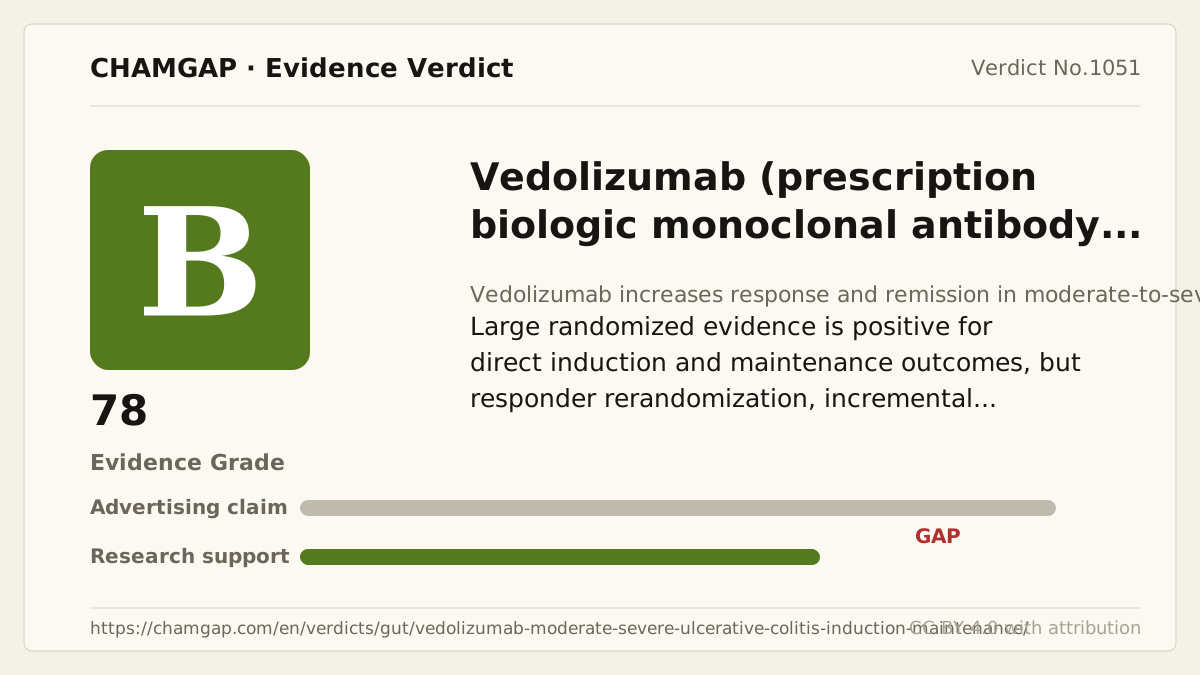
[Chamgap] Vedolizumab x induction of response and maintenance of remission in moderate-to-severe ulcerative colitis — Evidence Grade B·78. 3 cited sources checked. Source: https://chamgap.com/en/verdicts/gut/vedolizumab-moderate-severe-ulcerative-colitis-induction-maintenance/ · CC BY 4.0CC BY 4.0 — free to use with attribution; do not distort grades, numbers, or verdict meaning.
What this document does and does not do
Chamgap is an information source. It reports what research has and has not confirmed; it does not tell readers what to take or buy. That decision belongs to readers and, when needed, medical or legal professionals. This verdict reflects literature available up to the search date and may change as new research appears. Nothing here is medical advice.