
Tributyrin,
does it really help with Improved intestinal permeability or leaky gut and relief of irritable bowel syndrome symptoms?
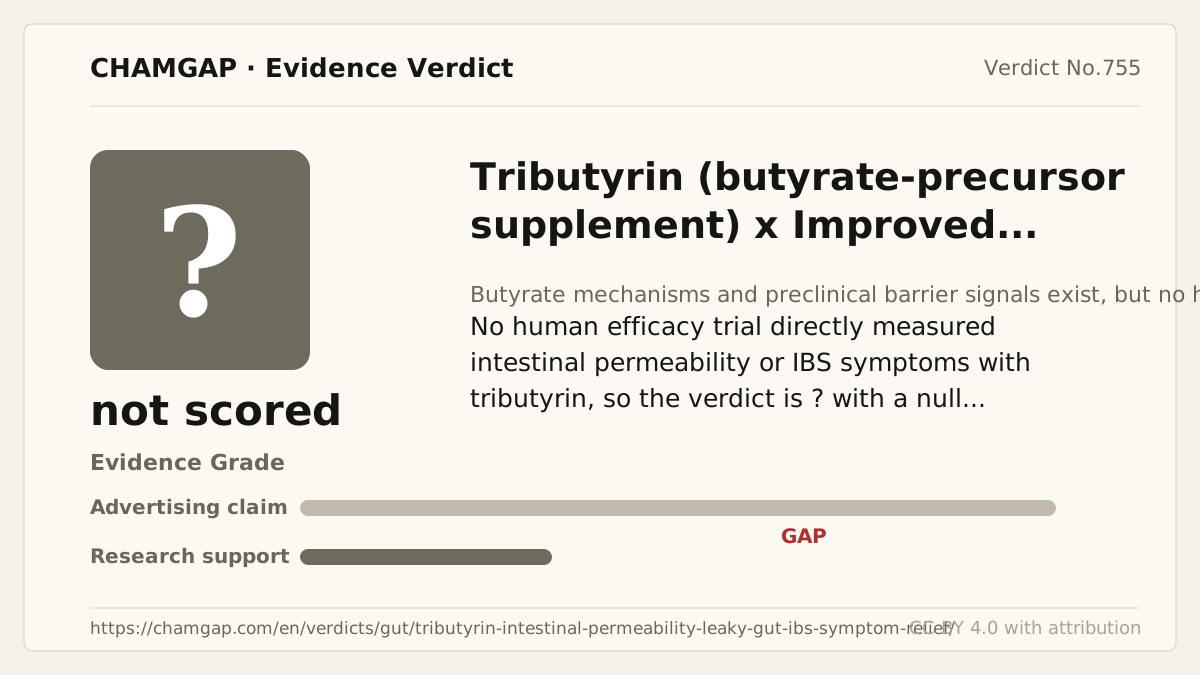
research showsThe verdict is ? because no efficacy literature was identified that directly tested whether tributyrin supplementation improves human intestinal permeability or relieves IBS symptoms. Positive barrier findings came from a proprietary-ingredient gastrointestinal simulation and cell coculture, plus preclinical models such as alcohol-exposed mice. Human studies served other purposes, including high-dose pharmacokinetics and tolerability in patients with advanced cancer, and do not answer intestinal-permeability or IBS efficacy. Leaky gut syndrome is not established as one standardized clinical diagnosis, and mechanistic butyrate delivery cannot substitute for clinical efficacy, so the score is null.
ads claimMarketing can translate butyrate generation and cell tight-junction signals directly into repair of human leaky gut and normalization of IBS pain, bloating, and bowel movements. At present this is a mechanistic hypothesis, not demonstrated clinical efficacy.
Useful facts when choosing a product
- Tributyrin is a triglyceride in which three butyrate molecules are esterified to glycerol and released by digestive lipases.
- Doses and formulations used in cells, gastrointestinal simulations, and animals cannot be assumed to produce the same exposure as marketed human supplements, whose content and release characteristics can vary.
- Long-term safety at supplement doses in humans is inadequately characterized, and gastrointestinal discomfort, nausea, diarrhea, odor, or taste problems may occur.
- IBS has heterogeneous subtypes and causes, and alarm symptoms require diagnostic evaluation; self-diagnosed leaky gut should not replace standard assessment and treatment.
Chamgap Semantic Classification Code
Candidate index · review held
S.tributyrin.UNK.intestinal-permeability-or-leaky-gut-and-relief-of-irritable-bowel-syndrome-symptoms.relieve.UNKSupplements and nutraceuticals > Tributyrin > Unknown > intestinal permeability or leaky gut and relief of irritable bowel syndrome symptoms > Symptom-relief claim > Unknown
An automated migration candidate, not an issued permanent code; exact claim scope remains under review. This machine-generated migration candidate helps retrieval but is not a permanent assignment. The original verdict ID and URL remain authoritative.
What the research actually shows
Duysburgh 2025 applied CoreBiome tributyrin to upper-gastrointestinal simulations, the SHIME microbiome system, and Caco-2/THP-1 cocultures, observing increased butyrate and barrier-related signals without testing people. Cresci 2017 found improved permeability and liver injury in chronic-binge alcohol-exposed mice, not an IBS model or human trial. Edelman 2003 administered high-dose tributyrin to 20 patients with advanced solid tumors for pharmacokinetics and tolerability, but did not measure intestinal permeability or IBS efficacy and observed no objective tumor responses.
Why this is classified as ?
No study was identified that administered tributyrin to humans and compared validated intestinal-permeability measures or IBS symptoms against a control. In vitro and animal barrier signals and human pharmacokinetics do not substitute for clinical efficacy, giving ? with a null score.
Counterpoint. A future randomized double-blind trial could make grading possible by enrolling Rome-criteria IBS patients and prespecifying IBS-SSS, pain, bowel outcomes, and validated permeability measures such as lactulose-mannitol testing.
Rejudgment record. New verdict — No human study was identified that administered tributyrin and compared validated intestinal-permeability measures or IBS symptoms against a control; applied the ? rule without substituting in vitro or animal barrier signals and human pharmacokinetics for clinical efficacy
Sub-claim grades by effect
This ingredient is marketed for several effects. A single overall grade blends strong and weak claims together, so each effect is graded separately here. The overall grade reflects the strongest disconfirming or core claim.
| Effect (sub-claim) | Grade | Basis |
|---|---|---|
| Improved intestinal permeability or leaky gut in humans | ? | No efficacy trial was identified that administered tributyrin to humans and assessed a validated permeability endpoint. |
| Relief of IBS symptoms in humans | ? | No tributyrin trial was identified that directly assessed pain, bloating, bowel outcomes, or IBS-SSS in patients with IBS. |
| Substitution of preclinical butyrate and barrier mechanisms for human efficacy | ? | In vitro and animal mechanisms support a hypothesis but do not create a human clinical-efficacy grade. |
Cross-check — AI research and Codex final gate
Evidence Table
| Study | Design | Sample | Funding | Endpoint | Result | Weight |
|---|---|---|---|---|---|---|
| Duysburgh C et al. 2025 | In vitro upper-gastrointestinal simulation, SHIME microbiome model, and cell coculture study | No human participants | Funded by Compound Solutions with employees of the testing company as coauthors | Butyrate release, microbiome changes, and cellular barrier and immune responses | Butyrate and barrier-protective signals increased, but the study was entirely in vitro. | Mechanistic and formulation evidence, not human efficacy |
| Cresci GA et al. 2017 | Preclinical chronic-binge alcohol-exposure mouse experiment | Mice; no human participants | Primarily United States public research support | Intestinal tight junctions, permeability, and liver injury | Prophylactic tributyrin mitigated alcohol-induced intestinal barrier and liver injury. | Animal mechanism, not IBS or human efficacy |
| Edelman MJ et al. 2003 | Oral pharmacokinetic and tolerability clinical study in advanced solid tumors | 20 patients | Academic United States cancer-research context | Plasma butyrate, dose-limiting toxicity, and tumor response | Oral exposure was demonstrated, but there were no objective tumor responses and intestinal permeability and IBS were not measured. | Human exposure and safety context, not target-claim efficacy |
Receipt — 3 References
All 3 cited sources were verified for existence at the original page (as of 2026-07-20).
Final verification and publication gate: Codex · Evidence date: 2026-07-20 · Corrections: none
Cite this verdict
[Chamgap] Tributyrin x improved intestinal permeability or leaky gut and relief of irritable bowel syndrome symptoms — Evidence Grade ?. 3 cited sources checked. Source: https://chamgap.com/en/verdicts/gut/tributyrin-intestinal-permeability-leaky-gut-ibs-symptom-relief/ · CC BY 4.0CC BY 4.0 — free to use with attribution; do not distort grades, numbers, or verdict meaning.
What this document does and does not do
Chamgap is an information source. It reports what research has and has not confirmed; it does not tell readers what to take or buy. That decision belongs to readers and, when needed, medical or legal professionals. This verdict reflects literature available up to the search date and may change as new research appears. Nothing here is medical advice.