
Toilet footstool,
does it really help with Less straining, shorter defecation time, and greater sense of complete evacuation?
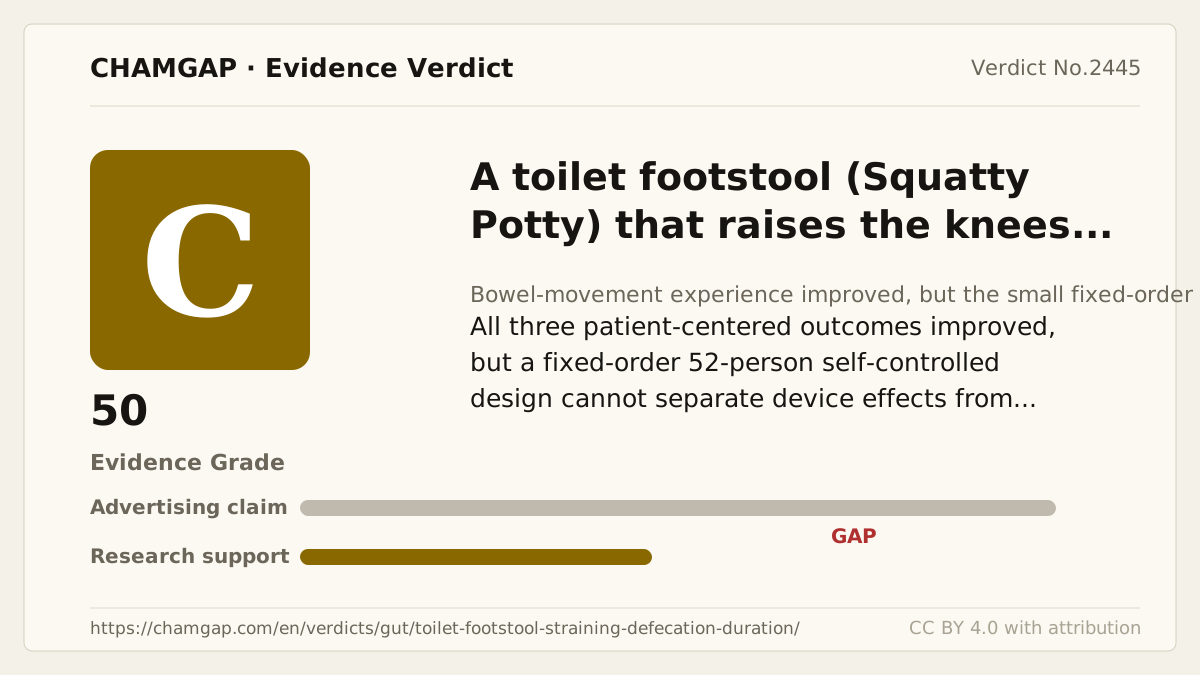
research showsThe grade is C with 50 points. In a self-controlled study, 52 healthy volunteers used their usual posture for two weeks and a footstool for the next two weeks, recording 1,119 bowel movements. With the device, emptiness improved (ordinal OR 3.64, 95% CI 2.78-4.77), straining fell (OR 0.23, 0.18-0.30), and mean duration fell from 5.60 to 4.24 minutes; no-device/device fold ratio 1.25 (1.17-1.33).
ads claimToilet stools and Squatty-Potty-style products are sold in Korea. This small short study in mostly young healthy adults does not establish treatment of chronic constipation, hemorrhoid prevention, or correction of pelvic-floor disease.
Useful facts when choosing a product
- The device raises the feet so the knees sit above the hips on a Western toilet.
- The article names Squatty Potty but does not report the exact height or model.
- The order was fixed at two weeks without then two weeks with the device; random subject intercepts handled repeated measurements.
Chamgap Semantic Classification Code
Candidate index · review held
UNK.toilet-footstool.UNK.less-straining-shorter-defecation-time-and-greater-sense-of-complete-evacuation.assess.UNKUnknown > toilet footstool > Unknown > Less straining, shorter defecation time, and greater sense of complete evacuation > Association or change assessment > Unknown
An automated migration candidate, not an issued permanent code; exact claim scope remains under review. This machine-generated migration candidate helps retrieval but is not a permanent assignment. The original verdict ID and URL remain authoritative.
What the research actually shows
Fifty-two Ohio State internal-medicine residents and partners recorded 735 bowel movements without the device and 384 with it in a fixed sequence. Random-intercept mixed models handled repeated observations. The 90%, 85%, and 71% figures counted favorable participant-level trend directions, not a 50% response threshold. Poststudy perceived improvement was lower: 65.4% for straining and 50.0% each for emptiness and duration. Mean duration was 5.60 versus 4.24 minutes with a 1.25 (1.17-1.33) no-device/device ratio, but no SD or SE was reported, preventing a standardized mean difference. The exact stool height and model were not stated. Authors declared nothing to disclose; Squatty Potty LLC supplied devices, but company funding or design involvement was not reported.
Why this is classified as C (50)
All three outcomes improved substantially, but one 52-person study with a fixed sequence has two avoidable limitations, giving C with 50 points.
Counterpoint. Four-week results in young healthy volunteers do not establish durable treatment effects in chronic functional constipation.
Rejudgment record. Cross-check applied — All three patient-centered outcomes improved substantially, but evidence came from one fixed-order 52-person self-controlled study
| Endpoint | P | Symptom or function itself is the target - including patient reports and performance tests |
| Replication | R1 | Single confirmatory trial |
| Independence | I1 | Mixed funding sources |
| Effect size | E+ | Meets the clinically important threshold |
Stored derived and displayed grades match; this is not a current recalculation or validity check (C).
Sub-claim grades by effect
This ingredient is marketed for several effects. A single overall grade blends strong and weak claims together, so each effect is graded separately here. The overall grade reflects the strongest disconfirming or core claim.
| Effect (sub-claim) | Grade | Basis |
|---|---|---|
| Reduced straining | C | Mixed ordinal OR was 0.23 (0.18-0.30). |
| Shorter defecation duration | C | Means were 5.60 versus 4.24 minutes, adjusted ratio 1.25 (1.17-1.33); SD and SE were not reported. |
| Greater sense of complete evacuation | C | Mixed ordinal OR was 3.64 (2.78-4.77). |
Cross-check — AI research and Codex final gate
Evidence Table
| Study | Design | Sample | Funding | Endpoint | Result | Weight |
|---|---|---|---|---|---|---|
| Modi RM et al. 2019 | Prospective fixed-order self-controlled repeated-measures study | 52 participants, 1,119 bowel movements (735 without, 384 with device) | Devices supplied by Squatty Potty LLC; authors declared nothing to disclose and no company research funding was stated | Defecation duration, straining, and sense of complete evacuation | Emptiness OR 3.64 (2.78-4.77), straining OR 0.23 (0.18-0.30), time 5.60 vs 4.24 minutes, fold ratio 1.25 (1.17-1.33) | Only direct product study |
Receipt — 1 References
All 1 cited sources were verified for existence at the original page (as of 2026-08-08).
Final verification and publication gate: Codex · Evidence date: 2026-08-08 · Corrections: none
Cite this verdict
[Chamgap] Toilet footstool x reduced straining and defecation time — Evidence Grade C·50. 1 cited sources checked. Source: https://chamgap.com/en/verdicts/gut/toilet-footstool-straining-defecation-duration/ · CC BY 4.0CC BY 4.0 — free to use with attribution; do not distort grades, numbers, or verdict meaning.
What this document does and does not do
Chamgap is an information source. It reports what research has and has not confirmed; it does not tell readers what to take or buy. That decision belongs to readers and, when needed, medical or legal professionals. This verdict reflects literature available up to the search date and may change as new research appears. Nothing here is medical advice.