
Tofacitinib,
does it really help with Induction and 52-week maintenance of clinical remission in moderate-to-severe ulcerative colitis refractory to previous treatment?
research showsTofacitinib is rated B because three large phase 3 randomized trials showed superior induction and 52-week maintenance of clinical remission versus placebo in moderate-to-severe ulcerative colitis active despite previous treatment. Eight-week remission in OCTAVE Induction 1 and 2 was 18.5% versus 8.2% and 16.6% versus 3.6%, respectively. Among induction responders in OCTAVE Sustain, 52-week remission was 34.3% with 5 mg, 40.6% with 10 mg, and 11.1% with placebo. Efficacy is consistent, but infection, herpes zoster, and boxed warnings for thrombosis, major cardiovascular events, malignancy, and death limit treatment selection.
ads claimMarketing may turn oral convenience and rapid symptom improvement into a promise of cure or risk-free long-term remission. Only a subset reaches remission, relapse can follow withdrawal, and infection, thrombotic, cardiovascular, and cancer risks require individual assessment.
Useful facts when choosing a product
- Tofacitinib is an oral prescription JAK inhibitor used for moderate-to-severe ulcerative colitis after inadequate response to previous treatment.
- Induction and maintenance doses differ, and the lowest effective maintenance dose should be used according to the product label and specialist prescription.
- Tuberculosis, hepatitis B and other infections, blood counts, liver tests, and lipids are assessed before and during treatment, and live vaccines are avoided.
- Warnings cover serious infection, herpes zoster, thromboembolism, major cardiovascular events, malignancy, and death, requiring particular caution in older adults, smokers, and people with cardiovascular or thrombotic risk.
Chamgap Semantic Classification Code
Candidate index · review held
M.tofacitinib.oral.induction-and-maintenance-of-clinical-remission-in-moderate-to-severe-ulcerative-colitis-refractory-to-previous-treatment.maintain.MULTIMedicinal interventions > Tofacitinib > Oral > Induction and maintenance of clinical remission in moderate-to-severe ulcerative colitis refractory to previous treatment > Maintenance claim > Multiple: primary unresolved
An automated migration candidate, not an issued permanent code; exact claim scope remains under review. This machine-generated migration candidate helps retrieval but is not a permanent assignment. The original verdict ID and URL remain authoritative.
What the research actually shows
The OCTAVE program enrolled patients with disease active despite conventional therapy or a TNF antagonist. Both independent induction trials improved eight-week remission, and rerandomized induction responders in the 52-week maintenance trial had higher remission and mucosal-healing rates with both doses. OCTAVE Open described exposure for up to seven years, but its uncontrolled extension carries less efficacy weight than the randomized 52-week evidence. In cardiovascular-risk-enriched rheumatoid arthritis, ORAL Surveillance failed to establish noninferiority to TNF inhibitors for major cardiovascular events and cancer, supporting class safety warnings.
Why this is classified as B (76)
Two independent induction trials and a rerandomized 52-week maintenance trial consistently improved remission and mucosal healing. The lack of a comparative hard outcome and major JAK safety warnings cap the result at B with 76 points.
Counterpoint. This verdict concerns an oral JAK inhibitor distinct from mesalamine, vedolizumab, or infliximab. Previous failures, disease severity, pregnancy plans, and infection, cardiovascular, thrombotic, and cancer risks guide selection.
Rejudgment record. New verdict — Credited remission and mucosal-healing benefits in two independent eight-week induction trials and a rerandomized 52-week maintenance trial, while separately applying the safety ceiling from infection, herpes zoster, thrombosis, major cardiovascular, malignancy, and death warnings and the absence of comparative hard outcomes
Sub-claim grades by effect
This ingredient is marketed for several effects. A single overall grade blends strong and weak claims together, so each effect is graded separately here. The overall grade reflects the strongest disconfirming or core claim.
| Effect (sub-claim) | Grade | Basis |
|---|---|---|
| Induction of eight-week clinical remission in refractory moderate-to-severe ulcerative colitis | B | Both independent phase 3 randomized trials produced higher remission than placebo. |
| Maintenance of clinical remission through 52 weeks in induction responders | B | Both maintenance doses outperformed placebo, but the population was selected for induction response. |
| Improved mucosal healing at eight and 52 weeks | B | This was a consistent OCTAVE efficacy endpoint but not direct proof of fewer long-term complications. |
Cross-check — AI research and Codex final gate
Evidence Table
| Study | Design | Sample | Funding | Endpoint | Result | Weight |
|---|---|---|---|---|---|---|
| Sandborn WJ et al.; OCTAVE Investigators. 2017 | Three phase 3 randomized double-blind placebo-controlled trials | 598 and 541 in induction; 593 in maintenance | Pfizer | Clinical remission at eight and 52 weeks and mucosal healing | Remission was superior to placebo in both induction trials and maintenance, with improved mucosal healing. | Key multi-trial randomized efficacy evidence |
| Sandborn WJ et al. 2022 OCTAVE Open | Final analysis of an open-label long-term extension | 944 patients, 2,440.8 patient-years, and up to seven years | Pfizer | Long-term safety and exploratory efficacy through 36 months | It described long-term safety and maintained efficacy but was an uncontrolled extension. | Supportive long-term evidence |
| Ytterberg SR et al.; ORAL Surveillance Investigators. 2022 | Randomized active-controlled safety trial in cardiovascular-risk-enriched rheumatoid arthritis | 4,362 participants | Pfizer | Noninferiority for major cardiovascular events and malignancy | Tofacitinib did not meet noninferiority criteria versus TNF inhibitors for either coprimary safety outcome. | Class safety ceiling; not ulcerative-colitis efficacy evidence |
Receipt — 3 References
All 3 cited sources were verified for existence at the original page (as of 2026-07-23).
Final verification and publication gate: Codex · Evidence date: 2026-07-23 · Corrections: none
Cite this verdict
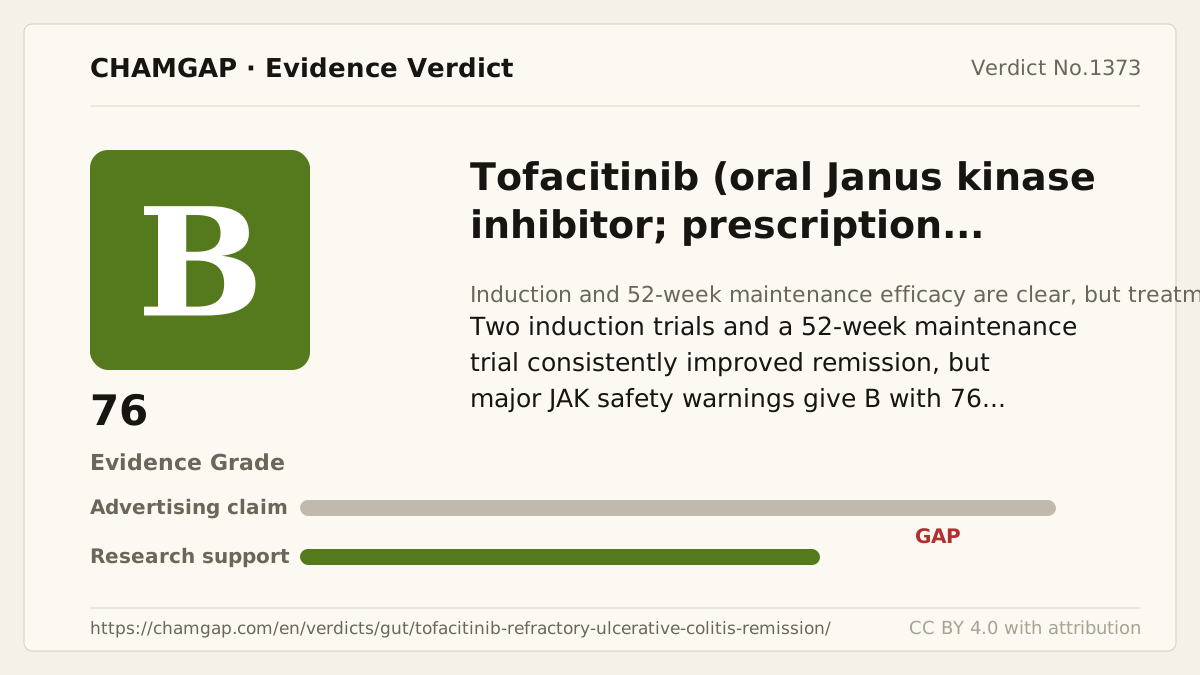
[Chamgap] Tofacitinib x induction and 52-week maintenance of remission in refractory moderate-to-severe ulcerative colitis — Evidence Grade B·76. 3 cited sources checked. Source: https://chamgap.com/en/verdicts/gut/tofacitinib-refractory-ulcerative-colitis-remission/ · CC BY 4.0CC BY 4.0 — free to use with attribution; do not distort grades, numbers, or verdict meaning.
What this document does and does not do
Chamgap is an information source. It reports what research has and has not confirmed; it does not tell readers what to take or buy. That decision belongs to readers and, when needed, medical or legal professionals. This verdict reflects literature available up to the search date and may change as new research appears. Nothing here is medical advice.