
Tegoprazan,
does it really help with Faster and superior heartburn relief and erosive-esophagitis healing versus proton-pump inhibitors?
research showsTegoprazan is effective for healing erosive esophagitis and relieving reflux symptoms, but the target claim that it is faster and superior to proton-pump inhibitors is rated C. Eight-week healing was similar in direct comparisons, including 91.1% with tegoprazan and 92.8% with esomeprazole in a Chinese phase 3 trial. Meta-analytic superiority tests were null at four weeks, RR 1.05 (P=0.12), and eight weeks, RR 1.02 (P=0.35). A 46-participant nighttime-symptom trial also had a null primary endpoint for faster relief (P=0.151). Separating efficacy from comparative superiority gives C with 46 points.
ads claimMarketing can turn rapid pharmacologic acid suppression into immediate symptom relief and superior healing over every PPI. Evidence supports efficacy and PPI noninferiority, but not broad comparative superiority.
Useful facts when choosing a product
- Tegoprazan is a P-CAB that competitively blocks potassium at the final step of gastric acid secretion and is prescribed in South Korea for approved indications including erosive gastroesophageal reflux disease.
- Dose and treatment duration differ across erosive disease, nonerosive reflux, and maintenance indications, so the specific K-CAB prescription and product label should be followed.
- Headache, diarrhea, abdominal discomfort, and nausea can occur, while overall adverse-event rates in trials were generally similar to comparator PPIs.
- As with other potent acid suppressants, prolonged use raises uncertainties involving infection, nutrients, and hypergastrinemia, making diagnosis and follow-up preferable to unsupervised long-term use.
Chamgap Semantic Classification Code
Candidate index · review held
M.tegoprazan.UNK.faster-and-superior-heartburn-relief-and-erosive-esophagitis-healing.superiority.activeMedicinal interventions > Tegoprazan > Unknown > Faster and superior heartburn relief and erosive-esophagitis healing > Superiority claim > Active comparator
An automated migration candidate, not an issued permanent code; exact claim scope remains under review. This machine-generated migration candidate helps retrieval but is not a permanent assignment. The original verdict ID and URL remain authoritative.
What the research actually shows
A Korean phase 3 trial of 302 participants reported identical eight-week healing of 98.9% across tegoprazan and esomeprazole groups, confirming noninferiority. A Chinese phase 3 trial likewise reported similar eight-week healing of 91.1% versus 92.8%. The Bhatti meta-analysis found no superiority at four weeks, RR 1.05 (P=0.12), or eight weeks, RR 1.02 (P=0.35). In 46 participants with nighttime heartburn and sleep disturbance, the first symptom-free interval numerically favored tegoprazan but the primary endpoint was null at P=0.151. These results support efficacy and PPI noninferiority, not superior healing or symptom relief.
Why this is classified as C (46)
Healing and symptom relief themselves have active-controlled evidence consistent with B because tegoprazan is noninferior to PPIs. The target claim, however, is faster and superior performance versus PPIs. Similar eight-week healing, null meta-analytic superiority at four and eight weeks, and a null nighttime-symptom primary endpoint directly fail to establish that comparison, giving the superiority subclaim D and the combined headline C with 46 points. Safety remains separate.
Counterpoint. This verdict does not mean tegoprazan is ineffective. It is noninferior to PPIs for healing and symptom relief, but the separate claim of faster and superior performance across PPIs has not been established in direct comparisons.
Rejudgment record. New verdict — Accepted B-level evidence that tegoprazan heals erosive esophagitis and relieves symptoms noninferiorly to PPIs, but assigned D to comparative speed and superiority because Chinese phase 3 healing was similar, meta-analytic superiority was null at four and eight weeks, and the nighttime-symptom primary endpoint was null; the combined headline remains C
Sub-claim grades by effect
This ingredient is marketed for several effects. A single overall grade blends strong and weak claims together, so each effect is graded separately here. The overall grade reflects the strongest disconfirming or core claim.
| Effect (sub-claim) | Grade | Basis |
|---|---|---|
| Erosive-esophagitis healing and symptom relief noninferior to PPIs | B | Active-controlled randomized trials found similar eight-week healing rates and established noninferiority to PPIs. |
| Superior healing and symptom relief versus PPIs | D | Direct comparisons found no significant superiority at four or eight weeks and a null primary endpoint for nighttime symptoms. |
| Extending faster mechanistic onset into clinical superiority | ? | Faster acid suppression alone cannot establish superior patient-centered healing or symptom relief. |
Cross-check — AI research and Codex final gate
Evidence Table
| Study | Design | Sample | Funding | Endpoint | Result | Weight |
|---|---|---|---|---|---|---|
| Lee KJ et al. 2019 | Multicenter randomized double-blind esomeprazole-controlled noninferiority phase 3 trial | 302 participants with erosive esophagitis | Manufacturer support and employee coauthorship from CJ Healthcare | Cumulative endoscopically confirmed healing of erosive esophagitis by eight weeks | Healing was 98.9% with tegoprazan 50 mg, tegoprazan 100 mg, and esomeprazole 40 mg, showing noninferiority but not superiority. | Pivotal phase 3 healing evidence that limits superiority |
| Kim JS et al. 2023 | Multicenter double-blind randomized comparison of tegoprazan and esomeprazole | 46 participants with erosive esophagitis, nighttime heartburn, and sleep disturbance | Product trial with HK inno.N employee coauthors | Time to the first nighttime heartburn-free interval | The interval was numerically shorter at 1.5 versus 3 days, but the difference was not significant (P=0.151). | Null primary endpoint for faster symptom relief |
Receipt — 3 References
All 3 cited sources were verified for existence at the original page (as of 2026-07-19).
Final verification and publication gate: Codex · Evidence date: 2026-07-19 · Corrections: none
Cite this verdict
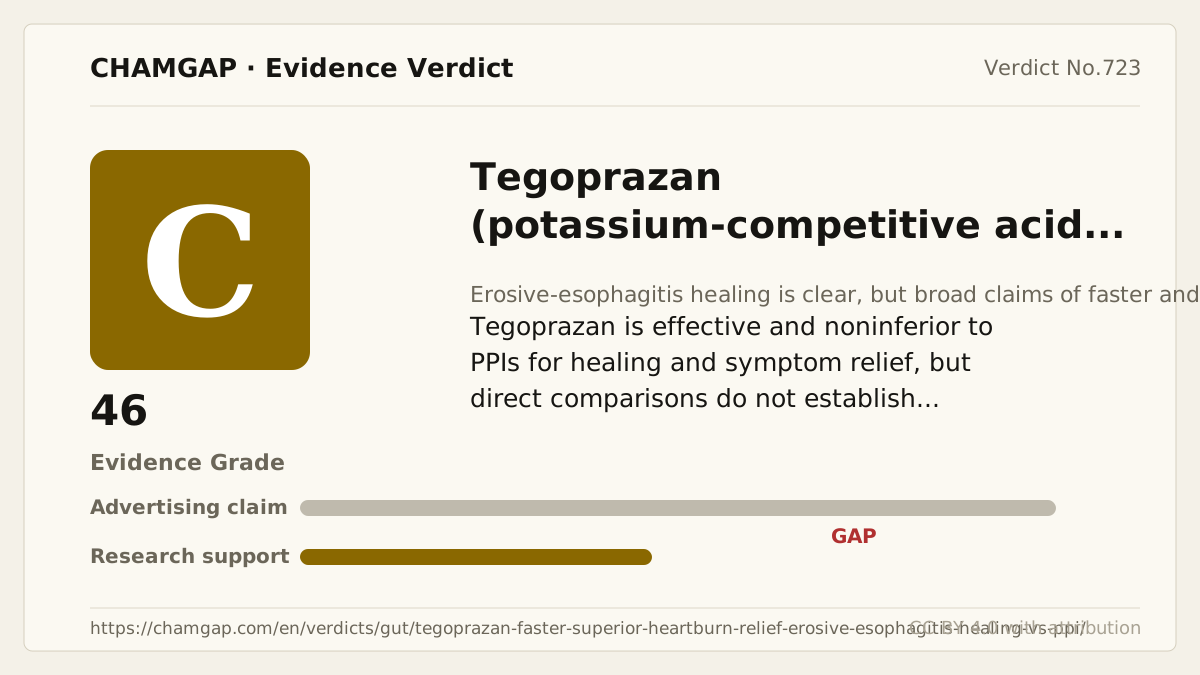
[Chamgap] Tegoprazan x faster and superior heartburn relief and erosive-esophagitis healing versus proton-pump inhibitors — Evidence Grade C·46. 3 cited sources checked. Source: https://chamgap.com/en/verdicts/gut/tegoprazan-faster-superior-heartburn-relief-erosive-esophagitis-healing-vs-ppi/ · CC BY 4.0CC BY 4.0 — free to use with attribution; do not distort grades, numbers, or verdict meaning.
What this document does and does not do
Chamgap is an information source. It reports what research has and has not confirmed; it does not tell readers what to take or buy. That decision belongs to readers and, when needed, medical or legal professionals. This verdict reflects literature available up to the search date and may change as new research appears. Nothing here is medical advice.