
SER-109 or Vowst,
does it really help with Prevention of recurrent C. difficile infection after antibacterial treatment?
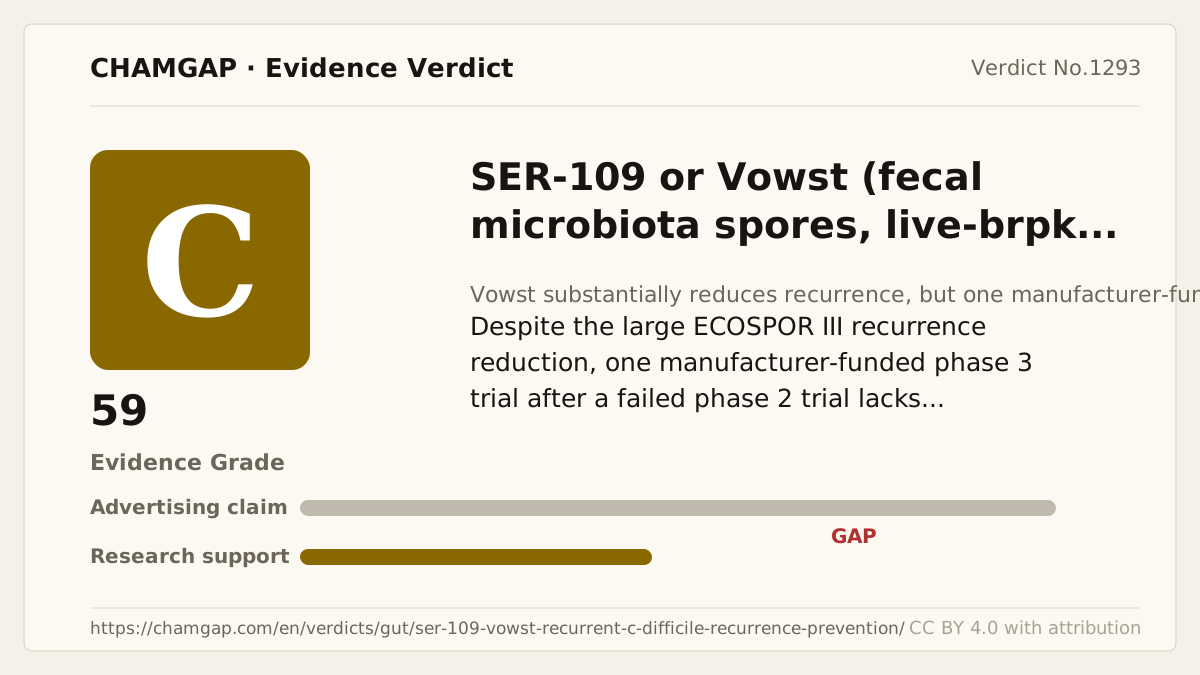
research showsSER-109, marketed as Vowst, is rated C despite substantially lowering the risk of another C. difficile recurrence in adults who have completed antibiotic treatment for recurrent infection. In 182 ECOSPOR III participants, eight-week recurrence was 12.4% versus 39.8%, RR 0.32 (95% CI 0.18 to 0.58), and the difference persisted at 24 weeks, 21.3% versus 47.3%. Positive confirmatory evidence is concentrated in one manufacturer-funded phase 3 randomized trial, while an earlier 89-participant phase 2 trial missed its primary endpoint at 44.1% versus 53.3%. Infection recurrence is a clinically important semihard outcome, but this single 182-participant trial does not meet the large hard-outcome prescription-drug exception, so the independent-replication rule caps the verdict at C with 59 points.
ads claimMicrobiome restoration can be misconstrued as evidence for generic probiotics or as treatment for active C. difficile infection. Vowst evidence and approval are restricted to a specific product, dose, and preparation used to prevent recurrence after antibiotic treatment of recurrent CDI in adults.
Useful facts when choosing a product
- Vowst is a prescription biologic used to prevent recurrence after antibiotic treatment of recurrent C. difficile infection in adults; it is not an antibiotic treatment for active infection.
- The labeled regimen begins two to four days after finishing antibiotics and consists of four capsules swallowed whole on an empty stomach once daily for three consecutive days.
- Bowel preparation is required before the first dose, but magnesium citrate may be unsuitable with impaired kidney function or other conditions, so the prescribed preparation instructions must be followed exactly.
- Abdominal distension, fatigue, constipation, chills, or diarrhea can occur, and a live-spore product derived from human feces carries theoretical risks of infectious-agent transmission and unknown food-allergen reactions.
Chamgap Semantic Classification Code
Candidate index · review held
S.ser-109-or-vowst.oral.recurrent-c-difficile-infection-after-antibacterial-treatment.prevent.placeboSupplements and nutraceuticals > SER-109 or Vowst > Oral > recurrent C. difficile infection after antibacterial treatment > Occurrence-prevention claim > Placebo
An automated migration candidate, not an issued permanent code; exact claim scope remains under review. This machine-generated migration candidate helps retrieval but is not a permanent assignment. The original verdict ID and URL remain authoritative.
What the research actually shows
The earlier phase 2 trial randomized 89 patients with clinically resolved recurrent CDI after standard antibiotics to a single lower dose of SER-109 or placebo; eight-week recurrence was 44.1% versus 53.3% and not statistically significant. ECOSPOR III used an approximately tenfold higher spore dose and toxin confirmation, comparing 89 with 93 patients; eight-week recurrence was 11 of 89 versus 37 of 93. In the prespecified extension, 24-week recurrence was 19 of 89 versus 44 of 93, RR 0.46. Most adverse events were mild to moderate and gastrointestinal, with broadly similar safety between groups, but the product contains live spores derived from screened human feces, so the possibility of transmitting an infectious agent cannot be reduced to zero.
Why this is classified as C (59)
ECOSPOR III produced a large, direct clinical effect: eight-week recurrence was 12.4% versus 39.8%, RR 0.32, and the 24-week RR was 0.46. The sample was 182, infection recurrence is a semihard outcome, positive confirmation rests on one manufacturer-funded phase 3 trial, and the prior 89-participant phase 2 trial missed its primary endpoint. The evidence lacks independent replication and misses the large hard-outcome prescription-drug exception, giving the maximum C score of 59.
Counterpoint. For an eligible adult suffering multiple recurrences who has completed standard antibiotics, the large absolute recurrence reduction can make Vowst an important option. It should not be self-started while diarrhea persists or diagnosis is uncertain, and a generic probiotic is not an equivalent substitute.
Rejudgment record. Cross-check applied — Applied the C ceiling because ECOSPOR III showed a large reduction in toxin-confirmed semihard clinical recurrence through 8 and 24 weeks, but positive confirmation is concentrated in one manufacturer-funded phase 3 trial of 182 participants after a failed phase 2 primary endpoint, lacks independent replication, and does not meet the large hard-outcome prescription-drug exception
Sub-claim grades by effect
This ingredient is marketed for several effects. A single overall grade blends strong and weak claims together, so each effect is graded separately here. The overall grade reflects the strongest disconfirming or core claim.
| Effect (sub-claim) | Grade | Basis |
|---|---|---|
| Prevention of C. difficile recurrence through eight weeks after antibiotics | C | ECOSPOR III found 12.4% versus 39.8%, RR 0.32, but one manufacturer-funded confirmatory phase 3 trial lacks independent replication. |
| Prevention of C. difficile recurrence through 24 weeks after antibiotics | C | The prespecified extension of the same trial found 21.3% versus 47.3%, RR 0.46, but this is not independent replication. |
| Reduction in hospitalization or death related to recurrent C. difficile | ? | ECOSPOR III was not powered to establish a reduction in these hard outcomes. |
Cross-check — AI research and Codex final gate
Evidence Table
| Study | Design | Sample | Funding | Endpoint | Result | Weight |
|---|---|---|---|---|---|---|
| Feuerstadt P et al. 2022, ECOSPOR III | Phase 3 multicenter randomized double-blind placebo-controlled trial | 182 adults with recurrent C. difficile infection | Funded by manufacturer Seres Therapeutics | Toxin-confirmed C. difficile recurrence through eight weeks after antibiotic treatment | Eight-week recurrence was 12.4% versus 39.8%, RR 0.32 (95% CI 0.18 to 0.58; P<.001). | Pivotal single confirmatory phase 3 randomized trial |
| McGovern BH et al. 2021, ECOSPOR phase 2 | Phase 2 randomized double-blind placebo-controlled trial | 89 adults with recurrent C. difficile infection | Manufacturer-led by Seres Therapeutics | C. difficile recurrence through eight weeks | Recurrence was 44.1% versus 53.3%, but the overall primary endpoint was not statistically significant. | Prior null trial limiting consistency |
| Cohen SH et al. 2022, ECOSPOR III extended follow-up | Prespecified 24-week extension of the same randomized trial | 182 randomized ECOSPOR III participants | Extension of the Seres Therapeutics-funded trial | Cumulative C. difficile recurrence through 24 weeks | Twenty-four-week recurrence was 21.3% versus 47.3%, RR 0.46 (95% CI 0.30 to 0.73; P<.001). | Supportive durability evidence, not an independent trial |
Receipt — 3 References
All 3 cited sources were verified for existence at the original page (as of 2026-07-24).
Final verification and publication gate: Codex · Evidence date: 2026-07-24 · Corrections: none
Cite this verdict
[Chamgap] SER-109 or Vowst x prevention of recurrent C. difficile infection after antibiotics — Evidence Grade C·59. 3 cited sources checked. Source: https://chamgap.com/en/verdicts/gut/ser-109-vowst-recurrent-c-difficile-recurrence-prevention/ · CC BY 4.0CC BY 4.0 — free to use with attribution; do not distort grades, numbers, or verdict meaning.
What this document does and does not do
Chamgap is an information source. It reports what research has and has not confirmed; it does not tell readers what to take or buy. That decision belongs to readers and, when needed, medical or legal professionals. This verdict reflects literature available up to the search date and may change as new research appears. Nothing here is medical advice.