
Senna leaf and sennosides,
does it really help with Improved bowel-movement frequency and symptoms in adults with chronic functional constipation?
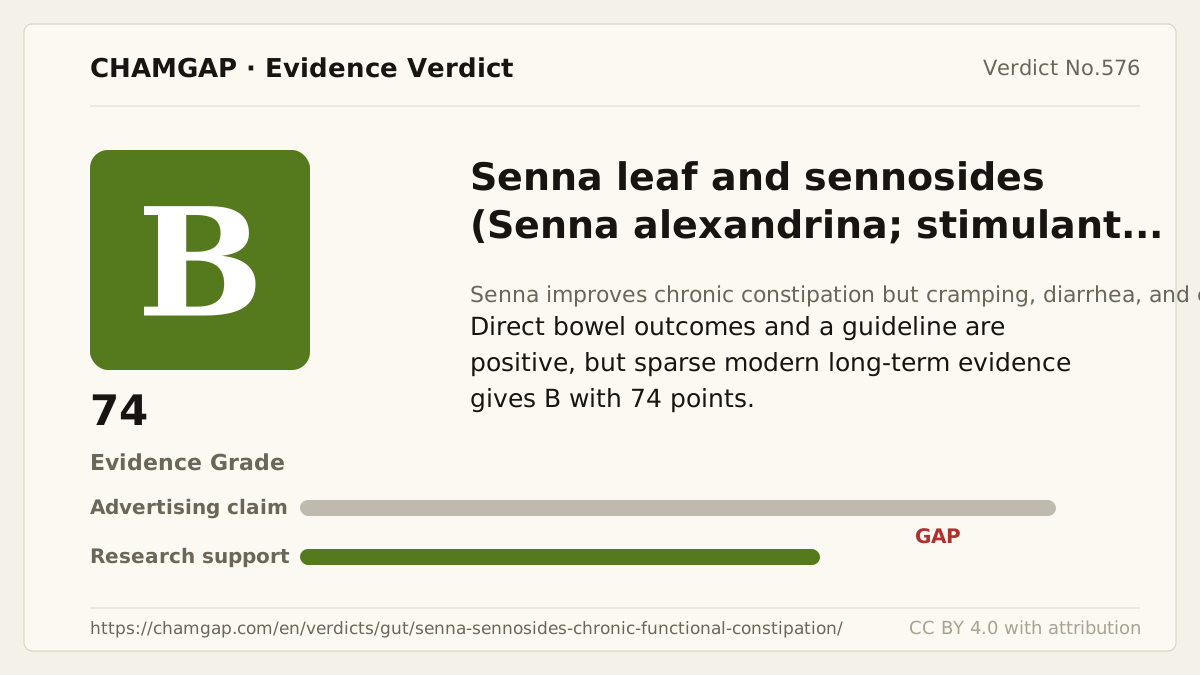
research showsSenna is rated B because it improves bowel frequency and symptoms in chronic idiopathic or functional constipation. In a 90-participant double-blind placebo-controlled trial, four-week overall improvement was 69.2% versus 11.7%, and spontaneous and complete spontaneous bowel movements increased. AGA-ACG also conditionally recommends senna, but one pivotal four-week modern trial, subjective symptoms, and sparse long-term evidence limit the result to B with 74 points. Cramping, diarrhea, and electrolyte risk are separated under safety.
ads claimMarketing expands stimulant-laxative efficacy into colon cleansing, detoxification, and indefinite daily natural-tea use.
Useful facts when choosing a product
- Sennosides are converted in the colon to active metabolites that stimulate motility and secretion.
- Korean nonprescription products, including Araksil-type products, may contain senna alone or in combinations, so product-specific content and duration should be checked.
- This verdict concerns Senna alexandrina leaf, which differs in species, plant part, and direct evidence from Cassia obtusifolia or Senna obtusifolia seed in verdict 165.
- Cramping and diarrhea are common, and excessive continuous use can cause dehydration and electrolyte abnormalities such as hypokalemia.
Chamgap Semantic Classification Code
Candidate index · review held
UNK.senna-leaf-and-sennosides.UNK.bowel-movement-frequency-and-symptoms-with-chronic-functional-constipation.improve.placeboUnknown > Senna leaf and sennosides > Unknown > bowel-movement frequency and symptoms with chronic functional constipation > Improvement claim > Placebo
An automated migration candidate, not an issued permanent code; exact claim scope remains under review. This machine-generated migration candidate helps retrieval but is not a permanent assignment. The original verdict ID and URL remain authoritative.
What the research actually shows
Morishita and colleagues randomized 90 adults to senna 1.0 g, magnesium oxide 1.5 g, or placebo for 28 days under double masking. Senna improved symptoms and direct bowel outcomes. AGA-ACG issued a conditional recommendation after GRADE review while noting low certainty and long-term gaps.
Why this is classified as B (74)
A 69.2% versus 11.7% response, direct bowel outcomes, and an independent guideline support efficacy. A single-center 90-participant four-week trial, an approximately 93% female sample, the low-certainty conditional AGA-ACG recommendation, and sparse long-term evidence give B with 74 points; harms remain separate.
Counterpoint. Repeated laxative need, bloody stool, severe pain, or persistent constipation warrants evaluation.
Rejudgment record. New verdict — Accepted direct bowel outcomes and the AGA-ACG guideline while accounting for one small four-week pivotal trial and sparse long-term evidence
Sub-claim grades by effect
This ingredient is marketed for several effects. A single overall grade blends strong and weak claims together, so each effect is graded separately here. The overall grade reflects the strongest disconfirming or core claim.
| Effect (sub-claim) | Grade | Basis |
|---|---|---|
| Improved bowel frequency and symptoms in chronic functional or idiopathic constipation | B | Direct four-week trial outcomes agree with the conditional AGA-ACG recommendation. |
| Long-term safety, dependence, and electrolyte effects | ? | Long-term controlled data are inadequate, and risks are separated under safety. |
Cross-check — AI research and Codex final gate
Evidence Table
| Study | Design | Sample | Funding | Endpoint | Result | Weight |
|---|---|---|---|---|---|---|
| Morishita D et al. 2021 | Randomized double-blind senna, magnesium-oxide, and placebo-controlled trial | 90 adults with chronic constipation for 28 days | Academic-center study; limited external-funding detail | Overall symptoms, spontaneous and complete spontaneous bowel movements, and quality of life | Response was 69.2% with senna versus 11.7% with placebo, and bowel frequency improved. | Key direct short-term evidence |
| Chang L et al. 2023 AGA-ACG guideline | Systematic evidence review and GRADE guideline | 28 constipation-drug trials; one pivotal senna trial | AGA-ACG funded without industry support | Bowel outcomes, symptoms, quality of life, and adverse events | Conditionally recommended senna and identified a long-term evidence gap. | Independent guideline synthesis |
Receipt — 2 References
All 2 cited sources were verified for existence at the original page (as of 2026-07-19).
Final verification and publication gate: Codex · Evidence date: 2026-07-19 · Corrections: none
Cite this verdict
[Chamgap] Senna leaf and sennosides x improved bowel-movement frequency and symptoms in adults with chronic functional constipation — Evidence Grade B·74. 2 cited sources checked. Source: https://chamgap.com/en/verdicts/gut/senna-sennosides-chronic-functional-constipation/ · CC BY 4.0CC BY 4.0 — free to use with attribution; do not distort grades, numbers, or verdict meaning.
What this document does and does not do
Chamgap is an information source. It reports what research has and has not confirmed; it does not tell readers what to take or buy. That decision belongs to readers and, when needed, medical or legal professionals. This verdict reflects literature available up to the search date and may change as new research appears. Nothing here is medical advice.