
Racecadotril,
does it really help with Reduced duration and stool output in pediatric acute watery diarrhea?
research showsRacecadotril is rated at the lower end of C because evidence in pediatric acute diarrhea is limited and conflicting. The 2019 Cochrane review of seven trials and 1,140 children estimated rehydration failure at RR 0.41, but the 95% CI of 0.13 to 1.23 was wide and included no effect; evidence for diarrhea duration and 48-hour stool frequency was inconclusive. This is not a large definitive null result warranting D, but a conflict between older positive trials and recent nonconfirmation. Oral rehydration solution remains first line and cannot be replaced by racecadotril.
ads claimMarketing can say the drug rapidly stops diarrhea and treats dehydration. It is an antisecretory adjunct, not a substitute for oral rehydration, continued feeding, and monitoring for danger signs.
Useful facts when choosing a product
- Racecadotril is a prescription antidiarrheal that inhibits intestinal enkephalinase and reduces hypersecretion of water and electrolytes.
- When used for pediatric acute diarrhea, it is an adjunct to oral rehydration solution; correcting dehydration and continuing feeding remain central.
- Blood in stool, high fever, repeated vomiting, reduced urination, marked lethargy, or dehydration signs require prompt medical assessment rather than self-treatment.
- Overall adverse-event rates in trials were similar to placebo, but rash and headache can occur, and rare angioedema of the face, lips, tongue, or airway requires immediate discontinuation.
Chamgap Semantic Classification Code
Candidate index · review held
M.racecadotril.UNK.duration-and-stool-output-in-pediatric-acute-watery-diarrhea.reduce.UNKMedicinal interventions > Racecadotril > Unknown > duration and stool output in pediatric acute watery diarrhea > Reduction claim > Unknown
An automated migration candidate, not an issued permanent code; exact claim scope remains under review. This machine-generated migration candidate helps retrieval but is not a permanent assignment. The original verdict ID and URL remain authoritative.
What the research actually shows
Gordon 2016 reviewed seven randomized trials and found symptoms shorter by a mean 53.48 hours in three trials and lower stool output in two inpatient trials, but every study had moderate-to-high risk of bias. Liang's 2019 Cochrane update included seven trials and 1,140 children and judged rehydration failure low-certainty, duration and 48-hour stool frequency inconclusive, and hospital stay similar. The 2018 FISPGHAN recommendations did not endorse racecadotril under stringent consensus criteria and kept oral rehydration central. A 2018 synthesis led by manufacturer employees pooled 58 trials and reached a strongly positive conclusion but broadly included abstracts and lower-quality reports.
Why this is classified as C (42)
In the 2019 Cochrane review of seven trials and 1,140 children, rehydration failure had RR 0.41 with a wide 95% CI of 0.13 to 1.23, while duration and stool-frequency evidence was inconclusive. Older positive signals conflict with recent nonconfirmation, but this is not a large definitive null result, yielding lower-end C with 42 points.
Counterpoint. A clinician may prescribe it as an oral-rehydration adjunct where locally authorized after considering age and clinical status. Caregivers should prioritize correct oral rehydration, continued feeding, and danger signs.
Rejudgment record. Reassessment (cross-check reflected) — Applied lower-end C because the 2019 independent Cochrane review of seven trials and 1,140 children estimated rehydration failure at RR 0.41 with a wide 95% CI of 0.13 to 1.23 and found duration and stool-frequency evidence inconclusive, creating limited conflicting evidence rather than a large definitive null result
Sub-claim grades by effect
This ingredient is marketed for several effects. A single overall grade blends strong and weak claims together, so each effect is graded separately here. The overall grade reflects the strongest disconfirming or core claim.
| Effect (sub-claim) | Grade | Basis |
|---|---|---|
| Reduced duration and stool output in pediatric acute diarrhea | C | Older positive signals conflict with nonconfirmation in the latest independent Cochrane review, supporting a limited effect. |
| Wide confidence interval for rehydration failure and inconclusive symptom outcomes | ? | The RR of 0.41 had a 95% CI of 0.13 to 1.23, and evidence for duration and stool frequency was inconclusive. |
| Replacement for oral rehydration in treating dehydration | F | Trials and guidelines retain oral rehydration as standard care; an antidiarrheal cannot replace fluid and electrolyte replacement. |
Cross-check — AI research and Codex final gate
Evidence Table
| Study | Design | Sample | Funding | Endpoint | Result | Weight |
|---|---|---|---|---|---|---|
| Liang Y et al. Cochrane 2019 | Systematic review and meta-analysis of randomized trials | Seven randomized trials and 1,140 children | Cochrane and academic research; no commercial support reported | Rehydration failure, duration, stool frequency and output, and hospital stay | Duration and stool frequency were inconclusive and hospital stay was similar; routine use was unsupported. | Highest-priority recent independent synthesis |
| Gordon M and Akobeng A. 2016 | Cochrane-format systematic review and meta-analysis | Seven trials; three trials and 642 children for duration | Academic research; unrelated industry support disclosed | Diarrhea duration, stool output, and adverse events | Duration MD was -53.48 hours, but every trial had moderate-to-high risk of bias. | Positive but weakly confirmatory conflicting evidence |
| Guarino A et al. FISPGHAN 2018 | Guideline comparison, Delphi consensus, and external validation | Twenty-three recommendations validated by 28 experts | International academic pediatric-gastroenterology group | Pediatric acute-gastroenteritis treatment recommendations | Oral rehydration was central and racecadotril was not endorsed under stringent criteria. | Clinical-scope limitation |
Receipt — 4 References
All 4 cited sources were verified for existence at the original page (as of 2026-07-20).
Final verification and publication gate: Codex · Evidence date: 2026-07-20 · Corrections: none
Cite this verdict
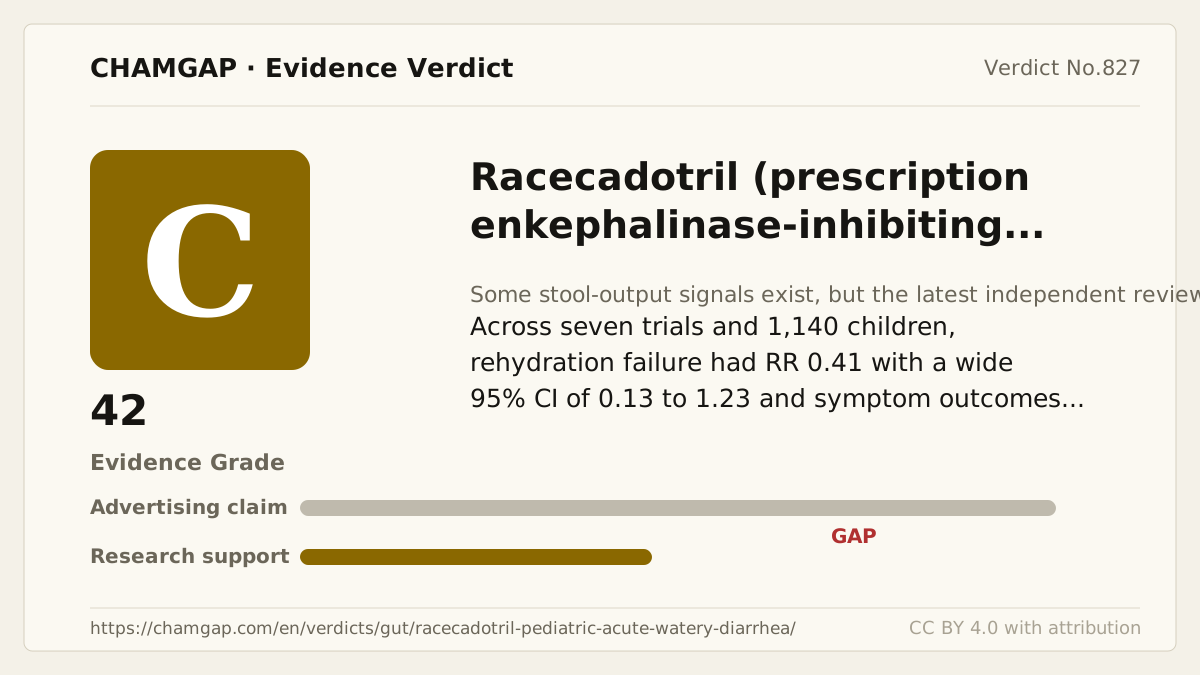
[Chamgap] Racecadotril x reduced duration and stool output in pediatric acute watery diarrhea — Evidence Grade C·42. 4 cited sources checked. Source: https://chamgap.com/en/verdicts/gut/racecadotril-pediatric-acute-watery-diarrhea/ · CC BY 4.0CC BY 4.0 — free to use with attribution; do not distort grades, numbers, or verdict meaning.
What this document does and does not do
Chamgap is an information source. It reports what research has and has not confirmed; it does not tell readers what to take or buy. That decision belongs to readers and, when needed, medical or legal professionals. This verdict reflects literature available up to the search date and may change as new research appears. Nothing here is medical advice.