
Prunes,
does it really help with Improved complete spontaneous bowel movements and stool consistency in chronic constipation?
research showsThe grade is C with 50 points. In a randomized single-blind crossover trial of 40 adults with chronic constipation, 100 g/day of prunes produced 3.5 versus 2.8 complete spontaneous bowel movements per week with fiber-matched psyllium (P=0.006), and Bristol stool scores of 3.2 versus 2.8 (P=0.02). Bowel movement is a direct treatment target rather than a biomarker surrogate, but the trial was small, lasted three weeks per treatment, could not readily mask taste and texture, and used only an active comparator.
ads claimThe trial tested 100 g/day of whole prunes against fiber-matched psyllium. It does not establish the same effect for a few pieces, juice concentrate, or mixed products sold for regularity.
Useful facts when choosing a product
- The trial dose was 100 g/day, supplying 6 g fiber along with sorbitol.
- A complete spontaneous bowel movement requires a sense of complete evacuation without rescue laxative or enema in the preceding 24 hours.
- Verdict 1984 is C with 50 points for fig paste, and verdict 532 is C with 55 points for green kiwifruit powder. Both concern functional constipation but use interventions different from this direct comparison of 100 g prunes with psyllium.
Chamgap Semantic Classification Code
Candidate index · review held
UNK.prunes.oral.complete-spontaneous-bowel-movements-and-stool-consistency-in-chronic-constipation.improve.activeUnknown > Prunes > Oral > complete spontaneous bowel movements and stool consistency in chronic constipation > Improvement claim > Active comparator
An automated migration candidate, not an issued permanent code; exact claim scope remains under review. This machine-generated migration candidate helps retrieval but is not a permanent assignment. The original verdict ID and URL remain authoritative.
What the research actually shows
Attaluri and colleagues enrolled 40 adults, 37 women and 3 men, mean age 38, in an eight-week single-blind randomized crossover trial. After baseline observation, participants received either prunes 50 g twice daily or psyllium 11 g twice daily for three weeks, had a one-week washout, and crossed to the other treatment for three weeks. Assignment to the two treatment sequences was randomized; the paper does not support a broader statement that every condition order was randomized. The primary endpoint was weekly complete spontaneous bowel movements: 3.5±0.2 versus 2.8±0.2, P=0.006. Stool consistency was 3.2 versus 2.8, P=0.02. Confidence intervals were not reported, and ±0.2 was SEM, not SD. Treatment-order interaction was nonsignificant and outcomes returned to baseline during washout. The paper states that it was supported by an unrestricted research grant from the California Dried Plum Board, a prune-industry organization. A separate randomized parallel-group comparative trial by Chey et al. 2021 also exists, so this is not the only randomized trial.
Why this is classified as C (50)
A medium-sized advantage on a patient-centered primary bowel endpoint is offset by a small, short, difficult-to-mask, active-control-only trial, giving C with 50 points.
Counterpoint. Both treatments were tolerated and rated similarly for taste, but 100 g/day adds sugar, calories, sorbitol, and fiber and may cause bloating or diarrhea.
Rejudgment record. Cross-check applied — A 40-person randomized crossover trial improved a patient-centered primary bowel endpoint versus psyllium but was short, difficult to mask, and had no placebo arm
| Endpoint | P | Symptom or function itself is the target - including patient reports and performance tests |
| Replication | R1 | Single confirmatory trial |
| Independence | I0 | Evidence comes only from manufacturer studies |
| Effect size | E+ | Meets the clinically important threshold |
Stored derived and displayed grades match; this is not a current recalculation or validity check (C).
Sub-claim grades by effect
This ingredient is marketed for several effects. A single overall grade blends strong and weak claims together, so each effect is graded separately here. The overall grade reflects the strongest disconfirming or core claim.
| Effect (sub-claim) | Grade | Basis |
|---|---|---|
| More weekly complete spontaneous bowel movements | C | Prunes produced 3.5 versus 2.8 with psyllium. |
| Superior straining and global symptom relief | D | There was no significant between-treatment difference. |
Cross-check — AI research and Codex final gate
Evidence Table
| Study | Design | Sample | Funding | Endpoint | Result | Weight |
|---|---|---|---|---|---|---|
| Attaluri A et al. 2011 | Single-blind randomized crossover active-comparator trial | 40 adults with chronic constipation, each exposed to both treatments | Unrestricted research grant from the California Dried Plum Board, a prune-industry organization | Primary: weekly complete spontaneous bowel movements; secondary stool consistency, straining, and global symptoms | 3.5±0.2 versus 2.8±0.2 per week (P=0.006); stool consistency 3.2 versus 2.8 (P=0.02); no CI reported | Pivotal direct comparative trial |
Receipt — 2 References
All 2 cited sources were verified for existence at the original page (as of 2026-08-07).
Final verification and publication gate: Codex · Evidence date: 2026-08-07 · Corrections: none
Cite this verdict
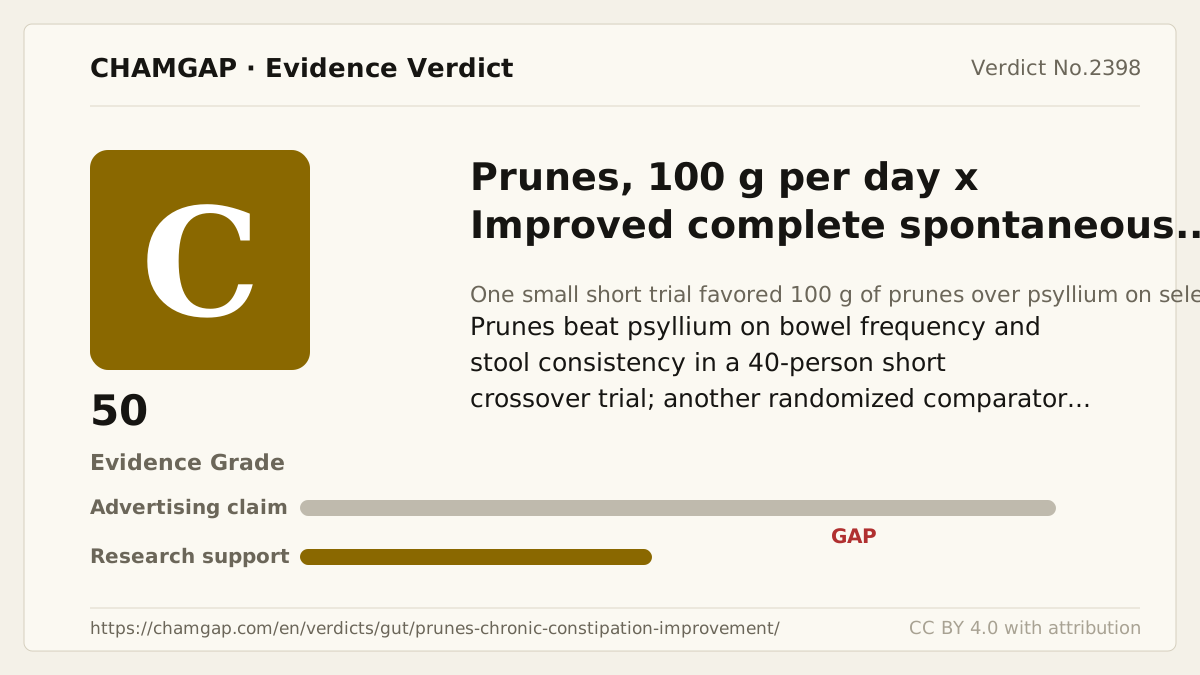
[Chamgap] Prunes x improvement of chronic constipation — Evidence Grade C·50. 2 cited sources checked. Source: https://chamgap.com/en/verdicts/gut/prunes-chronic-constipation-improvement/ · CC BY 4.0CC BY 4.0 — free to use with attribution; do not distort grades, numbers, or verdict meaning.
What this document does and does not do
Chamgap is an information source. It reports what research has and has not confirmed; it does not tell readers what to take or buy. That decision belongs to readers and, when needed, medical or legal professionals. This verdict reflects literature available up to the search date and may change as new research appears. Nothing here is medical advice.