
Prophylactic broad-spectrum antibiotics,
does it really help with Prevention of infected pancreatic necrosis and death?
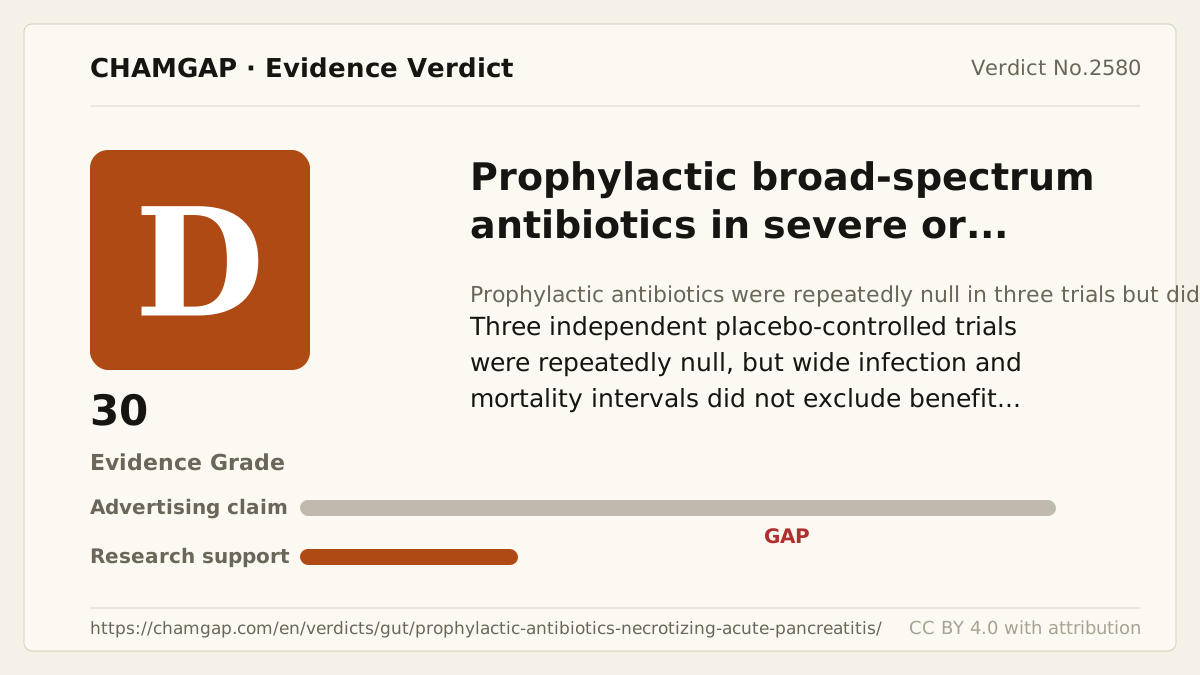
research showsThe grade is D. Three double-blind placebo-controlled trials with nonoverlapping teams repeatedly failed to reduce infected necrosis or death. Infected-necrosis or pancreatic-infection events were 7/58 versus 5/56 in Isenmann, 9/50 versus 6/50 in Dellinger, and 8/22 versus 8/19 in García-Barrasa. Yet every confidence interval still allowed substantial benefit, so repeated null results do not establish precise refutation. This gives D with 30 points.
ads claimAntibiotics may be required once infected necrosis is suspected or confirmed. The null claim here is routine treatment of everyone before evidence of infection to prevent infected necrosis and death.
Useful facts when choosing a product
- Isenmann compared intravenous ciprofloxacin 400 mg twice daily plus metronidazole 500 mg twice daily with placebo.
- Dellinger used meropenem 1 g every eight hours for 7 to 21 days, and García-Barrasa used ciprofloxacin 300 mg every 12 hours for 10 days.
- Therapeutic antibiotics after infection or clinical deterioration are a different question from this prophylaxis verdict.
Chamgap Semantic Classification Code
Candidate index · review held
M.prophylactic-broad-spectrum-antibiotics-in-severe-or-necrotizing-acute-pancreatitis-without-confirmed-infection.UNK.infected-pancreatic-necrosis-and-death.prevent.placeboMedicinal interventions > Prophylactic broad-spectrum antibiotics in severe or necrotizing acute pancreatitis without confirmed infection > Unknown > infected pancreatic necrosis and death > Occurrence-prevention claim > Placebo
An automated migration candidate, not an issued permanent code; exact claim scope remains under review. This machine-generated migration candidate helps retrieval but is not a permanent assignment. The original verdict ID and URL remain authoritative.
What the research actually shows
Isenmann R, Rünzi M, Kron M, Kahl S et al. randomized 114, 58 versus 56, and stopped recruitment after an adaptive interim analysis beyond half of a planned 200. Infected necrosis was 7/58 versus 5/56 and death 3/58 versus 4/56. Dellinger EP, Tellado JM, Soto NE et al. randomized 100, 50 per arm, reporting infection 9/50 versus 6/50, death 10/50 versus 9/50, and surgery or intervention 13/50 versus 10/50. García-Barrasa A, Borobia FG, Pallares R et al. randomized 46 but excluded five post-randomization and analyzed 41, with infection 8/22 versus 8/19 and death 4/22 versus 2/19. The author teams did not overlap. Two of the three trials had manufacturer funding. Isenmann received Bayer Vital financial support and study drugs from Bayer and Ratiopharm. Dellinger was supported by a grant from AstraZeneca Pharmaceuticals; the company biostatistics team generated the randomization schedule, and company-employed coauthors participated. García-Barrasa was sponsored by Bellvitge Hospital with no pharmaceutical-company payment.
Why this is classified as D (30)
Three double-blind randomized trials with separate teams and funding routes repeatedly failed to show infection or mortality benefit in the same indication. All intervals retained substantial benefit and every trial had fewer than 200 participants, so the grade is D, not F, with 30 points.
Counterpoint. Repeated null evidence is strong, but intervals still permit 42% to 60% relative infection reductions and 51% to 83% relative mortality reductions; this is not precise refutation.
Rejudgment record. Cross-check applied — The three primary reports were cross-checked for randomized and analyzed counts, infection and mortality events, author teams, study drugs, masking, interim stopping, and funding routes; event-count risk-ratio intervals were used to separate repeated null evidence from exclusion of benefit.
| Endpoint | H | Hard endpoint - actual events such as death |
| Replication | RX | Repeatedly refuted in the same indication |
| Independence | I1 | Mixed funding sources |
| Effect size | E0 | Null |
| Precision | C0 | The confidence interval leaves room for benefit |
Stored derived and displayed grades match; this is not a current recalculation or validity check (D).
Sub-claim grades by effect
This ingredient is marketed for several effects. A single overall grade blends strong and weak claims together, so each effect is graded separately here. The overall grade reflects the strongest disconfirming or core claim.
| Effect (sub-claim) | Grade | Basis |
|---|---|---|
| Prevention of infected pancreatic necrosis | D | Three trials were repeatedly null, but intervals allowed substantial benefit. |
| Prevention of death | D | None of the three trials reduced death, and intervals were wide. |
Cross-check — AI research and Codex final gate
Evidence Table
| Study | Design | Sample | Funding | Endpoint | Result | Weight |
|---|---|---|---|---|---|---|
| Isenmann R, Rünzi M, Kron M, Kahl S et al., 2004 | Multicenter double-blind placebo-controlled randomized trial | 114 randomized and analyzed, 58 and 56; recruitment stopped after adaptive interim analysis from a planned 200 | Financial support from Bayer Vital; study drugs provided by Bayer Vital and Ratiopharm | Infected pancreatic necrosis and death | Infected necrosis 7/58 vs 5/56, P=.585, calculated RR 1.35, 95% CI about 0.46 to 4.01; death 3/58 vs 4/56, calculated RR 0.72, about 0.17 to 3.09 | Repeatedly null evidence 1 |
| Dellinger EP, Tellado JM, Soto NE et al., 2007 | International multicenter double-blind placebo-controlled randomized trial | 100 randomized with major events analyzed, 50 per arm | Supported by a grant from AstraZeneca Pharmaceuticals; company biostatistics team generated the randomization schedule; company-employed coauthors | Pancreatic or peripancreatic infection, death, and surgery or intervention through 42 days | Infection 9/50 vs 6/50, P=.401, RR 1.50, 95% CI about 0.58 to 3.90; death 10/50 vs 9/50, P=.799, RR 1.11, about 0.49 to 2.50; surgery 13/50 vs 10/50 | Repeatedly null evidence 2 |
| García-Barrasa A, Borobia FG, Pallares R et al., 2009 | Single-center double-blind placebo-controlled randomized trial | 46 randomized; five excluded post-randomization and 41 analyzed, 22 and 19 | Promoted by Bellvitge Hospital with no pharmaceutical-industry grant or payment | Infected pancreatic necrosis and death | Infected necrosis 8/22 vs 8/19, P=.7, RR 0.86, 95% CI about 0.40 to 1.85; death 4/22 vs 2/19, P=.6, RR 1.73, about 0.35 to 8.41 | Repeatedly null evidence 3 |
Receipt — 3 References
All 3 cited sources were verified for existence at the original page (as of 2026-08-14).
Final verification and publication gate: Codex · Evidence date: 2026-08-14 · Corrections: none
Cite this verdict
[Chamgap] Prophylactic broad-spectrum antibiotics x infection and death in necrotizing acute pancreatitis — Evidence Grade D·30. 3 cited sources checked. Source: https://chamgap.com/en/verdicts/gut/prophylactic-antibiotics-necrotizing-acute-pancreatitis/ · CC BY 4.0CC BY 4.0 — free to use with attribution; do not distort grades, numbers, or verdict meaning.
What this document does and does not do
Chamgap is an information source. It reports what research has and has not confirmed; it does not tell readers what to take or buy. That decision belongs to readers and, when needed, medical or legal professionals. This verdict reflects literature available up to the search date and may change as new research appears. Nothing here is medical advice.