
Processed meat,
does it really help with Increased colorectal cancer incidence?
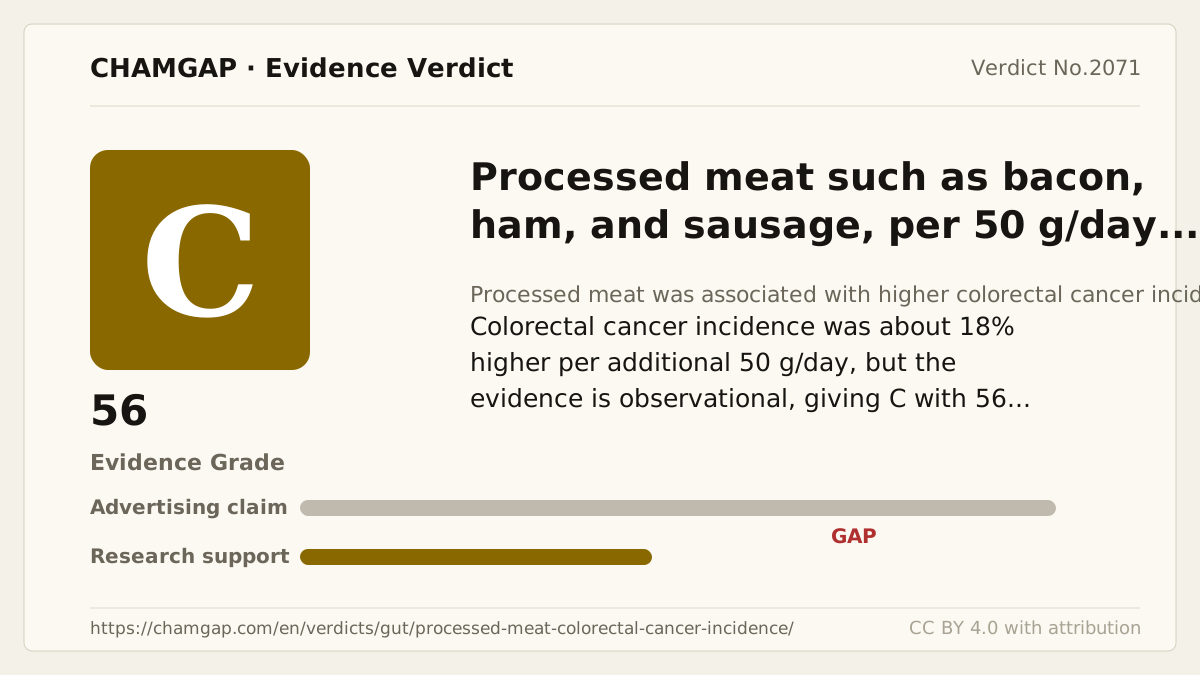
research showsThe grade is C. A dose-response meta-analysis of nine prospective cohorts found RR 1.18 (95% CI 1.10 to 1.28) per 50 g/day of processed meat. The direction was fairly consistent, but food-frequency questionnaires, residual lifestyle and dietary confounding, and limited cooking-method data prevent a causal estimate, giving C with 56 points.
ads claimMeasured sodium or residual nitrite in processed meat is a composition fact; increased cancer incidence is a separate clinical claim that depends on long-term risk estimates and their uncertainty.
Useful facts when choosing a product
- A five-country retail survey found median bacon sodium ranging from 805 to 1,667 mg/100 g; these were market samples, not products measured in the cohorts.
- A composition database reported median residual nitrite of 12.25 mg/kg in bacon, 11.24 in ham, and 13.90 in frankfurters; these were not cohort product measurements.
- High-temperature grilling or pan-frying can form HCAs, while flame, smoke, and smoking can form PAHs; the pivotal cohorts did not consistently separate cooking methods and doneness.
- IARC Group 1 describes certainty that processed meat can cause cancer, not a risk magnitude equal to tobacco.
- Verdict 2037 is C with 56 points for edible mushrooms and prostate cancer; this verdict concerns processed meat and colorectal cancer incidence.
Chamgap Semantic Classification Code
Candidate index · review held
F.processed-meat-such.food.colorectal-cancer-incidence.increase.UNKFoods and beverages > Processed meat such > Food consumption > colorectal cancer incidence > Increase claim > Unknown
An automated migration candidate, not an issued permanent code; exact claim scope remains under review. This machine-generated migration candidate helps retrieval but is not a permanent assignment. The original verdict ID and URL remain authoritative.
What the research actually shows
The review searched PubMed through March 31, 2011 and included nine prospective cohorts with 10,863 colorectal cancers in the processed-meat dose-response analysis. The representative EPIC cohort followed 478,040 people for a mean 4.8 years and recorded 1,329 cases, about 2.8 per 1,000 overall during follow-up; that is not an exposure-specific absolute difference. EPIC was already included in the Chan meta-analysis and was not counted as a second replication. Funding of the pivotal evidence checked was public or nonprofit, including World Cancer Research Fund International and Europe Against Cancer.
Why this is classified as C (56)
The pooled association from publicly or nonprofit-funded cohorts was precise and directionally consistent, but questionnaire exposure, incomplete confounding control, and cooking-method misclassification limit the evidence to C with 56 points.
Counterpoint. No safe threshold has been established, but a per-50-g/day estimate should not be presented as a certain personal consequence of an occasional serving.
Rejudgment record. Cross-check applied — A precise dose-response association across nine publicly or nonprofit-funded prospective cohorts, balanced against dietary measurement error and residual confounding
| Endpoint | H | Hard endpoint - actual events such as death |
| Replication | R2 | Independently replicated across trials |
| Independence | I2 | Decisive evidence is publicly or non-profit funded |
| Effect size | E+ | Meets the clinically important threshold |
Stored derived and displayed grades match; this is not a current recalculation or validity check (C).
Sub-claim grades by effect
This ingredient is marketed for several effects. A single overall grade blends strong and weak claims together, so each effect is graded separately here. The overall grade reflects the strongest disconfirming or core claim.
| Effect (sub-claim) | Grade | Basis |
|---|---|---|
| Increased colorectal cancer incidence per 50 g/day processed meat | C | Nine prospective cohorts gave RR 1.18 (1.10 to 1.28), but causality is not established. |
Cross-check — AI research and Codex final gate
Evidence Table
| Study | Design | Sample | Funding | Endpoint | Result | Weight |
|---|---|---|---|---|---|---|
| Chan DS et al. 2011 dose-response meta-analysis | Meta-analysis of prospective cohorts | Nine cohorts and 10,863 colorectal cancer cases in the processed-meat analysis | World Cancer Research Fund International | Incident colorectal cancer | RR 1.18 per 50 g/day, 95% CI 1.10 to 1.28, I-squared 12% | Pivotal dose-response evidence |
| Norat T et al. 2005 EPIC | Multinational prospective cohort | 478,040 participants, mean 4.8 years, 1,329 cases | Public and nonprofit support including Europe Against Cancer | Incident colorectal cancer | HR 1.35 for over 160 versus under 20 g/day, 95% CI 0.96 to 1.88; trend P=0.03 | Representative individual cohort |
Receipt — 6 References
All 6 cited sources were verified for existence at the original page (as of 2026-08-03).
Final verification and publication gate: Codex · Evidence date: 2026-08-03 · Corrections: none
Cite this verdict
[Chamgap] Processed meat x increased colorectal cancer incidence — Evidence Grade C·56. 6 cited sources checked. Source: https://chamgap.com/en/verdicts/gut/processed-meat-colorectal-cancer-incidence/ · CC BY 4.0CC BY 4.0 — free to use with attribution; do not distort grades, numbers, or verdict meaning.
What this document does and does not do
Chamgap is an information source. It reports what research has and has not confirmed; it does not tell readers what to take or buy. That decision belongs to readers and, when needed, medical or legal professionals. This verdict reflects literature available up to the search date and may change as new research appears. Nothing here is medical advice.