
Probiotics,
does it really help with Prevention of antibiotic-associated diarrhea in adults?
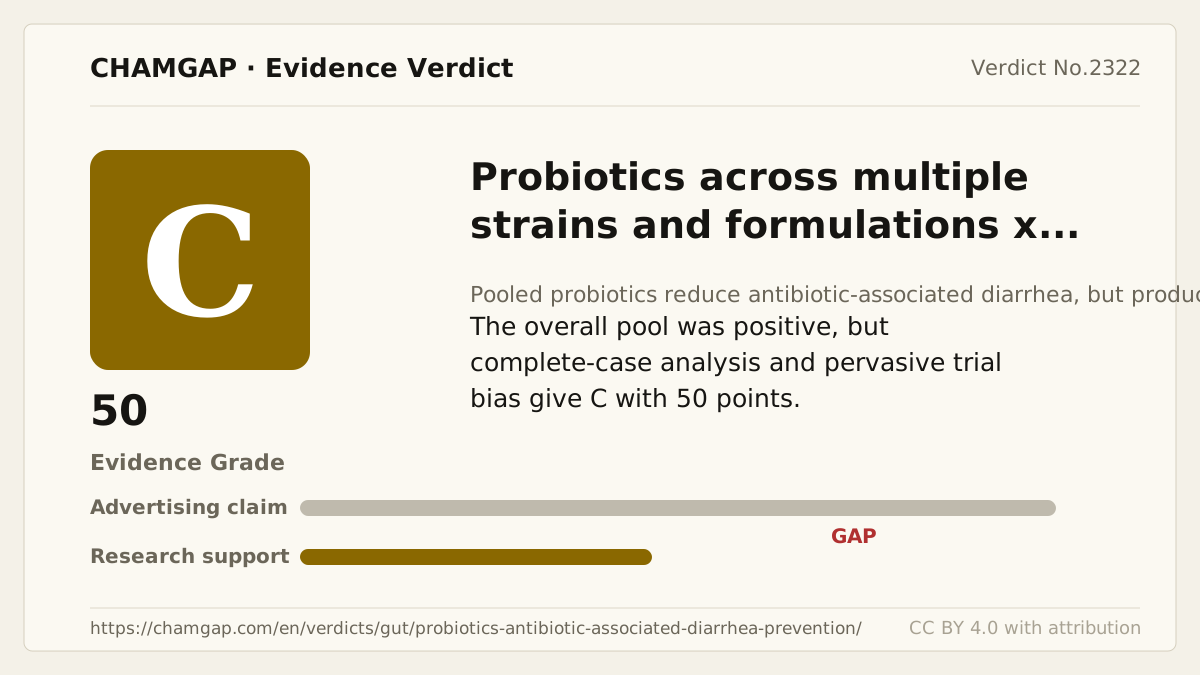
research showsThe grade is C. Complete-case pooling of 42 randomized trials and 11,305 adults found RR 0.63, 95% CI 0.54 to 0.73, I-squared 60%, and NNT 20. The 8.5% versus 13.5% figures are weighted absolute risks reconstructed from the RR and NNT, not raw event rates. Products and diarrhea definitions varied, and the six low-risk-of-bias trials alone were null, RR 0.78, 95% CI 0.57 to 1.07.
ads claimA class-wide result does not establish equal benefit for every strain, dose, and product, especially in low-baseline-risk settings.
Useful facts when choosing a product
- The pool combined different organisms and formulations rather than one standardized product.
- The primary pool used complete cases; the low-risk-of-bias subset was null.
- The review declared no specific grant and no competing interests.
Chamgap Semantic Classification Code
Candidate index · review held
S.probiotics-across-multiple-strains-and-formulations.UNK.antibiotic-associated-diarrhea.prevent.MULTISupplements and nutraceuticals > Probiotics across multiple strains and formulations > Unknown > antibiotic-associated diarrhea > Occurrence-prevention claim > Multiple: primary unresolved
An automated migration candidate, not an issued permanent code; exact claim scope remains under review. This machine-generated migration candidate helps retrieval but is not a permanent assignment. The original verdict ID and URL remain authoritative.
What the research actually shows
Goodman and colleagues pooled 42 adult trials and 11,305 participants. Thirty-three were placebo controlled, eight used no treatment, and one used both controls. Species, mixtures, doses, tablets, powders, yogurts, and fermented drinks varied; I-squared was 60%. The review states that the authors had not declared a specific grant and declared no competing interests. Funding of the underlying trials was mixed, so the evidence base cannot be labeled unfunded. The funnel plot was symmetrical, suggesting little publication-bias signal, while the risk-of-bias sensitivity analysis materially weakened the conclusion. Existing probiotic verdicts address different indications such as body composition, general gut outcomes, or liver disease.
Why this is classified as C (50)
Diarrhea is a patient-relevant endpoint and the main pool was positive, but complete-case analysis and widespread high or unclear bias cap the evidence at C with 50 points.
Counterpoint. A well-defined high-dose strain in a high-risk population may perform differently from the class average.
Rejudgment record. Cross-check applied — Adult 42-trial meta-analysis cross-checked for absolute risk, heterogeneity, definitions, strains, funding, and low-bias sensitivity
| Endpoint | P | Symptom or function itself is the target - including patient reports and performance tests |
| Replication | R1 | Single confirmatory trial |
| Independence | I1 | Mixed funding sources |
| Effect size | E+ | Meets the clinically important threshold |
Stored derived and displayed grades match; this is not a current recalculation or validity check (C).
Sub-claim grades by effect
This ingredient is marketed for several effects. A single overall grade blends strong and weak claims together, so each effect is graded separately here. The overall grade reflects the strongest disconfirming or core claim.
| Effect (sub-claim) | Grade | Basis |
|---|---|---|
| Prevention of adult antibiotic-associated diarrhea | C | The full pool was positive, but the low-bias subset was null. |
| Prevention of C. difficile infection | ? | This requires a separate verdict from general diarrhea. |
Cross-check — AI research and Codex final gate
Evidence Table
| Study | Design | Sample | Funding | Endpoint | Result | Weight |
|---|---|---|---|---|---|---|
| Goodman C et al. 2021 | Systematic review and random-effects meta-analysis of adult randomized trials | 42 trials and 11,305 participants in complete-case analysis | Review authors declared no specific grant and no competing interests; funding of included trials was mixed | Antibiotic-associated diarrhea incidence as defined by each trial | RR 0.63, 95% CI 0.54 to 0.73; I-squared 60%; NNT 20; weighted risks about 8.5% versus 13.5% | Primary pooled evidence |
| Goodman 2021 low-risk-of-bias sensitivity analysis | Restricted pooling of six low-risk-of-bias trials | Six trials; the main text did not separately report the pooled participant count | Mixed across included trials | Antibiotic-associated diarrhea incidence | RR 0.78, 95% CI 0.57 to 1.07, P=0.13 | Key bias sensitivity analysis |
Receipt — 2 References
All 2 cited sources were verified for existence at the original page (as of 2026-08-06).
Final verification and publication gate: Codex · Evidence date: 2026-08-06 · Corrections: none
Cite this verdict
[Chamgap] Probiotics x prevention of antibiotic-associated diarrhea — Evidence Grade C·50. 2 cited sources checked. Source: https://chamgap.com/en/verdicts/gut/probiotics-antibiotic-associated-diarrhea-prevention/ · CC BY 4.0CC BY 4.0 — free to use with attribution; do not distort grades, numbers, or verdict meaning.
What this document does and does not do
Chamgap is an information source. It reports what research has and has not confirmed; it does not tell readers what to take or buy. That decision belongs to readers and, when needed, medical or legal professionals. This verdict reflects literature available up to the search date and may change as new research appears. Nothing here is medical advice.