
P6 Neiguan acupressure band,
does it really help with Reduced nausea from motion sickness?
research showsGrade D, 24 points. Small laboratory trials using rotating chairs or visual motion sometimes favored P6 bands over no band, but benefit was not reproduced against look-alike sham bands. In a 60-person trial, time to moderate nausea was 352 seconds with P6 and 280 seconds with sham, with no significant difference between those two groups.
ads claimMarketing says pressure at a specific wrist point prevents motion-sickness nausea without medication. Highlighting only no-band comparisons can misattribute nonspecific sham effects to P6.
Useful facts when choosing a product
- The Alkaissi trial had Swedish public funding; manufacturer funding or product support was not reported. That is not evidence that support was absent.
- Sea Band UK Ltd supplied active and placebo bands for the Bruce trial; cash funding was not reported.
- Funding and product support for the Miller trial could not be confirmed from the publicly accessible text.
- The key outcomes were subjective nausea induced by rotating-chair or optokinetic-drum exposure, not real-world travel.
Chamgap Semantic Classification Code
Candidate index · review held
K.p6-neiguan-acupressure-band.UNK.nausea-from-motion-sickness.reduce.MULTIFolk and alternative interventions > P6 Neiguan acupressure band > Unknown > nausea from motion sickness > Reduction claim > Multiple: primary unresolved
An automated migration candidate, not an issued permanent code; exact claim scope remains under review. This machine-generated migration candidate helps retrieval but is not a permanent assignment. The original verdict ID and URL remain authoritative.
What the research actually shows
Alkaissi and colleagues exposed 60 women at high risk of postoperative nausea to a blindfolded eccentric rotating chair with head movements. Participants rated nausea on a subjective zero-to-six Likert scale and symptom measures. Bruce and colleagues recruited 19 male naval volunteers and analyzed 18 in a crossover rotating-chair challenge comparing Sea-Band, a reversed-button sham, and hyoscine. Sea Band UK Ltd supplied the active and sham bands; cash funding was not reported. Miller and Muth exposed 77 participants to an optokinetic drum and tested mechanical Acuband and electrical ReliefBand conditions; neither device prevented motion sickness relative to placebo. These were controlled laboratory provocations, not actual voyages, and electrical stimulation is distinct from mechanical P6 pressure.
Why this is classified as D (28)
Different small sham-controlled experiments did not reproduce a P6-specific effect and used brief subjective outcomes. Their size and lack of a prespecified clinical boundary prevented exclusion of worthwhile benefit, supporting D with 28 points.
Counterpoint. Prolonged symptoms during actual sea or vehicle travel are not equivalent to minutes of laboratory provocation.
Rejudgment record. Cross-check applied — Motion provocation, active, sham and no-band comparators, subjective scales, standardized between-group effect, and manufacturer product support were separated trial by trial.
| Endpoint | P | Symptom or function itself is the target - including patient reports and performance tests |
| Replication | RX | Repeatedly refuted in the same indication |
| Independence | I1 | Mixed funding sources |
| Effect size | E0 | Null |
| Precision | C0 | The confidence interval leaves room for benefit |
Stored derived and displayed grades match; this is not a current recalculation or validity check (D).
Sub-claim grades by effect
This ingredient is marketed for several effects. A single overall grade blends strong and weak claims together, so each effect is graded separately here. The overall grade reflects the strongest disconfirming or core claim.
| Effect (sub-claim) | Grade | Basis |
|---|---|---|
| P6 acupressure bands reduce motion-sickness nausea | D | Small direct sham comparisons did not establish a point-specific effect. |
Cross-check — AI research and Codex final gate
Evidence Table
| Study | Design | Sample | Funding | Endpoint | Result | Weight |
|---|---|---|---|---|---|---|
| Alkaissi et al., 2005 randomized trial | P6 band versus dorsal-forearm sham band versus no band during rotating-chair provocation | 60 women, 20 per group | Public funding from the Health Research Council in southeast Sweden; manufacturer support not reported | Time to moderate nausea on a subjective zero-to-six scale | P6 352 seconds, sham 280 seconds; direct comparison not significant | Sham-controlled and maskable, but a small laboratory provocation study |
| Bruce et al., 1990 crossover trial | Sea-Band versus reversed-button sham during rotating-chair provocation | 19 male naval volunteers recruited; 18 analyzed | Sea Band UK Ltd supplied active and sham bands; cash funding not reported | Time to a severe motion-sickness stage and subjective symptoms | Active 16.3 minutes, sham 16.2 minutes; no difference | Direct sham comparison, but a very small, brief crossover study |
| Miller and Muth, 2004 randomized trial | Mechanical and electrical wrist bands versus placebo during optokinetic-drum provocation | 77 participants | Could not be confirmed from publicly accessible text | Subjective motion-sickness and nausea symptoms | The evaluated bands did not prevent motion sickness versus placebo | Small and included both mechanical and electrical devices |
Receipt — 3 References
All 3 cited sources were verified for existence at the original page (as of 2026-08-05).
Final verification and publication gate: Codex · Evidence date: 2026-08-05 · Corrections: none
Cite this verdict
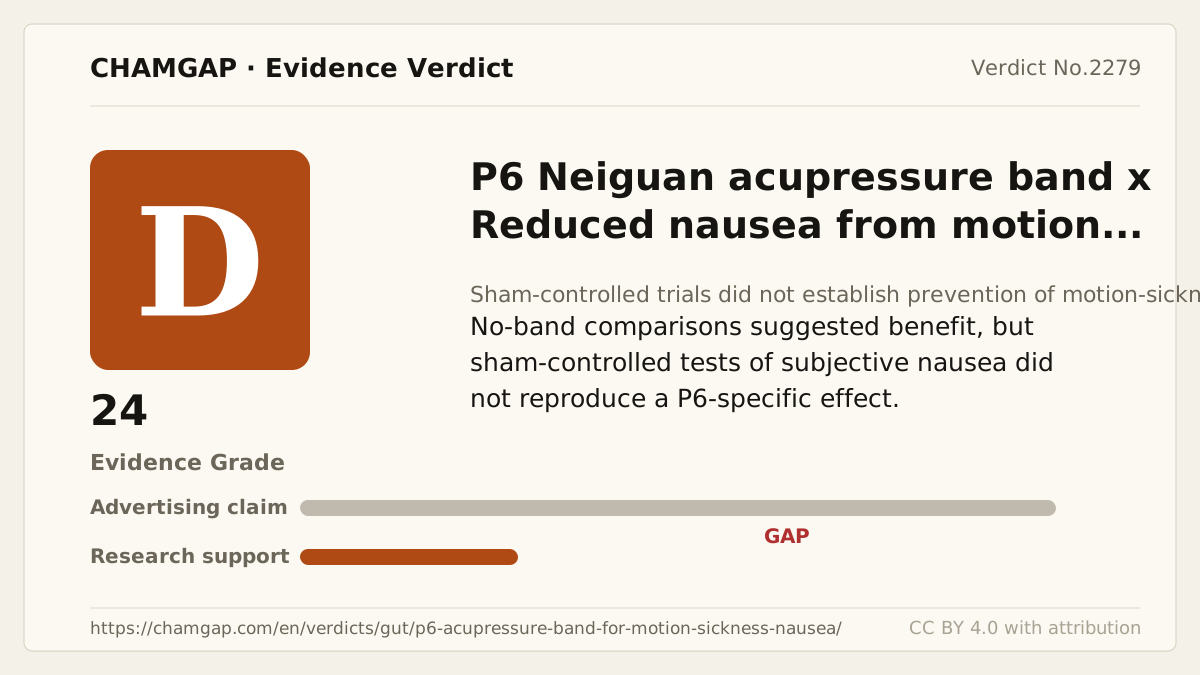
[Chamgap] P6 acupressure band × motion-sickness nausea — Evidence Grade D·28. 3 cited sources checked. Source: https://chamgap.com/en/verdicts/gut/p6-acupressure-band-for-motion-sickness-nausea/ · CC BY 4.0CC BY 4.0 — free to use with attribution; do not distort grades, numbers, or verdict meaning.
What this document does and does not do
Chamgap is an information source. It reports what research has and has not confirmed; it does not tell readers what to take or buy. That decision belongs to readers and, when needed, medical or legal professionals. This verdict reflects literature available up to the search date and may change as new research appears. Nothing here is medical advice.