
Premeal versus other proton-pump-inhibitor timing,
does it really help with Improved reflux symptoms versus other existing dosing times?
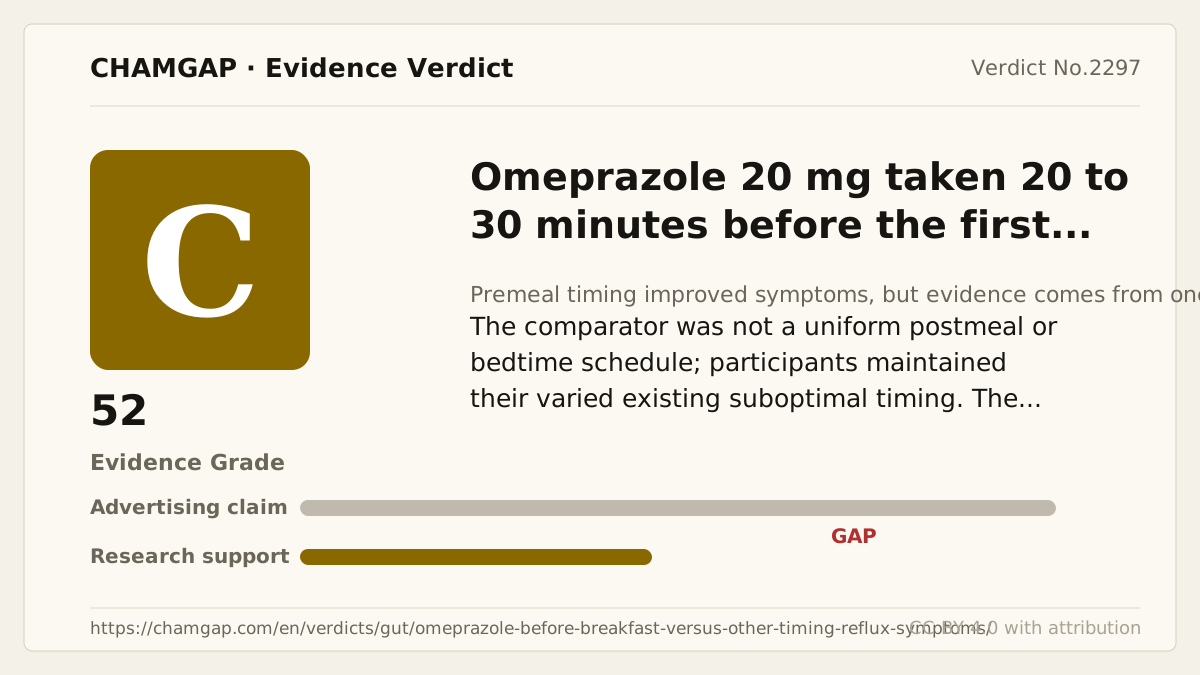
research showsThe grade is C with 54 points. Sixty-four adults with persistent heartburn who were not taking omeprazole at an appropriate premeal time were randomized to take 20 mg 20 to 30 minutes before breakfast or their first meal, or to maintain their own suboptimal timing, for four weeks. Patient-reported symptom number, frequency, severity, and distress improved more with premeal dosing, but this was one small, short, unblinded timing trial.
ads claimVerdict 853 is A with 85 points for omeprazole itself healing erosive reflux esophagitis and resolving heartburn. This verdict asks a different question: the same dose before the first meal versus varied existing dosing times.
Useful facts when choosing a product
- Premeal dosing meant 20 to 30 minutes before breakfast or the first meal of the day.
- Controls did not follow one postmeal or bedtime schedule; they maintained their existing suboptimal timing.
- The endpoint was the 15-item patient-reported GSAS, not pH monitoring.
- The first randomized comparison involved 64 participants at four weeks.
Chamgap Semantic Classification Code
Candidate index · review held
F.omeprazole-taken-before-the-first-meal.food.reflux-symptoms.improve.UNKFoods and beverages > Omeprazole taken before the first meal > Food consumption > reflux symptoms > Improvement claim > Unknown
An automated migration candidate, not an issued permanent code; exact claim scope remains under review. This machine-generated migration candidate helps retrieval but is not a permanent assignment. The original verdict ID and URL remain authoritative.
What the research actually shows
Waghray and colleagues enrolled 64 adults taking omeprazole 20 mg daily who still had heartburn at least three times weekly and used suboptimal timing. After a two-week observation period, 24 were randomized to dosing 20 to 30 minutes before the first meal and 40 to maintain their existing suboptimal timing. At four weeks, the 15-item Gastroesophageal Reflux Disease Symptom Assessment Scale measured patient-reported symptom number, frequency, severity, and distress. A later rerandomization of the control group followed, but the principal comparison was the first four weeks. The paper states that the authors had no financial or grant support and no conflict of interest.
Why this is classified as C (54)
Symptoms are a patient-important endpoint and the approximate effect exceeded medium size, but a single 64-person, four-week, unblinded subjective trial gives C with 54 points.
Counterpoint. All four overall and heartburn-specific GSAS domains favored premeal timing. Exact mean differences and confidence intervals could not be reconstructed from the publicly available figures.
Rejudgment record. Cross-check applied — The comparison of 20 to 30 minutes before the first meal versus each participant's existing suboptimal timing, 64 participants and four weeks, four patient-reported GSAS domains, approximate standardized contrast reconstructed from P value, and no-support statement were applied
| Endpoint | P | Symptom or function itself is the target - including patient reports and performance tests |
| Replication | R1 | Single confirmatory trial |
| Independence | I2 | Decisive evidence is publicly or non-profit funded |
| Effect size | E+ | Meets the clinically important threshold |
Stored derived and displayed grades match; this is not a current recalculation or validity check (C).
Sub-claim grades by effect
This ingredient is marketed for several effects. A single overall grade blends strong and weak claims together, so each effect is graded separately here. The overall grade reflects the strongest disconfirming or core claim.
| Effect (sub-claim) | Grade | Basis |
|---|---|---|
| Improved reflux symptoms | C | Overall and heartburn-specific GSAS domains favored premeal dosing at four weeks. |
| Improved gastric acidity | ? | This trial did not measure pH or acid exposure. |
Cross-check — AI research and Codex final gate
Evidence Table
| Study | Design | Sample | Funding | Endpoint | Result | Weight |
|---|---|---|---|---|---|---|
| Waghray A et al. 2019 OSCAR | Open-label randomized timing-instruction trial versus maintaining existing suboptimal timing | 64 participants: 24 premeal and 40 existing timing | The paper states no financial or grant support and no conflict of interest | Four-week patient-reported changes in GSAS symptom number, frequency, severity, and distress | All four overall and heartburn-specific domains favored premeal dosing, P<.01; about 0.69 or greater is a reconstructed approximation, not a reported result; exact group means and confidence intervals could not be confirmed | Decisive single small randomized trial |
Receipt — 1 References
All 1 cited sources were verified for existence at the original page (as of 2026-08-05).
Final verification and publication gate: Codex · Evidence date: 2026-08-05 · Corrections: none
Cite this verdict
[Chamgap] Premeal versus other proton-pump-inhibitor timing x reflux symptoms — Evidence Grade C·54. 1 cited sources checked. Source: https://chamgap.com/en/verdicts/gut/omeprazole-before-breakfast-versus-other-timing-reflux-symptoms/ · CC BY 4.0CC BY 4.0 — free to use with attribution; do not distort grades, numbers, or verdict meaning.
What this document does and does not do
Chamgap is an information source. It reports what research has and has not confirmed; it does not tell readers what to take or buy. That decision belongs to readers and, when needed, medical or legal professionals. This verdict reflects literature available up to the search date and may change as new research appears. Nothing here is medical advice.