
Nipple shield plus lactation support,
does it really help with Continuation of exclusive breastfeeding to six months among mothers with nipple abnormalities?
research showsThe grade is D. Among 687 randomized mothers with short, flat, inverted, budded, or cracked nipples, only 660 were analyzed. The primary six-month exclusive-breastfeeding outcome was 25.5% versus 22.1%; adjusted RR 1.24 (95% CI 0.89-1.73), not significant.
ads claimRetail availability in Korea does not make this a stand-alone product intervention. The evidence concerns targeted use with lactation assessment, follow-up, and a weaning plan.
Useful facts when choosing a product
- Both groups received structured lactation counseling and education.
- The primary outcome was WHO-defined exclusive breastfeeding at six months.
- Of 687 randomized participants, 660 entered the reported analysis.
Chamgap Semantic Classification Code
Candidate index · review held
X.silicone-nipple-shield-added-to-structured-lactation-support.behavioral.continuation-of-exclusive-breastfeeding-to-among-mothers-with-nipple-abnormalities.assess.addonBehaviors, exposures and policies > silicone nipple shield added to structured lactation support > Behavioral delivery > Continuation of exclusive breastfeeding to among mothers with nipple abnormalities > Association or change assessment > Added intervention on common background care
An automated migration candidate, not an issued permanent code; exact claim scope remains under review. This machine-generated migration candidate helps retrieval but is not a permanent assignment. The original verdict ID and URL remain authoritative.
What the research actually shows
This Thai single-center trial enrolled mothers delivering singleton infants at 34 weeks or later who had short, flat, inverted/budded, or cracked nipples. It assigned 349 versus 338 but analyzed 330 per group after five immediate discontinuations and 22 losses. Both groups received certified-nurse counseling on positioning and latch, nipple assessment and cracked-nipple care, hand expression, tongue-tie assessment, and frenotomy referral when indicated; only the intervention group added standardized shield instruction and a nipple shield. The actual comparison was lactation counseling in both groups with a shield added to one group only. WHO-defined exclusive breastfeeding at six months was primary; months one, two, and three were secondary. Outcomes came from structured maternal interviews. Verdict 1567 is C with 58 points and evaluates broad postpartum support, whereas this verdict isolates adding a shield to the same support. Verdict 2236 is B with 72 points and evaluates infant gastrointestinal infection, a disease event. Following that categorization precedent, this verdict is assigned to gut.
Why this is classified as D (30)
A single randomized trial was null on its primary outcome and did not precisely exclude benefit, giving D with 30 points.
Counterpoint. Early results and the short-nipple subgroup may support temporary targeted use but do not replace the primary six-month result.
Rejudgment record. Cross-check applied — Null six-month exclusive-breastfeeding primary outcome and completer analysis
| Endpoint | P | Symptom or function itself is the target - including patient reports and performance tests |
| Replication | R1 | Single confirmatory trial |
| Independence | I2 | Decisive evidence is publicly or non-profit funded |
| Effect size | E0 | Null |
| Precision | C0 | The confidence interval leaves room for benefit |
Stored derived and displayed grades match; this is not a current recalculation or validity check (D).
Sub-claim grades by effect
This ingredient is marketed for several effects. A single overall grade blends strong and weak claims together, so each effect is graded separately here. The overall grade reflects the strongest disconfirming or core claim.
| Effect (sub-claim) | Grade | Basis |
|---|---|---|
| Exclusive breastfeeding at six months | D | Adjusted RR was null at 1.24 (0.89-1.73). |
Cross-check — AI research and Codex final gate
Evidence Table
| Study | Design | Sample | Funding | Endpoint | Result | Weight |
|---|---|---|---|---|---|---|
| Saifon Chawanpaiboon et al. 2026 | Single-center parallel randomized trial | 687 randomized, 349/338; 660 analyzed, 330/330 | Faculty of Medicine, Mahidol University grant [IO] R016633003 | Primary: WHO-defined exclusive breastfeeding at six months | 25.5% versus 22.1%; adjusted RR 1.24 (95% CI 0.89-1.73) | Only direct randomized evidence |
Receipt — 1 References
All 1 cited sources were verified for existence at the original page (as of 2026-08-08).
Final verification and publication gate: Codex · Evidence date: 2026-08-08 · Corrections: none
Cite this verdict
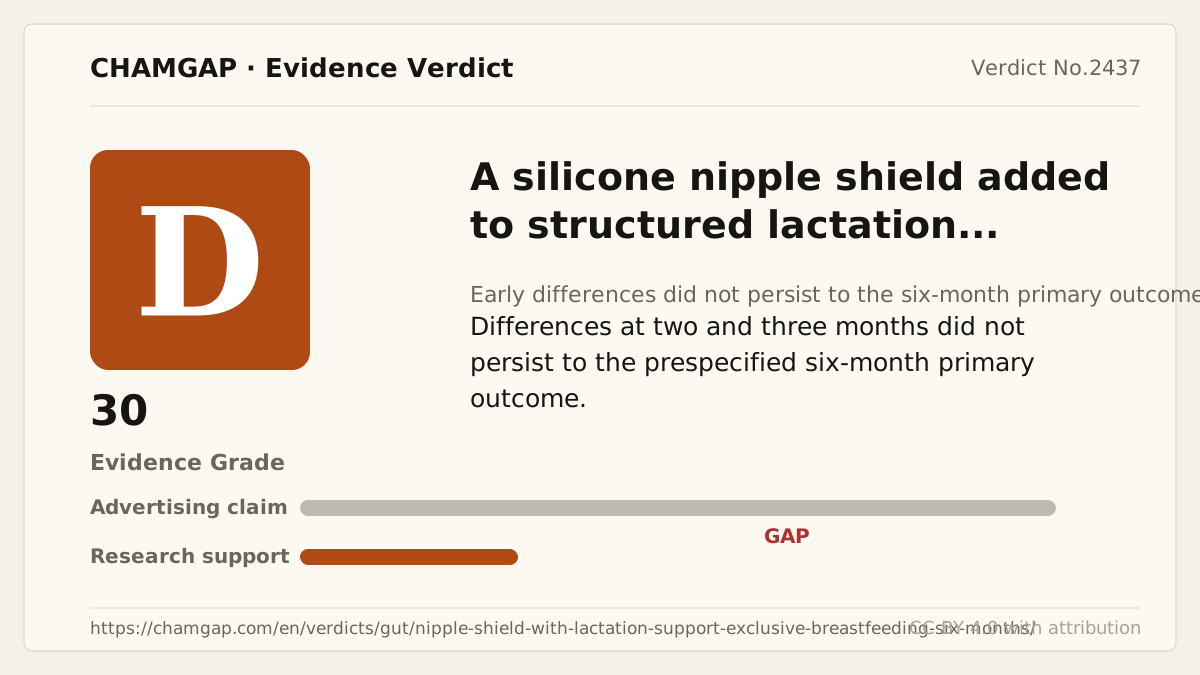
[Chamgap] Nipple shield plus lactation support x exclusive breastfeeding at six months — Evidence Grade D·30. 1 cited sources checked. Source: https://chamgap.com/en/verdicts/gut/nipple-shield-with-lactation-support-exclusive-breastfeeding-six-months/ · CC BY 4.0CC BY 4.0 — free to use with attribution; do not distort grades, numbers, or verdict meaning.
What this document does and does not do
Chamgap is an information source. It reports what research has and has not confirmed; it does not tell readers what to take or buy. That decision belongs to readers and, when needed, medical or legal professionals. This verdict reflects literature available up to the search date and may change as new research appears. Nothing here is medical advice.