
Two liters of mineral water plus fiber,
does it really help with Increased stool frequency and reduced laxative use in adults with chronic functional constipation?
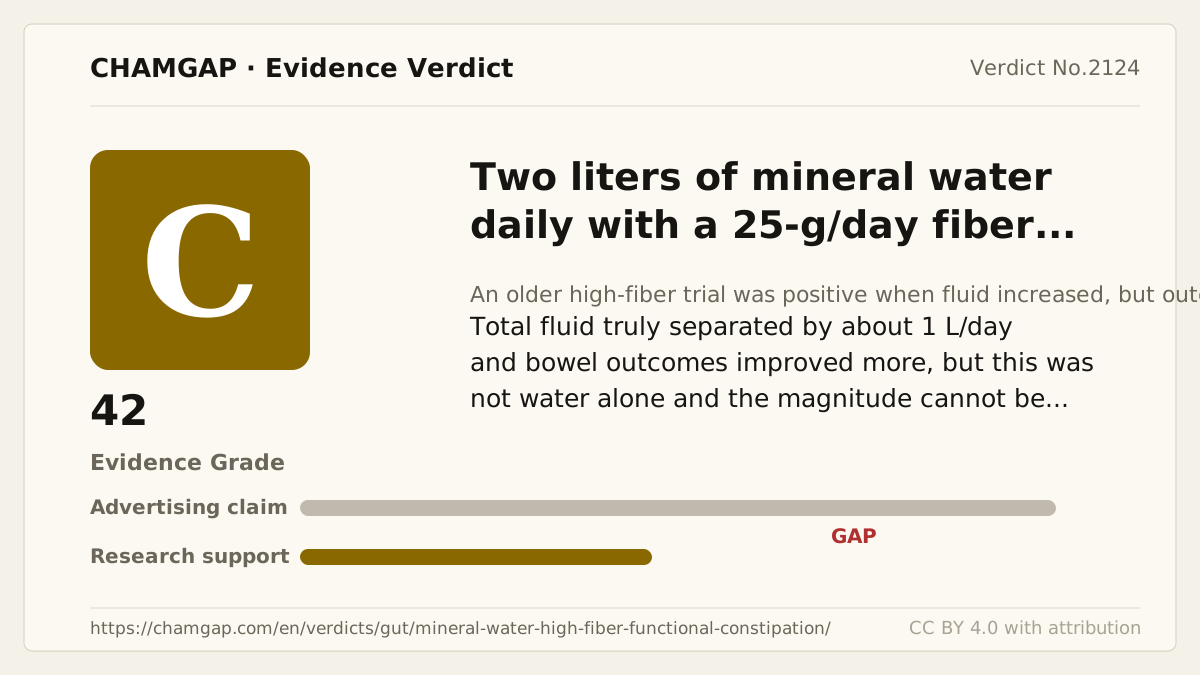
research showsThe grade is C. A two-month trial randomized 117 adults with chronic functional constipation. Both arms consumed 25 g/day of fiber, while total fluid averaged 2.1 L/day with prescribed mineral water versus 1.1 L/day with ad libitum intake. Stool frequency and laxative use improved more with water, but publicly accessible reporting lacks arm-level outcome values, dispersion, and test statistics needed to calculate the effect magnitude. One old small short trial gives C with 46 points.
ads claimThe fluid difference and statistical bowel improvement were real. Turning a trial that supplied 25 g/day of fiber to everyone into a promise that water alone cures any constipation removes the co-intervention and unknown magnitude.
Useful facts when choosing a product
- Actual total fluid averaged 2.1 versus 1.1 L/day, a separation of about 1.0 L/day.
- All participants consumed about 25 g/day of fiber, so this was not a water-only trial.
- Group 24-hour urine volume and urine osmolality were not found in the publicly accessible report.
- Verdict 1088 is D with 30 points for postexercise rehydration; this verdict concerns stool frequency and laxative use during a high-fiber diet.
Chamgap Semantic Classification Code
Candidate index · review held
D.two-liters-of-mineral-water-with-a-fiber-diet.dietary.stool-frequency-and-reduced-laxative-use-with-chronic-functional-constipation.reduce.UNKDietary patterns and eating practices > Two liters of mineral water with a fiber diet > Dietary regimen > stool frequency and reduced laxative use with chronic functional constipation > Reduction claim > Unknown
An automated migration candidate, not an issued permanent code; exact claim scope remains under review. This machine-generated migration candidate helps retrieval but is not a permanent assignment. The original verdict ID and URL remain authoritative.
What the research actually shows
Anti randomized 117 adults aged 18 to 50 years with chronic functional constipation: 58 to ad libitum fluids and 59 to 2 L/day of mineral water. Both groups followed the same approximately 25-g/day fiber diet for two months. Actual total fluid separated to 1.1 versus 2.1 L/day, while fiber intake remained similar. Stool frequency and laxative use improved more with added water, but the article lacks the standard error, confidence interval, and covariance for the adjusted between-group contrast, so the clinical size of the effect cannot be judged. Group 24-hour urine volume, osmolality, and a registered primary endpoint were not confirmed. The article contains no funding-support statement; the independence value reflects unconfirmed funding, not an absence of industry funding, not a finding of mixed funding.
Why this is classified as C (46)
Actual intake separated and both bowel outcomes were statistically positive, but magnitude was not recoverable and one small short unblinded trial gives C with 46 points.
Counterpoint. Unknown magnitude does not mean no effect, but P<.001 alone cannot establish a patient-noticeable large effect.
Rejudgment record. Cross-check applied — One-liter daily fluid separation with positive bowel outcomes, limited by unrecoverable arm-level magnitude and a small short unblinded design
| Endpoint | P | Symptom or function itself is the target - including patient reports and performance tests |
| Replication | R1 | Single confirmatory trial |
| Independence | I1 | Mixed funding sources |
| Effect size | EX | The clinical size of the effect could not be judged |
Stored derived and displayed grades match; this is not a current recalculation or validity check (C).
Sub-claim grades by effect
This ingredient is marketed for several effects. A single overall grade blends strong and weak claims together, so each effect is graded separately here. The overall grade reflects the strongest disconfirming or core claim.
| Effect (sub-claim) | Grade | Basis |
|---|---|---|
| Increased stool frequency and reduced laxative use during a high-fiber diet | C | Both outcomes were statistically positive, but the public data do not permit calculation of the between-group magnitude. |
Cross-check — AI research and Codex final gate
Evidence Table
| Study | Design | Sample | Funding | Endpoint | Result | Weight |
|---|---|---|---|---|---|---|
| Anti M et al. 1998 | Two-month parallel randomized clinical trial | 117 randomized (58 ad libitum fluid/59 mineral water); endpoint analysis counts not confirmed | No funding-support statement in the article; I1 is the default for unconfirmed funding | Stool frequency and laxative use | Total fluid 1.1 versus 2.1 L/day; both outcomes improved more with added water (P<.001), without arm-level absolute values or CIs | Pivotal older single trial |
Receipt — 1 References
All 1 cited sources were verified for existence at the original page (as of 2026-08-04).
Final verification and publication gate: Codex · Evidence date: 2026-08-04 · Corrections: none
Cite this verdict
[Chamgap] Two liters of mineral water plus fiber x improvement of functional constipation — Evidence Grade C·46. 1 cited sources checked. Source: https://chamgap.com/en/verdicts/gut/mineral-water-high-fiber-functional-constipation/ · CC BY 4.0CC BY 4.0 — free to use with attribution; do not distort grades, numbers, or verdict meaning.
What this document does and does not do
Chamgap is an information source. It reports what research has and has not confirmed; it does not tell readers what to take or buy. That decision belongs to readers and, when needed, medical or legal professionals. This verdict reflects literature available up to the search date and may change as new research appears. Nothing here is medical advice.