
Mesalazine,
does it really help with Improvement of abdominal pain, global symptoms, and stool frequency in irritable bowel syndrome?
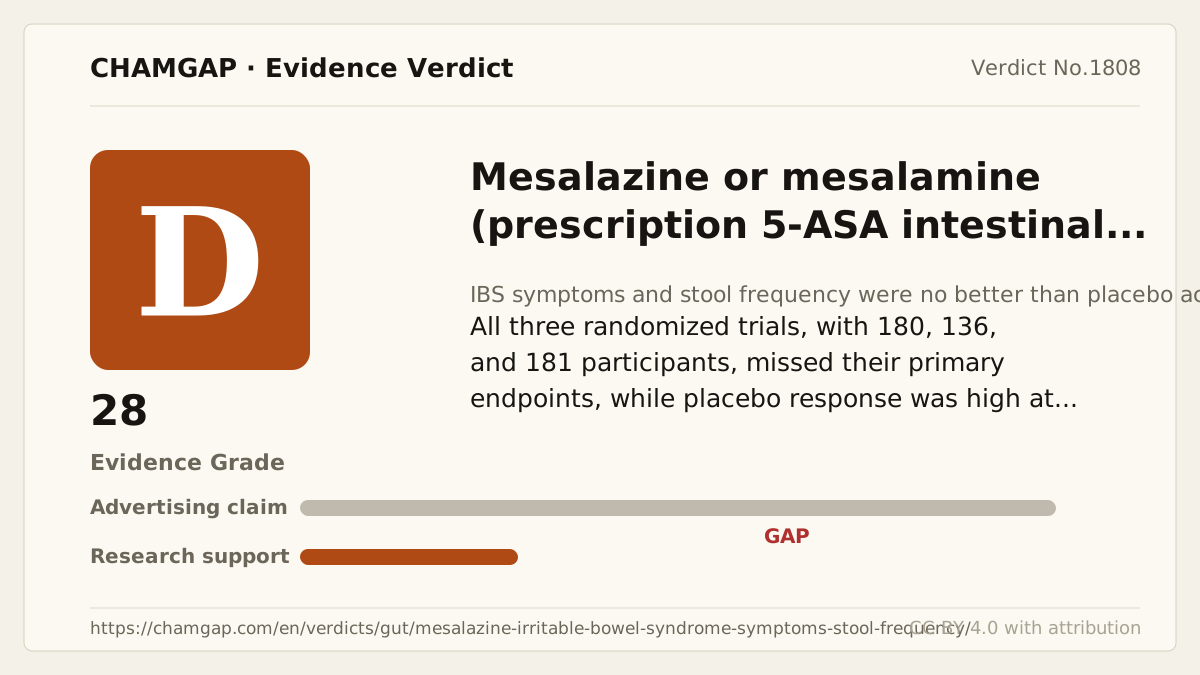
research showsMesalazine is rated D for IBS efficacy. In the Barbara trial, the actual primary analysis included 172 of 180 randomized participants, and satisfactory relief of abdominal pain or discomfort was 68.6% versus 67.4% with placebo, a 1.2-percentage-point difference (95% CI -12.8 to 15.1; P=0.870), so the primary endpoint failed. In the Lam trial, 115 of 136 randomized participants were analyzed; daily stool frequency was 2.8 versus 2.7, difference 0.10 stools per day (95% CI -0.33 to 0.53; P=0.66), another failure. An independent 2022 trial also failed at 36% versus 30% (P=0.40). The failures are repeated, but the pooled SMD of -0.07 (95% CI -0.21 to 0.07) does not fully exclude a small benefit, so RX with C0 gives D, not F, with 28 points.
ads claimMarketing may repurpose the drug's use against intestinal inflammation in inflammatory bowel disease into claims for IBS pain and bowel habits. IBS trials did not show consistent clinical efficacy beyond the large placebo response.
Useful facts when choosing a product
- The placebo primary-response rate was 67.4% in the Barbara trial, and placebo stool frequency was 2.7 per day in the Lam trial, illustrating substantial placebo response and natural variability.
- Mesalazine is a 5-ASA used for inflammatory bowel disease, but IBS and ulcerative colitis are different conditions. verdict 1282, which is B with 74 points, concerns infliximab and colectomy risk in ulcerative colitis and cannot be transferred to this IBS claim.
- The IBS evidence landscape includes verdict 1632, which is B with 70 points, for tenapanor; verdict 167, which is B with 70 points, for peppermint oil; and verdict 1611, which is C with 58 points, for a low-FODMAP diet. verdict 361, which is B with 65 points, for L. plantarum 299v and verdict 767, which is D with 30 points, for C. butyricum are also separate interventions.
Chamgap Semantic Classification Code
Candidate index · review held
M.mesalazine-or-mesalamine.UNK.abdominal-pain-global-symptoms-and-stool-frequency-in-irritable-bowel-syndrome.improve.placeboMedicinal interventions > Mesalazine or mesalamine > Unknown > abdominal pain, global symptoms, and stool frequency in irritable bowel syndrome > Improvement claim > Placebo
An automated migration candidate, not an issued permanent code; exact claim scope remains under review. This machine-generated migration candidate helps retrieval but is not a permanent assignment. The original verdict ID and URL remain authoritative.
What the research actually shows
Barbara and colleagues randomized 180 participants and included 172 in the actual primary analysis of satisfactory relief of abdominal pain or discomfort during at least half of 12 treatment weeks. The primary endpoint failed at 68.6% versus 67.4%. Lam and colleagues randomized 136 patients with IBS-D, but only 115, 57 and 58 per group, had stool-diary data for the primary analysis at weeks 11 and 12; stool frequency was 2.8 versus 2.7 per day and failed. Goodoory and colleagues assigned 181 participants, 91 and 90, and analyzed 179 after two exclusions; the global-relief endpoint again failed at 36% versus 30%, P=0.40, and their pooled SMD across trials was -0.07. Evidence for mesalazine in ulcerative colitis is not evidence for IBS.
Why this is classified as D (28)
Three independent randomized trials repeatedly failed their prespecified primary endpoints, producing P, RX, I1, and E0, with B2 from small studies and attrition. The pooled interval does not completely exclude a small benefit, so C0 yields D with 28 points rather than F.
Counterpoint. Selected IBS phenotypes may remain research questions, but current evidence does not support routine expectations of benefit in unselected IBS or IBS-D.
Rejudgment record. Cross-check applied — Applied D for repeated null primary endpoints in the same indication because the pooled confidence interval still leaves room for a small benefit, satisfying RX with C0 rather than C1
| Endpoint | P | Symptom or function itself is the target - including patient reports and performance tests |
| Replication | RX | Repeatedly refuted in the same indication |
| Independence | I1 | Mixed funding sources |
| Effect size | E0 | Null |
| Precision | C0 | The confidence interval leaves room for benefit |
Stored derived and displayed grades match; this is not a current recalculation or validity check (D).
Sub-claim grades by effect
This ingredient is marketed for several effects. A single overall grade blends strong and weak claims together, so each effect is graded separately here. The overall grade reflects the strongest disconfirming or core claim.
| Effect (sub-claim) | Grade | Basis |
|---|---|---|
| Satisfactory relief of IBS abdominal pain or discomfort | D | The prespecified primary endpoint failed at 68.6% versus 67.4%. |
| Reduced stool frequency in IBS-D | D | Stool frequency was 2.8 versus 2.7 per day, with no improvement over placebo. |
| Consistent improvement of global IBS symptoms | D | The additional 2022 randomized trial and pooled analysis were also null. |
Cross-check — AI research and Codex final gate
Evidence Table
| Study | Design | Sample | Funding | Endpoint | Result | Weight |
|---|---|---|---|---|---|---|
| Barbara G et al. 2016 | Phase 3 multicenter randomized double-blind placebo-controlled trial | 180 randomized (88/92); actual primary analysis 172 | Supported and sponsored by Sofar S.p.A.; sponsor participated in monitoring and approval of the analysis plan | Satisfactory relief of abdominal pain or discomfort during at least half of 12 treatment weeks | 68.6% versus 67.4%, difference 1.2 percentage points (95% CI -12.8 to 15.1), P=0.870; primary endpoint failed. | Key null confirmatory trial |
| Lam C et al. 2016 | Multicenter randomized double-blind placebo-controlled IBS-D trial | 136 randomized; actual primary analysis 115 (57/58) | Public MRC and NIHR EME funding; Ferring supplied active and placebo medication | Mean daily stool frequency during weeks 11 and 12 | 2.8 versus 2.7 stools per day, difference 0.10 (95% CI -0.33 to 0.53), P=0.66; primary endpoint failed. | Publicly funded independent null replication |
| Goodoory VC et al. 2022 | Multicenter randomized double-blind placebo-controlled trial and post hoc meta-analysis | 181 allocated (91/90); actual primary analysis 179 after two exclusions | Mixed funding from Eurostars, Swedish ALF public support, and Tillotts Pharma | Satisfactory relief of global IBS symptoms during at least half of eight treatment weeks | 32 (36%) versus 27 (30%), P=0.40, so the primary endpoint failed; pooled SMD -0.07 (95% CI -0.21 to 0.07). | Additional null replication and precision evidence |
Receipt — 3 References
All 3 cited sources were verified for existence at the original page (as of 2026-07-24).
Final verification and publication gate: Codex · Evidence date: 2026-07-24 · Corrections: none
Cite this verdict
[Chamgap] Mesalazine x improvement of IBS symptoms and stool frequency — Evidence Grade D·28. 3 cited sources checked. Source: https://chamgap.com/en/verdicts/gut/mesalazine-irritable-bowel-syndrome-symptoms-stool-frequency/ · CC BY 4.0CC BY 4.0 — free to use with attribution; do not distort grades, numbers, or verdict meaning.
What this document does and does not do
Chamgap is an information source. It reports what research has and has not confirmed; it does not tell readers what to take or buy. That decision belongs to readers and, when needed, medical or legal professionals. This verdict reflects literature available up to the search date and may change as new research appears. Nothing here is medical advice.