
Magnesium oxide,
does it really help with Improvement of chronic constipation and bowel-movement frequency?
research showsMagnesium oxide at 1.5 g/day improved bowel-movement frequency and overall response in two four-week placebo-controlled trials, but the evidence is rated C. The magnesium oxide and placebo arms contained only about 47 participants each, 93% of participants were women, and the authors and institution overlapped substantially, so the trials do not constitute independent replication. The American Gastroenterological Association and American College of Gastroenterology guideline also rated the evidence for spontaneous and complete spontaneous bowel movements as very low certainty because of inconsistency, indirectness, and imprecision.
ads claimMarketing converts poor absorption into a claim of a daily gut-cleansing magnesium supplement. The trials evaluated 1.5 g/day of magnesium oxide as an osmotic laxative treatment, not ordinary nutritional supplementation, and the result does not automatically transfer to other magnesium salts.
Useful facts when choosing a product
- Magnesium oxide is distributed in Korea both as a constipation or antacid medicine and as a magnesium source in health functional foods, so purpose and label units must be distinguished.
- The trial dose was 1.5 g/day of magnesium oxide, which is not the same numerical amount as elemental magnesium on a nutrition label.
- Combination products may mix oxide, citrate, and other salts and are not identical to the trial material.
- Renal impairment increases hypermagnesemia risk, and diarrhea or abdominal pain can occur, so dose and kidney function matter before long-term use.
Chamgap Semantic Classification Code
Candidate index · review held
UNK.magnesium-oxide.UNK.chronic-constipation-and-bowel-movement-frequency.improve.placeboUnknown > Magnesium oxide > Unknown > chronic constipation and bowel-movement frequency > Improvement claim > Placebo
An automated migration candidate, not an issued permanent code; exact claim scope remains under review. This machine-generated migration candidate helps retrieval but is not a permanent assignment. The original verdict ID and URL remain authoritative.
What the research actually shows
Mori 2019 randomized 34 women with mild to moderate chronic constipation to 1.5 g/day for 28 days. Overall improvement was 70.6% versus 25.0%, and spontaneous bowel movements improved, while complete spontaneous bowel-movement response was null. Morishita 2021 randomized 90 participants to senna, magnesium oxide, or placebo; both active treatments improved defecation and quality of life. The 2023 American Gastroenterological Association and American College of Gastroenterology guideline issued a conditional suggestion based on these two Japanese trials.
Why this is classified as C (53)
Direct bowel-movement frequency and response were positive, but the two 1.5-g/day, four-week trials were small and concentrated in the same authors and institution rather than providing independent replication. Together with the guideline's very-low-certainty assessment, these limitations support C with 53 points. Hypermagnesemia risk in renal impairment is reported separately under safety.
Counterpoint. An adjunctive short-term effect exists in chronic idiopathic constipation. Long-term persistence, broader populations, and ordinary nutritional doses remain inadequately tested.
Rejudgment record. Reassessment (cross-check reflected) — Accepted positive direct defecation endpoints but prioritized the limitations of 1.5 g/day for four weeks, only 47 participants per pooled arm, 93% women, overlapping authors and institution, and the guideline's very-low-certainty assessment
Sub-claim grades by effect
This ingredient is marketed for several effects. A single overall grade blends strong and weak claims together, so each effect is graded separately here. The overall grade reflects the strongest disconfirming or core claim.
| Effect (sub-claim) | Grade | Basis |
|---|---|---|
| Short-term improvement in bowel frequency and overall response in chronic constipation | C | Direct endpoints were positive in placebo-controlled trials of 1.5 g/day for four weeks, but samples were small and replication was not independent |
| Long-term persistence and replication in diverse populations | D | Four-week data, 93% women, and concentration in one institution leave long-term and external validity unestablished |
Cross-check — AI research and Codex final gate
Evidence Table
| Study | Design | Sample | Funding | Endpoint | Result | Weight |
|---|---|---|---|---|---|---|
| Mori S et al. 2019 | Randomized double-blind placebo-controlled trial | 33 | Hyogo College of Medicine; no external industry funding stated | Overall improvement, spontaneous and complete spontaneous bowel movements, stool form, and colonic transit | At 1.5 g/day for four weeks, overall response was 70.6% versus 25.0% and spontaneous bowel movements improved, while complete spontaneous bowel-movement response was null. | Key |
| Morishita D et al. 2021 | Randomized double-blind three-arm trial of senna, magnesium oxide, and placebo | 90 | Hyogo College of Medicine; no industry funding stated | Overall improvement, bowel frequency, and quality of life | Magnesium oxide 1.5 g/day and senna improved defecation and quality of life versus placebo at four weeks. | Key |
| AGA-ACG guideline 2023 | Evidence-based clinical practice guideline | 47 | Professional societies | Pharmacological management of chronic idiopathic constipation | Suggested conditional use and rated the certainty of evidence as very low. | Guideline |
Receipt — 3 References
All 3 cited sources were verified for existence at the original page (as of 2026-07-18).
Final verification and publication gate: Codex · Evidence date: 2026-07-18 · Corrections: none
Cite this verdict
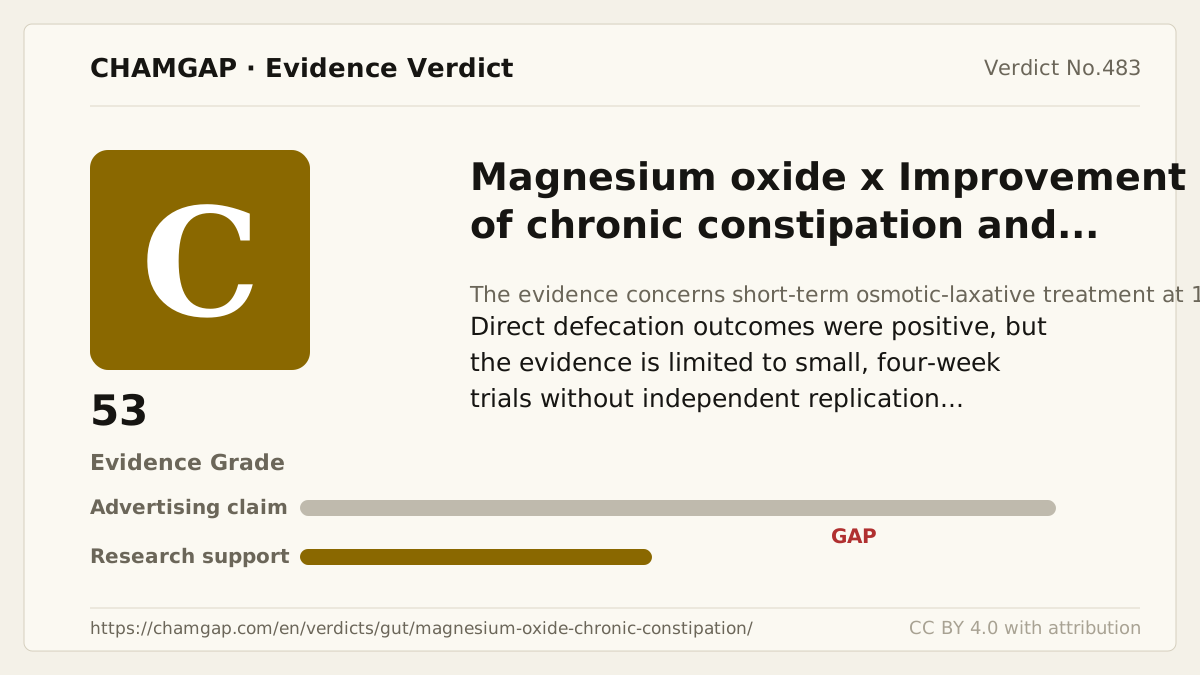
[Chamgap] Magnesium oxide x chronic constipation and bowel-movement frequency — Evidence Grade C·53. 3 cited sources checked. Source: https://chamgap.com/en/verdicts/gut/magnesium-oxide-chronic-constipation/ · CC BY 4.0CC BY 4.0 — free to use with attribution; do not distort grades, numbers, or verdict meaning.
What this document does and does not do
Chamgap is an information source. It reports what research has and has not confirmed; it does not tell readers what to take or buy. That decision belongs to readers and, when needed, medical or legal professionals. This verdict reflects literature available up to the search date and may change as new research appears. Nothing here is medical advice.