
Lubiprostone,
does it really help with Improvement of spontaneous and complete bowel movements in adults with chronic idiopathic constipation?
research showsLubiprostone is rated C because it improves spontaneous bowel-movement frequency and related symptoms in adults with chronic idiopathic constipation, but all efficacy outcomes were patient-recorded symptoms. Phase 3 trials improved spontaneous bowel movements, completeness, straining, and stool form. A meta-analysis of three trials involving 610 participants found a moderate reduction in treatment failure (RR 0.67, 95% CI 0.56 to 0.80), while pivotal evidence was short and concentrated in manufacturer development. The repeated positive signal is accepted, but the subjective-only endpoint, sponsor concentration, and limited long-term evidence impose the rule 1 ceiling of C with 59 points.
ads claimClaims that the medicine normalizes the bowel or cures constipation expand an on-treatment average improvement into disease modification. Some patients do not respond, and persistent benefit after stopping is not established.
Useful facts when choosing a product
- Lubiprostone is a prescription intestinal secretagogue that promotes chloride-ion secretion, and adults with chronic idiopathic constipation should follow the authorized product instructions and clinician-selected regimen.
- Taking it with food and water is often advised to reduce nausea, and severe diarrhea should prompt discussion with the treating clinician about continued dosing.
- It should not be used when mechanical bowel obstruction is suspected, and possible pregnancy, pregnancy, breastfeeding, severe diarrhea, or a history of dyspnea should be disclosed before prescribing.
Chamgap Semantic Classification Code
Candidate index · review held
M.lubiprostone.UNK.spontaneous-and-complete-bowel-movements-with-chronic-idiopathic-constipation.improve.placeboMedicinal interventions > Lubiprostone > Unknown > spontaneous and complete bowel movements with chronic idiopathic constipation > Improvement claim > Placebo
An automated migration candidate, not an issued permanent code; exact claim scope remains under review. This machine-generated migration candidate helps retrieval but is not a permanent assignment. The original verdict ID and URL remain authoritative.
What the research actually shows
Johanson 2008 randomized 242 adults with chronic constipation to lubiprostone 24 micrograms twice daily or placebo for four weeks. Week-one spontaneous bowel movements averaged 5.69 versus 3.46, with favorable findings in later weeks and for stool form, straining, and severity. Ford 2011 pooled three lubiprostone trials involving 610 participants and reported a treatment-failure risk ratio of 0.67. Fukudo 2015 randomized 124 Japanese patients and improved spontaneous bowel movements and quality of life. Coss-Adame 2023 randomized 211 Mexican patients and found a week-one increase of 4.9 versus 3.0 bowel movements, with improvement in straining, stool consistency, and bloating.
Why this is classified as C (59)
Multiple placebo-controlled trials improved spontaneous bowel movements, completeness, straining, and stool form, and the treatment-failure RR in a meta-analysis of three trials involving 610 participants was 0.67. All were patient-recorded symptom endpoints, the effect was moderate, and trials were mainly short manufacturer-development studies, imposing the rule 1 ceiling of C with 59 points. Nausea, diarrhea, headache, and pregnancy precautions remain separate safety issues.
Counterpoint. Increased bowel-movement frequency is a direct everyday benefit, but it does not resolve every case involving pain, pelvic-floor dysfunction, or a secondary cause. Etiologic evaluation and response to lifestyle and nonprescription treatment still matter.
Rejudgment record. Reassessment (cross-check reflected) — Accepted improvements in spontaneous bowel movements, completeness, straining, and stool form in phase 3 trials and a treatment-failure RR of 0.67 across three trials involving 610 participants, but applied the rule 1 ceiling of C because all were patient-recorded symptoms, the effect was moderate, and short evidence was concentrated in manufacturer development
Sub-claim grades by effect
This ingredient is marketed for several effects. A single overall grade blends strong and weak claims together, so each effect is graded separately here. The overall grade reflects the strongest disconfirming or core claim.
| Effect (sub-claim) | Grade | Basis |
|---|---|---|
| Improved spontaneous bowel movements and bowel-movement completeness in adults with chronic idiopathic constipation | C | Improvement was repeated, but all outcomes were patient-recorded symptoms and the meta-analytic effect was moderate. |
| Nausea as a common safety issue | ? | This is a separate safety axis rather than an efficacy subclaim; diarrhea and headache also require consideration. |
| Long-term durability and manufacturer-independent replication | ? | Pivotal trials were short and concentrated in manufacturer development, leaving long-term independent confirmation inadequate. |
Cross-check — AI research and Codex final gate
Evidence Table
| Study | Design | Sample | Funding | Endpoint | Result | Weight |
|---|---|---|---|---|---|---|
| Johanson JF et al. 2008 | Multicenter four-week double-blind randomized placebo-controlled trial | 242 adults with chronic constipation | Lubiprostone development program with a drug-developer coauthor | Number of spontaneous bowel movements at week one, later weekly frequency, and bowel-movement characteristics | Week-one spontaneous bowel movements averaged 5.69 per week versus 3.46 with placebo, with later and symptom outcomes also improved. | Pivotal direct short-term phase 3 evidence |
| Ford AC and Suares NC. 2011 | Systematic review and meta-analysis of pharmacologic randomized trials in chronic idiopathic constipation | Three lubiprostone trials involving 610 participants | Academic systematic review | Failure of therapy | Lubiprostone reduced treatment failure versus placebo (RR 0.67, 95% CI 0.56 to 0.80). | Independent synthesized evidence |
| Coss-Adame E et al. 2023 | Multicenter four-week double-blind randomized placebo-controlled phase 3 trial | 211 Mexican adults with chronic idiopathic constipation | Funding details not stated in the public abstract | Increase in spontaneous bowel movements at week one and symptoms through four weeks | The week-one increase was 4.9 versus 3.0 with placebo, and bowel movement within 24 hours, straining, stool consistency, and bloating improved. | Replication in a different region and era |
Receipt — 4 References
All 4 cited sources were verified for existence at the original page (as of 2026-07-20).
Final verification and publication gate: Codex · Evidence date: 2026-07-20 · Corrections: none
Cite this verdict
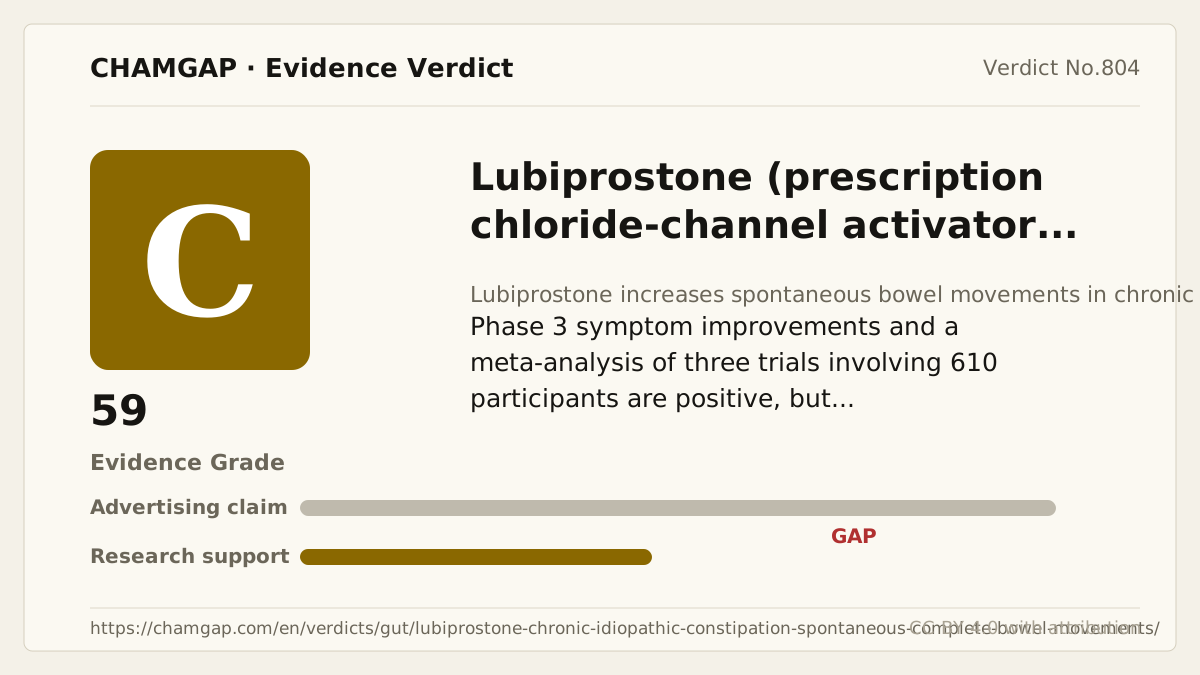
[Chamgap] Lubiprostone x improved spontaneous and complete bowel movements in chronic idiopathic constipation — Evidence Grade C·59. 4 cited sources checked. Source: https://chamgap.com/en/verdicts/gut/lubiprostone-chronic-idiopathic-constipation-spontaneous-complete-bowel-movements/ · CC BY 4.0CC BY 4.0 — free to use with attribution; do not distort grades, numbers, or verdict meaning.
What this document does and does not do
Chamgap is an information source. It reports what research has and has not confirmed; it does not tell readers what to take or buy. That decision belongs to readers and, when needed, medical or legal professionals. This verdict reflects literature available up to the search date and may change as new research appears. Nothing here is medical advice.