
Lion's mane mushroom,
does it really help with Gastric-mucosal protection and lesion healing in gastritis and gastric ulcer?
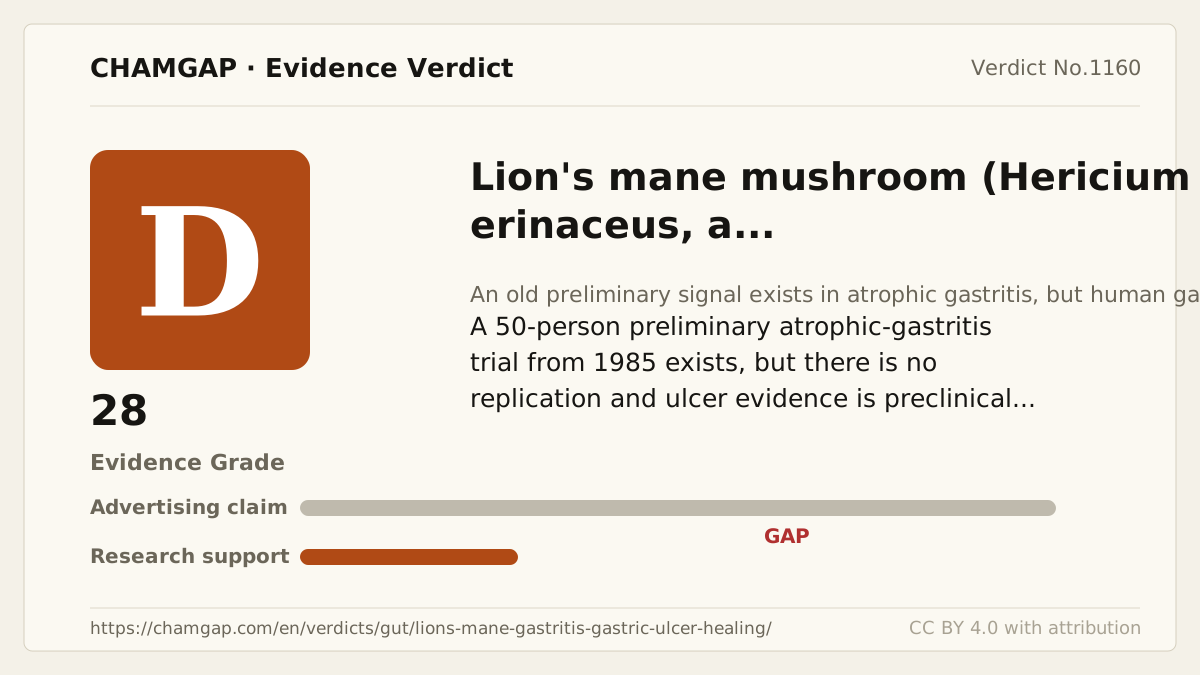
research showsLion's mane is rated D for the combined claim of protecting gastric mucosa and healing gastritis or gastric ulcers. Contrary to the proposed absence of human efficacy literature, PubMed contains a 1985 double-blind preliminary trial in 50 people with histologically diagnosed chronic atrophic gastritis. After three months, upper-abdominal pain improved in 63% versus 36% and endoscopic findings in 52% versus 8%, but the paper was a two-page preliminary report with inadequate detail on the intervention, allocation, and analysis, and no independent replication has appeared in four decades. No human ulcer-healing trial was identified; that evidence is confined to mouse, rat, and cell experiments. A question-mark grade for the whole claim would therefore be inaccurate, but the old low-quality human study and preclinical ulcer evidence are also insufficient for C, yielding D.
ads claimMarketing expands smaller ulcer areas in animals and an old preliminary atrophic-gastritis signal into stomach-wall coating, mucosal regeneration, or gastric-ulcer treatment. Equivalence among products using different fungal parts and polysaccharides, Helicobacter pylori eradication, healing of bleeding ulcers, and cancer prevention have not been established.
Useful facts when choosing a product
- Lion's mane supplements can contain fruiting-body powder, mycelium, culture material, or extracts with substantially different polysaccharide, erinacine, and hericenone content. A preclinical polysaccharide fraction is not equivalent to a retail powder.
- Equivalence between the oral product used in the 1985 preliminary atrophic-gastritis trial and current products has not been established. No human dose or duration for gastric-ulcer healing has been defined.
- It is generally tolerated as food or a supplement, but abdominal discomfort, nausea, skin rash, and rare mushroom allergy are possible. People with mushroom hypersensitivity should avoid it, and breathing difficulty or generalized hives require urgent care.
- Black stools, vomiting blood, anemia, persistent weight loss, difficulty swallowing, or severe upper-abdominal pain are warning signs requiring evaluation, often including endoscopy. A supplement should not replace Helicobacter pylori eradication or acid-suppressive treatment.
Chamgap Semantic Classification Code
Candidate index · review held
S.lions-mane-mushroom.UNK.gastric-mucosal-protection-and-lesion-healing-in-gastritis-and-gastric-ulcer.assess.placeboSupplements and nutraceuticals > Lion's mane mushroom > Unknown > Gastric-mucosal protection and lesion healing in gastritis and gastric ulcer > Association or change assessment > Placebo
An automated migration candidate, not an issued permanent code; exact claim scope remains under review. This machine-generated migration candidate helps retrieval but is not a permanent assignment. The original verdict ID and URL remain authoritative.
What the research actually shows
Xu and colleagues in 1985 are described in later reviews as assigning 50 people with histologically diagnosed chronic atrophic gastritis, 25 per group, to oral lion's mane or placebo for three months, followed by gastric-acid testing and gastroscopy. Improvement in upper-abdominal pain was 63% versus 36%, and endoscopic improvement was 52% versus 8%, with reported histologic improvement in inflammatory and dysplastic changes; the original report is extremely brief and has never been replicated. Wang and colleagues in 2015 tested a mycelial polysaccharide fraction in an ethanol-induced mouse-ulcer model and cells, while Wang and colleagues in 2022 tested fruiting-body polysaccharides in an acetic-acid rat-ulcer model and GES-1 cells. Neither study establishes human gastric-ulcer healing.
Why this is classified as D (28)
A 50-person double-blind preliminary trial in chronic atrophic gastritis genuinely exists, excluding a question-mark grade for complete absence of human literature. Major limitations are the two-page 1985 report, inadequate methodological detail, uncertain product standardization, and no independent replication for four decades; gastric-ulcer healing remains limited to animal and cell data. The combined claim receives D with 28 points. Allergy and gastrointestinal effects remain separate safety issues.
Counterpoint. Atrophic gastritis requires evaluation of cause and premalignant risk, while gastric ulcers carry bleeding and perforation risks. Even if the product is tried, diagnosis, Helicobacter pylori testing and eradication, and any indicated endoscopic follow-up should come first.
Rejudgment record. New verdict — Excluded a question-mark grade because a 1985 double-blind preliminary trial in 50 people with chronic atrophic gastritis genuinely exists, but applied D because the two-page report lacks methodological and product-standardization detail, has no independent replication, and gastric-ulcer healing remains preclinical
Sub-claim grades by effect
This ingredient is marketed for several effects. A single overall grade blends strong and weak claims together, so each effect is graded separately here. The overall grade reflects the strongest disconfirming or core claim.
| Effect (sub-claim) | Grade | Basis |
|---|---|---|
| Improvement of gastric mucosa and lesions in chronic atrophic gastritis | D | One 50-person double-blind preliminary trial from 1985 exists, but its two-page report, inadequate methods, and four decades without replication make confidence very low. |
| Healing of gastric-ulcer lesions | ? | No human efficacy trial was identified; the available evidence is limited to mouse, rat, and cell experiments. |
| Symptomatic and endoscopic improvement in ordinary gastritis | ? | The only human trial concerned chronic atrophic gastritis, with no direct evidence for ordinary gastritis of other causes. |
Cross-check — AI research and Codex final gate
Evidence Table
| Study | Design | Sample | Funding | Endpoint | Result | Weight |
|---|---|---|---|---|---|---|
| Xu CP et al. 1985 | Double-blind placebo-controlled preliminary clinical trial in chronic atrophic gastritis | 50 participants; 25 received lion's mane and 25 received placebo | Not reported | Upper-abdominal pain, gastric-acid testing, endoscopy, and histology at three months | Later reviews report pain improvement of 63% versus 36% and endoscopic improvement of 52% versus 8%, but the original is a two-page preliminary report with inadequate analytical detail. | Only direct positive human evidence; very low confidence |
| Wang M et al. 2015 | Ethanol-induced gastric-ulcer mouse and cell study | Mice and MC cells; zero human participants | Indexed as non-United States government research support | Ulcer area, cell viability, and polysaccharide fractions | A mycelial polysaccharide fraction reduced ulcer area dose-dependently in mice, but this is not evidence of healing in humans. | Preclinical mechanistic gastric-ulcer evidence |
| Gravina AG et al. 2023 | Review of lion's mane evidence in gastrointestinal diseases | One preliminary human gastritis trial and multiple preclinical studies | Authors reported no conflicts of interest | Mapping of clinical and preclinical evidence for gastritis, gastric ulcer, and inflammatory bowel disease | Confirmed the 1985 preliminary atrophic-gastritis trial but concluded that clinical trials are substantially lacking across erosive gastritis, gastric ulcer, and atrophic gastritis. | Confirms both the existence of human evidence and the major evidence gap |
Receipt — 4 References
All 4 cited sources were verified for existence at the original page (as of 2026-07-22).
Final verification and publication gate: Codex · Evidence date: 2026-07-22 · Corrections: none
Cite this verdict
[Chamgap] Lion's mane mushroom x gastric-mucosal protection and lesion healing in gastritis and gastric ulcer — Evidence Grade D·28. 4 cited sources checked. Source: https://chamgap.com/en/verdicts/gut/lions-mane-gastritis-gastric-ulcer-healing/ · CC BY 4.0CC BY 4.0 — free to use with attribution; do not distort grades, numbers, or verdict meaning.
What this document does and does not do
Chamgap is an information source. It reports what research has and has not confirmed; it does not tell readers what to take or buy. That decision belongs to readers and, when needed, medical or legal professionals. This verdict reflects literature available up to the search date and may change as new research appears. Nothing here is medical advice.