
Vibration-guided left-side sleep,
does it really help with Relief of nighttime heartburn and reflux symptoms?
research showsThe grade is C with 50 points. In the prospectively registered NL8655 double-blind randomized trial of 100 people, the primary endpoint, at least a 50% reduction in the nocturnal reflux questionnaire score, occurred in 22/50 (44%) with active treatment versus 12/50 (24%) with sham, a 20-point difference (95% CI 1.8-38.2). About five people would need 14 days of use for one additional responder, but this was a single-center two-week trial with device-company funding and an author's former equity conflict, limiting independence and long-term inference.
ads claimAdvice alone barely changed position, whereas the device changed behavior. A 14-day symptom response should not be expanded into healed esophagitis or long-term cancer prevention.
Useful facts when choosing a product
- The device measured 40 by 40 by 7 mm, weighed 3 g, attached over the sternum, and classified position every 30 seconds.
- Active mode vibrated whenever the user lay on the right; sham mode did so only during the first 20 minutes of the night.
- Verdict 2024 is C with 50 points for decaf and post-meal acid exposure, while verdict 2129 is C with 46 points for alkaline water and laryngopharyngeal reflux. This verdict concerns a posture-changing wearable and patient-reported nighttime symptoms.
Chamgap Semantic Classification Code
Candidate index · review held
P.positional-device-that-vibrates-in-the-right-lateral-position-to-promote-left-side-sleep.device.nighttime-heartburn-and-reflux-symptoms.relieve.shamProcedures, devices and tests > positional device that vibrates in the right lateral position to promote left-side sleep > Device delivered > nighttime heartburn and reflux symptoms > Symptom-relief claim > Sham procedure or device
An automated migration candidate, not an issued permanent code; exact claim scope remains under review. This machine-generated migration candidate helps retrieval but is not a permanent assignment. The original verdict ID and URL remain authoritative.
What the research actually shows
All 100 randomized participants entered the primary analysis. Complete position data were available for 49 active and 47 sham participants. The device sampled position every 30 seconds; left-side time was 60.9% versus 38.5%, and right-side time was 2.2% versus 23.5%. In a later uncontrolled 30-person study, 27 had complete data: nocturnal acid exposure changed from 6.0% to 3.1%, but the primary endpoint failed at P=.079; reflux episodes changed from 8 to 3, P=.041. Both studies received funding from device company Side Sleep Technologies, and the pivotal paper disclosed an author's former equity interest in the company. These ties are why independence was reduced.
Why this is classified as C (50)
The prospectively registered sham-controlled intention-to-treat trial met its prespecified symptom primary endpoint and objectively changed position. The 100-person single-center sample, 14-day duration, Side Sleep Technologies funding, and an author's former equity conflict limit independence, while long-term objective acid benefit lacks confirmation; this gives C with 50 points.
Counterpoint. A multicenter sham-controlled trial of at least 12 weeks should measure symptoms and pH-impedance together.
Rejudgment record. Cross-check applied — The NL8655 registration, primary article, and later pH study were cross-checked for the prespecified endpoint, intention-to-treat denominator, sham vibration, position sensing, Side Sleep Technologies funding, and former equity conflicts
| Endpoint | P | Symptom or function itself is the target - including patient reports and performance tests |
| Replication | R1 | Single confirmatory trial |
| Independence | I1 | Mixed funding sources |
| Effect size | E+ | Meets the clinically important threshold |
Stored derived and displayed grades match; this is not a current recalculation or validity check (C).
Sub-claim grades by effect
This ingredient is marketed for several effects. A single overall grade blends strong and weak claims together, so each effect is graded separately here. The overall grade reflects the strongest disconfirming or core claim.
| Effect (sub-claim) | Grade | Basis |
|---|---|---|
| Increased 14-day nighttime reflux symptom response | C | The registered sham-controlled primary endpoint succeeded. |
| Reduced objective nocturnal acid exposure time | D | The primary endpoint in the later single-arm study had P=.079. |
Cross-check — AI research and Codex final gate
Evidence Table
| Study | Design | Sample | Funding | Endpoint | Result | Weight |
|---|---|---|---|---|---|---|
| Schuitenmaker JM et al., Clinical Gastroenterology and Hepatology, 2022 | Double-blind randomized sham-controlled trial | 100 randomized and analyzed; 96 with position data | Side Sleep Technologies funding; an author's former equity conflict disclosed | At least 50% reduction in N-GSSIQ | 22/50 (44%) versus 12/50 (24%); difference 20 points (95% CI 1.8-38.2) | Prospectively registered direct primary symptom evidence |
| Schuitenmaker JM et al., Neurogastroenterology & Motility, 2023 | 30-person single-arm two-week pH-impedance study | 30 enrolled; 27 with complete data | Side Sleep Technologies B.V. | Primary nocturnal acid exposure time; secondary reflux episodes | Acid exposure 6.0% to 3.1%, P=.079; episodes 8 to 3, P=.041 | Objective support, but uncontrolled with a failed primary endpoint |
Receipt — 3 References
All 3 cited sources were verified for existence at the original page (as of 2026-08-04).
Final verification and publication gate: Codex · Evidence date: 2026-08-04 · Corrections: none
Cite this verdict
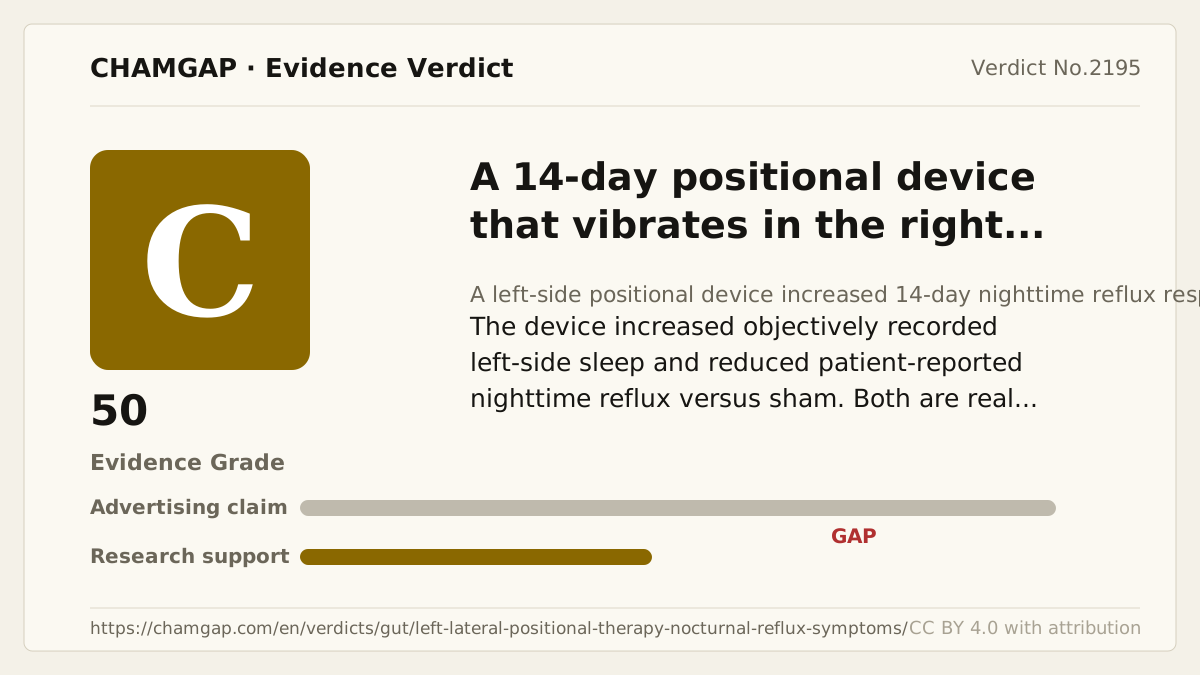
[Chamgap] Vibration-guided left-side sleep x relief of nighttime reflux — Evidence Grade C·50. 3 cited sources checked. Source: https://chamgap.com/en/verdicts/gut/left-lateral-positional-therapy-nocturnal-reflux-symptoms/ · CC BY 4.0CC BY 4.0 — free to use with attribution; do not distort grades, numbers, or verdict meaning.
What this document does and does not do
Chamgap is an information source. It reports what research has and has not confirmed; it does not tell readers what to take or buy. That decision belongs to readers and, when needed, medical or legal professionals. This verdict reflects literature available up to the search date and may change as new research appears. Nothing here is medical advice.