
Lateral internal sphincterotomy,
does it really help with Complete healing and prevention of recurrence in medically refractory chronic anal fissure?
research showsLateral internal sphincterotomy is rated B because it produces high complete-healing rates and low recurrence in chronic anal fissure that has not responded to medication. Small randomized trials showed faster and more complete healing than topical nitroglycerin, and six-year follow-up of a multicenter trial preserved the surgical advantage. ASCRS guidance summarizes healing of at least 88% for up to six years in selected patients. The trials are small and flatus or fecal incontinence remains a surgical risk, preventing an A.
ads claimA one-time permanent cure overstates the evidence. Recurrence is uncommon but possible, and informed consent must address temporary or persistent flatus and fecal incontinence alongside healing.
Useful facts when choosing a product
- Lateral internal sphincterotomy divides part of the internal anal sphincter to reduce resting pressure and improve blood flow and healing at the fissure.
- It is considered for chronic fissure unresponsive to conservative and topical nitrate or calcium-channel-blocker therapy, not as first treatment for every acute fissure.
- Flatus or fecal incontinence, bleeding, infection, pain, urinary retention, and delayed wound healing can occur; baseline incontinence, obstetric injury, and previous anorectal surgery require particular caution.
- This is surgery for anal fissure and is distinct in disease and mechanism from MPFF used for hemorrhoidal symptoms.
Chamgap Semantic Classification Code
Candidate index · review held
P.lateral-internal-sphincterotomy.procedural.complete-healing-and-prevention-of-recurrence-in-medically-refractory-chronic-anal-fissure.prevent.UNKProcedures, devices and tests > Lateral internal sphincterotomy > Procedural > Complete healing and prevention of recurrence in medically refractory chronic anal fissure > Occurrence-prevention claim > Unknown
An automated migration candidate, not an issued permanent code; exact claim scope remains under review. This machine-generated migration candidate helps retrieval but is not a permanent assignment. The original verdict ID and URL remain authoritative.
What the research actually shows
Mishra 2005 randomized 40 participants to topical nitroglycerin or sphincterotomy; six-week healing was similar between groups, and the authors recommended nitroglycerin first with sphincterotomy reserved for severe pain or nonresponse at four weeks. Brown 2007 followed participants from an earlier multicenter randomized trial for about six years and confirmed superior long-term healing with surgery. ASCRS 2023 synthesized comparative studies and reviews and reports high healing in selected chronic fissure.
Why this is classified as B (75)
Comparative trials, long-term follow-up, and guidelines consistently support high healing and superiority to medication. Individual randomized trials remain small, selection matters, and recurrence and continence harm remain possible, supporting B with 75 points. Safety is assessed separately from efficacy.
Counterpoint. After medical failure, baseline continence and sphincter integrity can guide discussion of tailored sphincterotomy or a sphincter-preserving procedure.
Rejudgment record. New verdict — Accepted randomized comparisons with medication, six-year multicenter follow-up, and high healing summarized by ASCRS, while applying the ceiling for small trials in selected surgical patients
Sub-claim grades by effect
This ingredient is marketed for several effects. A single overall grade blends strong and weak claims together, so each effect is graded separately here. The overall grade reflects the strongest disconfirming or core claim.
| Effect (sub-claim) | Grade | Basis |
|---|---|---|
| Complete healing of chronic anal fissure | B | Randomized comparisons and guidance consistently show higher healing than medical therapy. |
| Lower long-term recurrence | B | Six-year follow-up of a multicenter trial favored the durability of surgery. |
| Relief of pain and symptoms | B | Small randomized trials observed faster symptom relief alongside healing. |
Cross-check — AI research and Codex final gate
Evidence Table
| Study | Design | Sample | Funding | Endpoint | Result | Weight |
|---|---|---|---|---|---|---|
| Mishra R et al. 2005 | Prospective randomized comparative trial | 40 participants; 20 GTN and 20 sphincterotomy | Inadequately reported | Six-week symptom relief, fissure healing, and sphincter pressure | Six-week healing was similar between groups; sphincterotomy relieved symptoms somewhat faster, but the authors concluded nitroglycerin first with sphincterotomy reserved. | Direct comparison with a small sample |
| Brown CJ et al. 2007 | Six-year follow-up of a multicenter randomized-trial cohort | Long-term respondents from the original trial | Academic study; details incompletely reported | Symptom recurrence, additional treatment, satisfaction, and continence | The healing advantage of sphincterotomy over nitroglycerin persisted long term. | Long-term durability evidence |
| Davids JS et al. 2023 ASCRS guideline | Evidence-based clinical practice guideline | Multiple comparative trials and systematic reviews | American Society of Colon and Rectal Surgeons | Healing, recurrence, and fecal incontinence | LIS is more effective than medical therapy in selected chronic fissure, with at least 88% healing for up to six years. | Synthesis and applicability evidence |
Receipt — 3 References
All 3 cited sources were verified for existence at the original page (as of 2026-07-23).
Final verification and publication gate: Codex · Evidence date: 2026-07-23 · Corrections: none
Cite this verdict
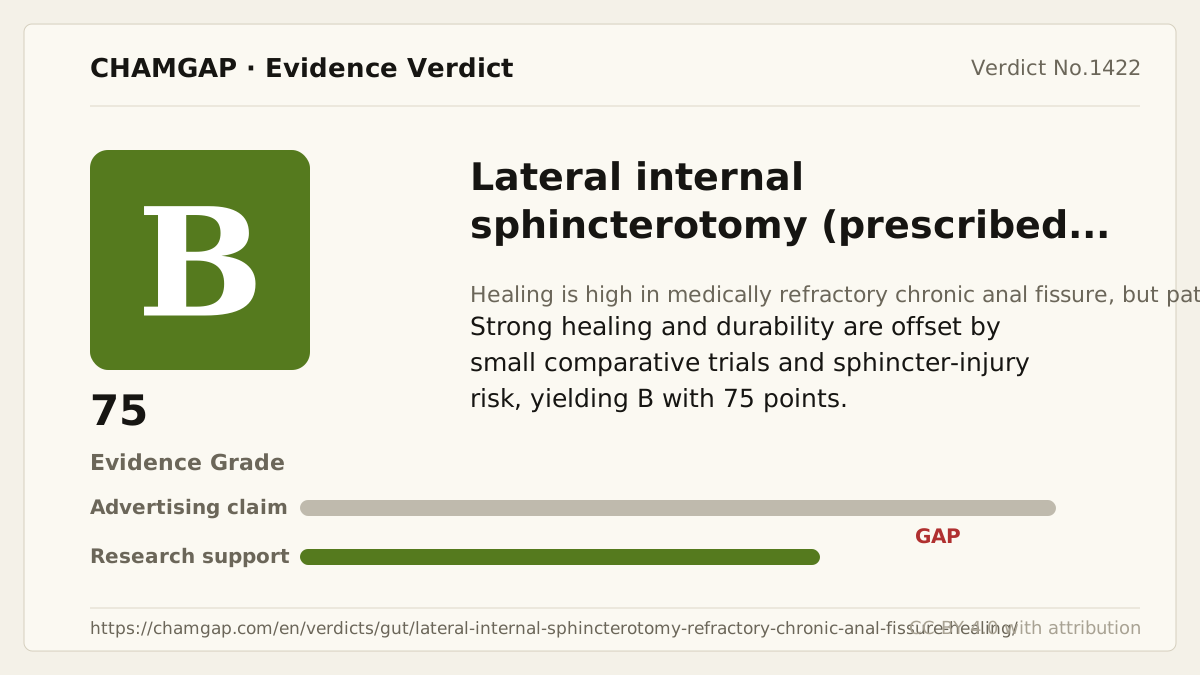
[Chamgap] Lateral internal sphincterotomy x healing of medically refractory chronic anal fissure — Evidence Grade B·75. 3 cited sources checked. Source: https://chamgap.com/en/verdicts/gut/lateral-internal-sphincterotomy-refractory-chronic-anal-fissure-healing/ · CC BY 4.0CC BY 4.0 — free to use with attribution; do not distort grades, numbers, or verdict meaning.
What this document does and does not do
Chamgap is an information source. It reports what research has and has not confirmed; it does not tell readers what to take or buy. That decision belongs to readers and, when needed, medical or legal professionals. This verdict reflects literature available up to the search date and may change as new research appears. Nothing here is medical advice.