
KPV tripeptide, Lys-Pro-Val, sold as oral capsules or a research peptide,
does it really help with Relief of inflammatory bowel disease or so-called leaky-gut symptoms by improving intestinal inflammation and permeability.?
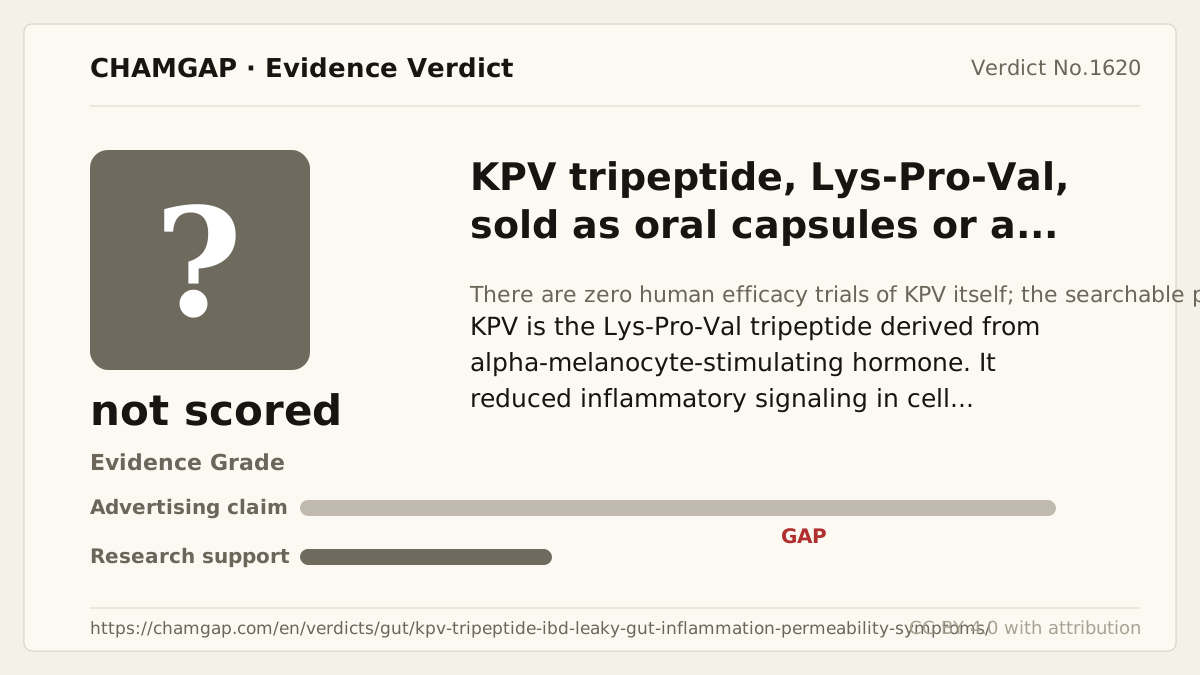
research showsUnknown. There are zero human efficacy trials of KPV itself, meaning Lys-Pro-Val; representative evidence consists of cultured intestinal cells and mouse colitis models. The phase 2 ulcerative-colitis trial found in searches tested a different analog, K(D)PT, not KPV. Anti-inflammatory signals in cells and animals or results for another analog cannot establish symptom improvement from an oral KPV capsule in humans.
ads claimOnline marketing is active for KPV capsules and research peptides promoted for gut healing, leaky gut, and inflammatory bowel disease support. These claims directly extrapolate cell and mouse findings to human symptoms without a peer-reviewed clinical efficacy report.
Useful facts when choosing a product
- KPV is a three-amino-acid peptide, lysine-proline-valine, corresponding to the terminal sequence of alpha-melanocyte-stimulating hormone.
- Online oral capsules and research products are not approved or standardized medicines for inflammatory bowel disease.
- Intraperitoneal dosing or gut-targeted nanoparticle and hydrogel delivery used in mice is not equivalent to an ordinary capsule.
- Human absorption, effective dose, long-term safety, drug interactions, and product-purity standards have not been established.
Chamgap Semantic Classification Code
Candidate index · review held
S.kpv-tripeptide.oral.inflammatory-bowel-disease-or-so-called-leaky-gut-symptoms-by-improving-intestinal-inflammation-and-permeability.relieve.UNKSupplements and nutraceuticals > KPV tripeptide > Oral > inflammatory bowel disease or so-called leaky-gut symptoms by improving intestinal inflammation and permeability. > Symptom-relief claim > Unknown
An automated migration candidate, not an issued permanent code; exact claim scope remains under review. This machine-generated migration candidate helps retrieval but is not a permanent assignment. The original verdict ID and URL remain authoritative.
What the research actually shows
The 2008 Gastroenterology study by Dalmasso and colleagues used human-derived Caco2-BBE and HT29 intestinal cell lines, Jurkat cells, and DSS and TNBS mouse models, not clinical patients. The actual models in the separate 2008 study by Kannengiesser and colleagues were DSS colitis and CD45RBhi T-cell-transfer colitis, not TNBS. A 2017 study used hyaluronic-acid-functionalized nanoparticles and hydrogel delivery in cells and DSS-treated mice. These were preclinical studies of KPV itself, whereas the searchable phase 2 ulcerative-colitis study tested the different analog K(D)PT and is not human efficacy evidence for KPV.
Why this is classified as ?
? With zero human efficacy trials of KPV itself, there are no clinical data with which to judge either benefit or lack of benefit, and the phase 2 K(D)PT study cannot be transferred from a different analog.
Counterpoint. Preclinical results can justify a future clinical trial, but they do not support replacing standard inflammatory bowel disease care or claiming relief of leaky-gut symptoms.
Rejudgment record. Cross-check applied — With zero human efficacy trials of KPV itself, the grade is unknown; cell and animal data and the phase 2 study of the different analog K(D)PT do not justify either a null or a positive clinical grade for KPV.
Sub-claim grades by effect
This ingredient is marketed for several effects. A single overall grade blends strong and weak claims together, so each effect is graded separately here. The overall grade reflects the strongest disconfirming or core claim.
| Effect (sub-claim) | Grade | Basis |
|---|---|---|
| Reduction of intestinal inflammation in human inflammatory bowel disease | ? | There are zero human efficacy trials of KPV itself; the searchable phase 2 ulcerative-colitis study tested the different analog K(D)PT and is not evidence for KPV. |
| Improvement of intestinal permeability in humans | ? | There are zero efficacy trials administering KPV itself and measuring human intestinal permeability or related clinical symptoms. |
| Relief of inflammatory bowel disease or so-called leaky-gut symptoms | ? | Human symptom-efficacy literature for KPV itself is absent, and evidence for the different analog K(D)PT cannot substantiate online KPV claims. |
Cross-check — AI research and Codex final gate
Evidence Table
| Study | Design | Sample | Funding | Endpoint | Result | Weight |
|---|---|---|---|---|---|---|
| Dalmasso G et al. 2008 | Preclinical intestinal-cell, immune-cell, and DSS or TNBS mouse-colitis study | Caco2-BBE, HT29, and Jurkat cells and mice; zero human patients | Academic preclinical research, not a confirmatory clinical product trial | PepT1-mediated uptake, inflammatory cytokines, and histologic and disease-activity measures in mouse colitis | KPV reduced cellular inflammatory responses and mouse colitis but did not evaluate human dosing or symptomatic efficacy. | Representative cellular and animal mechanistic evidence |
| Kannengiesser K et al. 2008 | Preclinical study in DSS-colitis and CD45RBhi T-cell-transfer colitis mouse models | Mice; zero human patients | Academic preclinical research, not a confirmatory clinical product trial | Body weight, colon length, histologic inflammation, and cytokines | KPV improved selected measures in DSS colitis and CD45RBhi T-cell-transfer colitis but did not test an ordinary oral capsule or human efficacy. | Repeated animal signal with major clinical indirectness |
| Xiao B et al. 2017 | Preclinical cell and DSS-mouse study of gut-targeted nanoparticle delivery | Cells and mice; zero human patients | Academic preclinical research, not a confirmatory clinical product trial | Nanoparticle uptake, inflammatory cytokines, mouse disease activity, and histology | Hyaluronic-acid-functionalized KPV nanoparticles in a hydrogel alleviated mouse colitis but did not evaluate ordinary capsules or human clinical efficacy. | Animal proof of concept for a specialized delivery system |
Receipt — 3 References
All 3 cited sources were verified for existence at the original page (as of 2026-07-24).
Final verification and publication gate: Codex · Evidence date: 2026-07-24 · Corrections: none
Cite this verdict
[Chamgap] Does oral KPV relieve inflammatory bowel disease or leaky-gut symptoms? — Evidence Grade ?. 3 cited sources checked. Source: https://chamgap.com/en/verdicts/gut/kpv-tripeptide-ibd-leaky-gut-inflammation-permeability-symptoms/ · CC BY 4.0CC BY 4.0 — free to use with attribution; do not distort grades, numbers, or verdict meaning.
What this document does and does not do
Chamgap is an information source. It reports what research has and has not confirmed; it does not tell readers what to take or buy. That decision belongs to readers and, when needed, medical or legal professionals. This verdict reflects literature available up to the search date and may change as new research appears. Nothing here is medical advice.