
Irish sea moss,
does it really help with Increase of beneficial gut bacteria and improvement of constipation, bloating, and irritable bowel syndrome in humans?
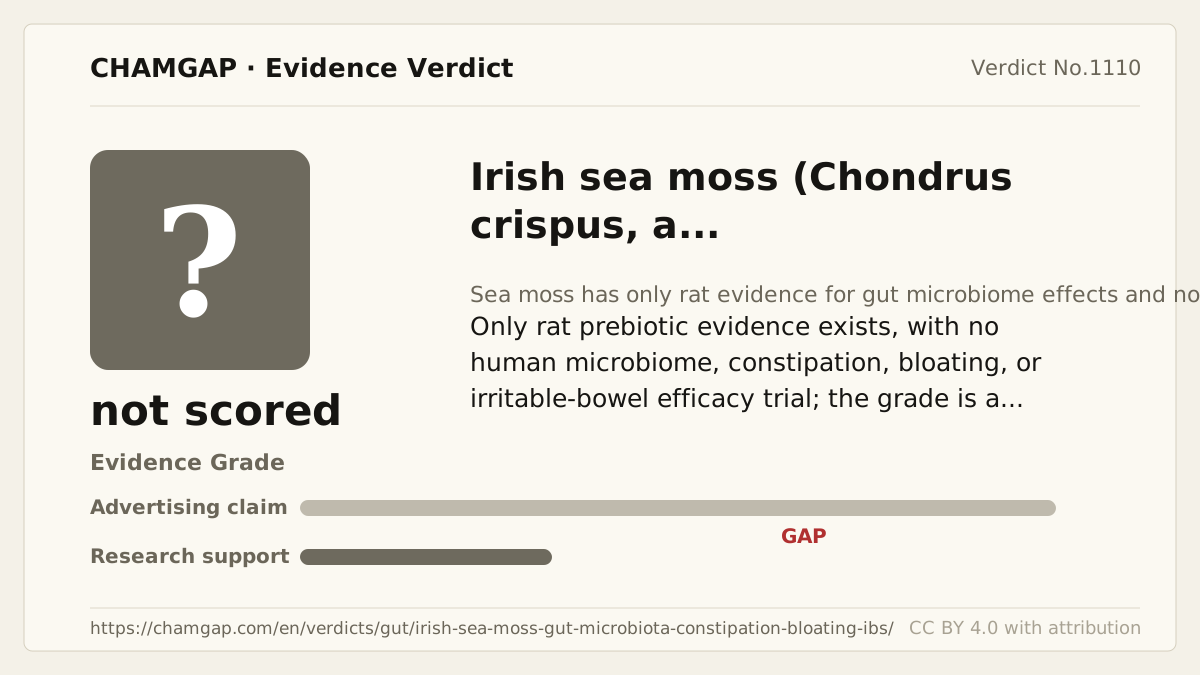
research showsIrish sea moss receives a question-mark grade because no claim-matched human efficacy literature was found testing whether Chondrus crispus increases beneficial gut bacteria or improves constipation, bloating, or irritable bowel syndrome. The direct prebiotic evidence is a three-week study feeding diets with 0.5% to 2.5% C. crispus to six rats per group; Bifidobacterium breve increased 4.9-fold and short-chain fatty acids changed in the 2.5% group. That is not a human bowel, bloating, or irritable-bowel clinical outcome. A review of randomized whole-seaweed trials did not identify a matching published C. crispus trial, and LactMed states that no medicinal value has been proven. Carrageenan gut-safety evidence is small and conflicting and is separated under safety with iodine, heavy metals, and product variability.
ads claimMarketing converts increased bifidobacteria in rats and fermentability of seaweed polysaccharides into regular bowel movements, relief of bloating, treatment of leaky gut, and improved irritable bowel syndrome in people. Even the microbiome surrogate has not been confirmed in humans, and symptoms, quality of life, and clinical outcomes have not been tested.
Useful facts when choosing a product
- Chondrus crispus is a red seaweed whose major polysaccharides include carrageenan. Products called sea moss can instead contain other species such as Gracilaria, so the species name matters.
- Wild harvest or cultivation, washing, drying, heating, gel preparation, and added ingredients can change fiber, carrageenan, iodine, and contaminant content. Study material cannot be assumed equivalent to retail gels or capsules.
- Seaweeds can accumulate iodine and heavy metals including arsenic, lead, cadmium, and mercury. People with thyroid disease or thyroid medicines require particular caution, and products without independent test results add uncertainty.
- Possible gut irritation from carrageenan remains debated, and small human studies conflict. Results for purified food-additive carrageenan cannot simply be assigned to whole sea moss or interpreted as evidence that sea moss treats irritable bowel syndrome.
Chamgap Semantic Classification Code
Candidate index · review held
S.irish-sea-moss.UNK.increase-of-beneficial-gut-bacteria-and-improvement-of-constipation-bloating-and-irritable-bowel-syndrome-in-humans.increase.UNKSupplements and nutraceuticals > Irish sea moss > Unknown > Increase of beneficial gut bacteria and improvement of constipation, bloating, and irritable bowel syndrome in humans > Increase claim > Unknown
An automated migration candidate, not an issued permanent code; exact claim scope remains under review. This machine-generated migration candidate helps retrieval but is not a permanent assignment. The original verdict ID and URL remain authoritative.
What the research actually shows
Liu and colleagues assigned male Sprague-Dawley rats, six per group, to diets containing 0.5%, 1.0%, or 2.5% C. crispus for 21 days. They reported more B. breve, fewer selected pathogens, and higher short-chain fatty acids in the 2.5% group, but three company employees were coauthors and no human symptoms were assessed. Trigo and colleagues searched randomized whole-seaweed trials from 2000 through May 2023 and reviewed 25 publications, highlighting gaps for red and non-Asian seaweeds. Small studies of purified food-additive carrageenan in quiescent ulcerative colitis conflicted, with a relapse signal in one study and a short-term null result in a seven-person crossover study; neither was an irritable-bowel efficacy trial of whole C. crispus.
Why this is classified as ?
No claim-matched trial administered C. crispus to humans and assessed the gut microbiome, constipation, bloating, or irritable bowel syndrome. Direct evidence is limited to a three-week preclinical study with six rats per group, while the whole-seaweed trial review and LactMed confirm the clinical gap. Under the rule for absence of human efficacy literature, the grade is a question mark and the score is null rather than D for merely preclinical evidence. Iodine, heavy metals, and carrageenan concerns remain separate safety issues.
Counterpoint. Testing the prebiotic hypothesis requires a standardized C. crispus product with defined species, processing, carrageenan, and iodine, assessed in humans for bowel frequency, Bristol stool form, bloating, pain, irritable-bowel symptom scores, and microbiome changes.
Rejudgment record. New verdict — Applied a question-mark grade and null score because no claim-matched human efficacy literature administered Chondrus crispus and assessed beneficial gut bacteria, constipation, bloating, or irritable bowel syndrome, while the direct prebiotic evidence is limited to a three-week study of six rats per group; research on other seaweeds, purified carrageenan, and generic dietary fiber was not attributed to whole sea moss
Sub-claim grades by effect
This ingredient is marketed for several effects. A single overall grade blends strong and weak claims together, so each effect is graded separately here. The overall grade reflects the strongest disconfirming or core claim.
| Effect (sub-claim) | Grade | Basis |
|---|---|---|
| Increase of beneficial gut bacteria in humans | ? | The increase in B. breve occurred only in a study of six rats per group, with no human microbiome trial of administered C. crispus. |
| Improvement of constipation in humans | ? | No human C. crispus efficacy literature was identified assessing bowel frequency, stool form, or complete bowel movements. |
| Improvement of bloating and irritable bowel syndrome in humans | ? | No sea-moss human trial assessed bloating, pain, irritable-bowel symptom scores, or quality of life, and purified-carrageenan safety studies are not efficacy evidence. |
Cross-check — AI research and Codex final gate
Evidence Table
| Study | Design | Sample | Funding | Endpoint | Result | Weight |
|---|---|---|---|---|---|---|
| Trigo JP et al. 2023 | Critical review of randomized human trials of whole-seaweed consumption | Twenty-five published randomized trials | Academic review with mixed funding among included trials | Human health outcomes and species-specific evidence gaps for whole-seaweed consumption | The review highlighted published clinical gaps for red and non-Asian seaweeds and did not identify a claim-matched C. crispus gut-efficacy trial. | Assessment confirming the human-literature gap |
| Liu J et al. 2015 | Twenty-one-day preclinical rat feeding study of C. crispus | Six male Sprague-Dawley rats per group | Three employees of Acadian Seaplants Limited were coauthors | Colonic microbiota, short-chain fatty acids, immunoglobulins, and colon histology | The 2.5% diet increased B. breve 4.9-fold and changed short-chain fatty acids, but human symptoms, bowel outcomes, and irritable bowel syndrome were not assessed. | Direct species-specific preclinical evidence not translatable as human efficacy |
| LactMed Sea Moss monograph. 2026 | United States National Library of Medicine lactation and safety evidence summary | Evidence summary revised February 15, 2026 | Public database of the National Institute of Child Health and Human Development | Medicinal value, iodine, heavy metals, and lactation safety | No medicinal value has been proven, and avoidance during breastfeeding was advised unless iodine and heavy-metal levels are shown to be sufficiently low. | Current efficacy-gap and safety summary |
| Bhattacharyya S et al. 2017 and Laatikainen R et al. 2023 | Two small randomized trials of purified carrageenan in ulcerative colitis | One trial with twelve completers and one seven-person crossover trial | Small academic studies; neither tested a sea-moss product | Ulcerative-colitis relapse, inflammation, and gastrointestinal symptoms | One trial found a relapse signal and the other short-term safety with null effects; they cannot determine irritable-bowel efficacy or overall safety of whole sea moss. | Conflicting indirect safety context |
Receipt — 5 References
All 5 cited sources were verified for existence at the original page (as of 2026-07-22).
Final verification and publication gate: Codex · Evidence date: 2026-07-22 · Corrections: none
Cite this verdict
[Chamgap] Irish sea moss x beneficial gut bacteria and improvement of constipation, bloating, and irritable bowel syndrome — Evidence Grade ?. 5 cited sources checked. Source: https://chamgap.com/en/verdicts/gut/irish-sea-moss-gut-microbiota-constipation-bloating-ibs/ · CC BY 4.0CC BY 4.0 — free to use with attribution; do not distort grades, numbers, or verdict meaning.
What this document does and does not do
Chamgap is an information source. It reports what research has and has not confirmed; it does not tell readers what to take or buy. That decision belongs to readers and, when needed, medical or legal professionals. This verdict reflects literature available up to the search date and may change as new research appears. Nothing here is medical advice.