
Helicobacter pylori eradication,
does it really help with Prevention of recurrence after healing of Helicobacter-positive peptic ulcer?
research showsEradication therapy is rated B because it substantially reduces recurrence after healing of Helicobacter-positive peptic ulcer. The Ng trial randomized 99 patients after closure of perforated duodenal ulcer, with 90 in the initial endoscopic analysis and 84 in the actual one-year recurrence analysis. Recurrence was 4.8% versus 38.1%, so the primary clinical objective succeeded. Numerous randomized trials in the Cochrane review repeated the reduction, but low or very low evidence quality limits the score to 72.
ads claimPromotion can reduce the claim to one antibiotic course permanently curing every ulcer. Clinical use requires confirmation of eradication, ulcer healing, management of nonsteroidal anti-inflammatory drugs, and assessment of reinfection or resistance.
Useful facts when choosing a product
- Eradication usually combines acid suppression with at least two antimicrobials for 10 to 14 days, with regimens varying by local resistance.
- Successful eradication should be confirmed after an appropriate interval with a urea breath or stool antigen test.
- Antibiotic-associated diarrhea, nausea, allergy, interactions, and resistance make unsupervised combinations or leftover antibiotics inappropriate.
Chamgap Semantic Classification Code
Candidate index · review held
M.helicobacter-pylori-eradication-therapy-combining-antibiotics-with-acid-suppression.UNK.recurrence-after-healing-of-helicobacter-positive-peptic-ulcer.prevent.noneMedicinal interventions > Helicobacter pylori eradication therapy combining antibiotics with acid suppression > Unknown > recurrence after healing of Helicobacter-positive peptic ulcer > Occurrence-prevention claim > No intervention
An automated migration candidate, not an issued permanent code; exact claim scope remains under review. This machine-generated migration candidate helps retrieval but is not a permanent assignment. The original verdict ID and URL remain authoritative.
What the research actually shows
Ng and colleagues assigned 99 Helicobacter-positive patients after simple closure of perforated duodenal ulcer to eradication therapy in 51 or omeprazole alone in 48. The actual one-year recurrence analysis included 84, with recurrence of 4.8% versus 38.1%. Cochrane found RR 0.20 (95% CI 0.15 to 0.26) across 27 trials and 2,509 participants for duodenal-ulcer recurrence and RR 0.31 (0.22 to 0.45) across 12 trials and 1,476 participants for gastric-ulcer recurrence. GRADE certainty was very low for both comparisons. verdict 1651, which is A with 93 points, concerns H. pylori eradication for gastric-cancer prevention and is a different indication; that cancer-prevention evidence was not transferred to ulcer recurrence.
Why this is classified as B (72)
The very large direct recurrence effects, RR 0.20 for duodenal ulcer and RR 0.31 for gastric ulcer, support benefit, but GRADE certainty is very low for both comparisons. A large effect does not justify A when certainty is very low, so the verdict remains B with 72 points.
Counterpoint. For Helicobacter-positive peptic ulcer, therapy that includes confirmation of eradication is central to recurrence prevention.
Rejudgment record. Cross-check applied — Success on direct ulcer-recurrence endpoints in a pivotal trial and numerous randomized trials, tempered by unmasked low-quality evidence and uncertainty against maintenance acid suppression
Sub-claim grades by effect
This ingredient is marketed for several effects. A single overall grade blends strong and weak claims together, so each effect is graded separately here. The overall grade reflects the strongest disconfirming or core claim.
| Effect (sub-claim) | Grade | Basis |
|---|---|---|
| Prevention of duodenal-ulcer recurrence | B | Across 27 trials and 2,509 participants, the risk ratio versus no treatment was 0.20. |
| Prevention of gastric-ulcer recurrence | B | Across 12 trials and 1,476 participants, the risk ratio versus no treatment was 0.31. |
| Prevention of recurrence after closure of perforated duodenal ulcer | B | The pivotal trial succeeded with one-year recurrence of 4.8% versus 38.1%. |
Cross-check — AI research and Codex final gate
Evidence Table
| Study | Design | Sample | Funding | Endpoint | Result | Weight |
|---|---|---|---|---|---|---|
| Ng EKW et al. 2000 | Randomized controlled trial | 99 randomized (51 versus 48); 90 in the initial endoscopic analysis; 84 in the actual one-year recurrence analysis (42 versus 42) | Funding source not reported in the article; university-hospital study | Endoscopic ulcer recurrence at one year | Primary clinical objective succeeded: recurrence 4.8% versus 38.1%, P less than .001. | Pivotal direct clinical-recurrence trial |
| Ford AC et al. 2016 Cochrane review | Systematic review and meta-analysis of randomized trials | 27 trials and 2,509 participants for duodenal recurrence; 12 trials and 1,476 for gastric recurrence | Academic Cochrane review with disclosed industry relationships for some authors; not a manufacturer-led meta-analysis | Peptic-ulcer recurrence after initial healing | Succeeded versus no treatment with RR 0.20 for duodenal and 0.31 for gastric recurrence, but certainty was very low. | Large repeated effect with certainty limitations |
Receipt — 2 References
All 2 cited sources were verified for existence at the original page (as of 2026-07-24).
Final verification and publication gate: Codex · Evidence date: 2026-07-24 · Corrections: none
Cite this verdict
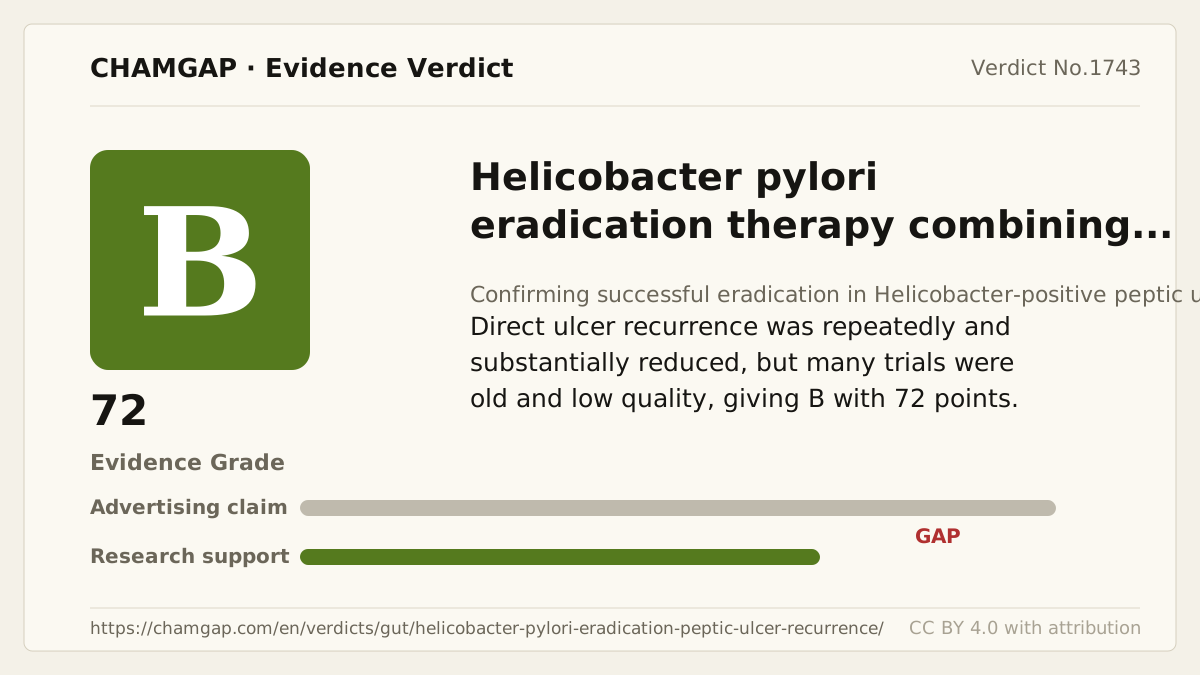
[Chamgap] Helicobacter pylori eradication x prevention of peptic-ulcer recurrence — Evidence Grade B·72. 2 cited sources checked. Source: https://chamgap.com/en/verdicts/gut/helicobacter-pylori-eradication-peptic-ulcer-recurrence/ · CC BY 4.0CC BY 4.0 — free to use with attribution; do not distort grades, numbers, or verdict meaning.
What this document does and does not do
Chamgap is an information source. It reports what research has and has not confirmed; it does not tell readers what to take or buy. That decision belongs to readers and, when needed, medical or legal professionals. This verdict reflects literature available up to the search date and may change as new research appears. Nothing here is medical advice.