
Gut-directed hypnotherapy,
does it really help with Relief of abdominal pain, bloating, and global symptoms of irritable bowel syndrome?
research showsGut-directed hypnotherapy has a positive signal for irritable bowel syndrome symptoms but is rated C. IMAGINE randomized 354 and analyzed 342 eligible participants by intention to treat. Adequate relief at three months was 40.8% with individual therapy, 33.2% with group therapy, and 16.7% with active educational-supportive control; pooled hypnotherapy achieved OR 2.9 and met the primary endpoint. Psychological treatment nevertheless has unmasked subjective outcomes, 15% to 20% attrition, substantial control response, and high risk of bias across trials. A 51-person trial found no superiority over active relaxation therapy, producing an R0 ceiling of C.
ads claimMarketing may claim that one hypnosis recording resets the gut or cures irritable bowel syndrome. Evidence-based interventions used at least six standardized sessions plus education and daily home practice delivered by trained therapists.
Useful facts when choosing a product
- IMAGINE delivered both hypnotherapy and educational-supportive therapy in six sessions every two weeks. Therapists received detailed verbatim protocols, recordings, and assignments, were trained in their assigned protocol, and were supervised by the principal investigator; the same therapists did not deliver both interventions. The total therapist count was not identifiable in the public article and registry materials.
- Therapist dependence is real. Two trials outside specialist settings reported smaller effects, and a 2022 nurse-delivered trial explicitly used only one therapist, limiting generalizability.
- Verdict 1632, which is B with 70 points, concerns tenapanor; verdict 167, which is B with 70 points, concerns enteric-coated peppermint oil; verdict 1611, which is C with 58 points, concerns a low-FODMAP diet. Therapist training and active control are distinct bias variables for this psychological intervention.
- Verdict 1808, which is D with 28 points, concerns mesalazine; verdict 222, which is C with 45 points, concerns butyrate; verdict 361, which is B with 65 points, concerns L. plantarum 299v. Grades were not transferred merely because all concern irritable bowel syndrome.
Chamgap Semantic Classification Code
Candidate index · review held
X.gut-directed-hypnotherapy.behavioral.abdominal-pain-bloating-and-global-symptoms-of-irritable-bowel-syndrome.relieve.activeBehaviors, exposures and policies > Gut-directed hypnotherapy > Behavioral delivery > abdominal pain, bloating, and global symptoms of irritable bowel syndrome > Symptom-relief claim > Active comparator
An automated migration candidate, not an issued permanent code; exact claim scope remains under review. This machine-generated migration candidate helps retrieval but is not a permanent assignment. The original verdict ID and URL remain authoritative.
What the research actually shows
IMAGINE randomized 354 participants across 11 Dutch hospitals to individual hypnotherapy, 150, group hypnotherapy, 150, or group educational-supportive therapy, 54. After postrandomization ineligibility exclusions, the actual intention-to-treat population was 342, or 142, 146, and 54. Dropout before or during therapy was 22, 15%, 22, 15%, and 11, 20%. The three-month primary endpoint required adequate relief during at least three of four weekly assessments and occurred in 40.8%, 33.2%, and 16.7%; pooled OR was 2.9 (95% CI 1.2 to 7.4), P=0.024. Control response was 16.7% at three months and 22.6% at 12 months. In a 51-person trial, gut-directed and individualized hypnosis and simple relaxation all improved symptoms without between-group differences, so superiority over active control did not replicate. A network meta-analysis of 41 psychological-therapy trials and 4,072 participants found RR 0.67 (0.49 to 0.91) for remaining symptomatic with gut-directed hypnotherapy, but high risk of bias and funnel asymmetry suggested overestimation.
Why this is classified as C (54)
The profile is P, R0, I2, E+, and B1. The active-control primary endpoint succeeded among 354 randomized and 342 eligible intention-to-treat participants, but an active-relaxation trial was null and unmasked subjective outcomes, attrition, and meta-analytic bias limit the grade to C with 54 points.
Counterpoint. For persistent symptoms despite standard care, a patient who prefers psychological treatment can consider a trained therapist using a gut-directed protocol. Blood in stool, weight loss, anemia, nocturnal symptoms, fever, or new onset at older age requires diagnostic evaluation rather than self-treatment as irritable bowel syndrome.
Rejudgment record. Cross-check applied — A multicenter trial met its primary endpoint against active education and support, but an active-relaxation trial was null and unmasked subjective outcomes left P, R0, I2, E+, and B1
| Endpoint | P | Symptom or function itself is the target - including patient reports and performance tests |
| Replication | R0 | Trials conflict in direction |
| Independence | I2 | Decisive evidence is publicly or non-profit funded |
| Effect size | E+ | Meets the clinically important threshold |
Stored derived and displayed grades match; this is not a current recalculation or validity check (C).
Sub-claim grades by effect
This ingredient is marketed for several effects. A single overall grade blends strong and weak claims together, so each effect is graded separately here. The overall grade reflects the strongest disconfirming or core claim.
| Effect (sub-claim) | Grade | Basis |
|---|---|---|
| Adequate irritable bowel syndrome relief at three months with individual gut-directed hypnotherapy | C | IMAGINE found 40.8% versus 16.7% with active control, but masking, attrition, and conflicting active-relaxation evidence remain. |
| Adequate irritable bowel syndrome relief at three months with group gut-directed hypnotherapy | C | IMAGINE found 33.2%, and noninferiority to individual therapy was established in the per-protocol analysis. |
| Persistence of symptom relief at 12 months after gut-directed hypnotherapy | C | IMAGINE reported pooled OR 2.8, but control response of 22.6% and unmasked follow-up must be considered. |
Cross-check — AI research and Codex final gate
Evidence Table
| Study | Design | Sample | Funding | Endpoint | Result | Weight |
|---|---|---|---|---|---|---|
| Flik CE et al. 2019 IMAGINE | Multicenter three-arm randomized educational-supportive active-controlled trial | 354 randomized (150/150/54); actual eligible intention-to-treat analysis 342 (142/146/54) | No external funding; academic multicenter study | Adequate irritable bowel syndrome symptom relief during at least three of four weekly assessments at three months | 40.8% and 33.2% versus 16.7% with active control; pooled OR 2.9 (1.2 to 7.4), P=0.024, meeting the primary endpoint. | Pivotal active-controlled confirmatory trial |
| Lindfors P et al. 2012 | Two randomized trials in different clinical settings using supportive-therapy active control and waitlist control | 138 randomized in total; 90 in the active-control trial and 48 in the waitlist trial | Vastra Gotaland Region Dagmar funds, Swedish Medical Research Council grants 13409, 21691, and 21692, Marianne and Marcus Wallenberg Foundation, University of Gothenburg, GPCC, and Centre for Clinical Research Gavleborg | Irritable bowel syndrome symptom severity and quality of life at three months | The supportive-therapy comparison was significant; the waitlist trial favored hypnotherapy but had P=0.17, and effects were smaller outside specialist centers. | Replication showing therapist and setting dependence |
| Black CJ et al. 2020 | Systematic review and network meta-analysis of psychological-therapy randomized trials | 41 randomized trials and 4,072 participants, including gut-directed hypnotherapy | Academic research from Leeds, Baylor, McMaster, and collaborators; no specific manufacturer funding reported in the public abstract | Persistence of irritable bowel syndrome symptoms after treatment | Gut-directed hypnotherapy RR 0.67 (0.49 to 0.91); high overall risk of bias and funnel asymmetry suggested overestimation. | Multiple-trial synthesis limited by bias |
| Phillips-Moore JS et al. 2015 | Three-arm randomized active-controlled trial of gut-directed and individualized hypnosis versus relaxation therapy | 51 randomized and analyzed | Academic research from Sydney Essential Health, University of Newcastle, and Macquarie University; no commercial funding reported | Bowel Symptom Severity Scale primary endpoint | All groups improved without between-group differences, so superiority of gut-directed hypnosis over active relaxation failed. | Conflicting active-control evidence |
Receipt — 4 References
All 4 cited sources were verified for existence at the original page (as of 2026-07-24).
Final verification and publication gate: Codex · Evidence date: 2026-07-24 · Corrections: none
Cite this verdict
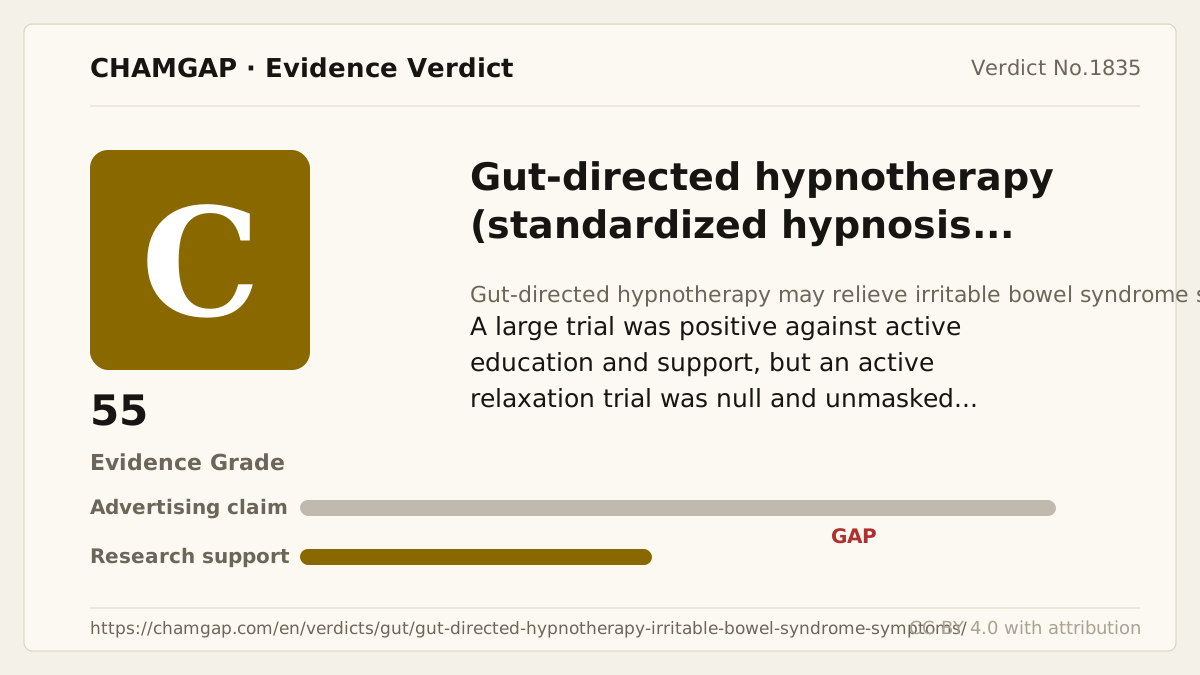
[Chamgap] Gut-directed hypnotherapy x relief of irritable bowel syndrome symptoms — Evidence Grade C·54. 4 cited sources checked. Source: https://chamgap.com/en/verdicts/gut/gut-directed-hypnotherapy-irritable-bowel-syndrome-symptoms/ · CC BY 4.0CC BY 4.0 — free to use with attribution; do not distort grades, numbers, or verdict meaning.
What this document does and does not do
Chamgap is an information source. It reports what research has and has not confirmed; it does not tell readers what to take or buy. That decision belongs to readers and, when needed, medical or legal professionals. This verdict reflects literature available up to the search date and may change as new research appears. Nothing here is medical advice.