
Grilled or barbecued red meat,
does it really help with Increased colorectal-cancer incidence?
research showsIn a cohort of women, grilled or barbecued steak and hamburger were associated with more colorectal cancer, while total red meat and other cooking items did not show a consistent pattern. The formation of compounds during high-temperature cooking does not by itself establish that the cooking method causes cancer in humans.
ads claimClaims that direct-flame meat causes colorectal cancer through carcinogens jump directly from possible formation to human disease. The study did not measure formed compounds and tested many cooking subitems.
Useful facts when choosing a product
- HCAs can form when muscle meat is cooked at high temperature, and PAHs can form when fat and juices hit flame and smoke deposits on the surface.
- Amounts vary by meat, temperature, time, and doneness.
- Verdict 2071 is C with 56 points and treats processing status as the exposure in processed meat and colorectal cancer; verdict 2108 treats the high-temperature cooking method as the exposure.
Chamgap Semantic Classification Code
Candidate index · review held
F.grilled-or-barbecued-red-meat.food.colorectal-cancer-incidence.increase.UNKFoods and beverages > Grilled or barbecued red meat > Food consumption > colorectal cancer incidence > Increase claim > Unknown
An automated migration candidate, not an issued permanent code; exact claim scope remains under review. This machine-generated migration candidate helps retrieval but is not a permanent assignment. The original verdict ID and URL remain authoritative.
What the research actually shows
The Sister Study followed 47,712 women for a median 8.7 years and identified 216 colorectal cancers. HRs were 2.23 (95% CI 1.20 to 4.14) for grilled or barbecued steak and 1.98 (1.00 to 3.91) for hamburger, while the top quartile of total red meat had HR 1.04 (0.68 to 1.60).
Why this is classified as C (56)
A large association with a clinical event supports the harm claim. Confidence is limited by one cohort, weak validity of specific cooking exposure, and unadjusted multiple comparisons with only selected subitems positive. The grade indicates confidence in the claim, not that the risk is minor.
Counterpoint. The null total-red-meat result does not automatically erase a cooking-specific signal, but independent replication is required.
Rejudgment record. Cross-check applied — Single hard-outcome cohort with exposure-measurement and multiple-testing defects
| Endpoint | H | Hard endpoint - actual events such as death |
| Replication | R1 | Single confirmatory trial |
| Independence | I2 | Decisive evidence is publicly or non-profit funded |
| Effect size | E+ | Meets the clinically important threshold |
Stored derived and displayed grades match; this is not a current recalculation or validity check (C).
Sub-claim grades by effect
This ingredient is marketed for several effects. A single overall grade blends strong and weak claims together, so each effect is graded separately here. The overall grade reflects the strongest disconfirming or core claim.
| Effect (sub-claim) | Grade | Basis |
|---|---|---|
| HCAs and PAHs can form during high-temperature or direct-flame meat cooking | C | Formation is a measurable composition fact and the amount varies by conditions. |
| Grilled or barbecued red meat increases colorectal cancer | C | Some subitems had large associations, but exposure misclassification and multiple testing remain. |
Cross-check — AI research and Codex final gate
Evidence Table
| Study | Design | Sample | Funding | Endpoint | Result | Weight |
|---|---|---|---|---|---|---|
| Mehta et al., 2020 Sister Study | Prospective cohort | 47,712 participants, median 8.7 years, and 216 colorectal cancers | NIH/NIEHS intramural funding Z01 ES044005 | Incident colorectal cancer reported and confirmed through medical records | Grilled/barbecued steak HR 2.23 (1.20 to 4.14), hamburger 1.98 (1.00 to 3.91); total red meat 1.04 (0.68 to 1.60) | Hard outcome, but a single cohort with multiple cooking-subitem comparisons |
Receipt — 3 References
All 3 cited sources were verified for existence at the original page (as of 2026-08-03).
Final verification and publication gate: Codex · Evidence date: 2026-08-03 · Corrections: none
Cite this verdict
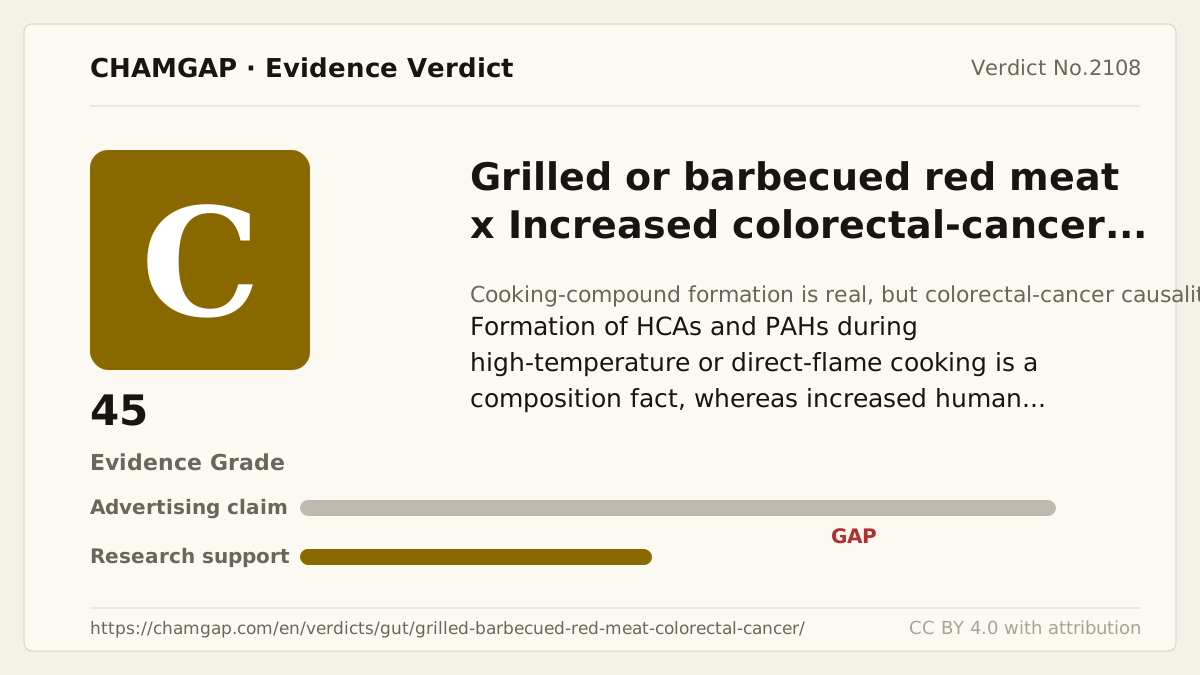
[Chamgap] Grilled or barbecued red meat x increased colorectal-cancer incidence — Evidence Grade C·56. 3 cited sources checked. Source: https://chamgap.com/en/verdicts/gut/grilled-barbecued-red-meat-colorectal-cancer/ · CC BY 4.0CC BY 4.0 — free to use with attribution; do not distort grades, numbers, or verdict meaning.
What this document does and does not do
Chamgap is an information source. It reports what research has and has not confirmed; it does not tell readers what to take or buy. That decision belongs to readers and, when needed, medical or legal professionals. This verdict reflects literature available up to the search date and may change as new research appears. Nothing here is medical advice.