
Green kiwifruit powder,
does it really help with Improvement in bowel frequency, stool form, and abdominal discomfort in functional constipation?
research showsThe target product, Actazin proprietary green kiwifruit powder, has C-level evidence for constipation. Two whole green kiwifruits daily increased complete spontaneous bowel movements by 1.53–1.73 per week in an international trial of 184 participants, but that is evidence for intact fresh fruit. Actazin itself was null in a nine-person functional-constipation subgroup in 2015, and the principal placebo-controlled positive finding in an 85-person 2024 trial was mainly Bristol stool form; the manufacturer participated in design, analysis, and writing.
ads claimMarketing can combine whole-fruit studies, unrelated kiwifruit extracts, and microbiome changes as if all established efficacy for one proprietary powder. Two whole fruits daily, Actazin at 600 or 2,400 mg/day, and other extracts are distinct interventions.
Useful facts when choosing a product
- Actazin research doses ranged from 600 to 2,400 mg/day, while whole-fruit studies used two green kiwifruits daily.
- As of July 18, 2026, no reliable public source confirming formal South Korean functional-food registration or distribution of the Actazin trademark ingredient was found.
- Generic kiwifruit powders may differ from Actazin in drying method, removal of skin and seeds, fiber, and actinidin content.
- Kiwifruit allergy, oral allergy syndrome, and gas are safety issues separate from the efficacy grade.
Chamgap Semantic Classification Code
Candidate index · review held
S.green-kiwifruit-powder.UNK.bowel-frequency-stool-form-and-abdominal-discomfort-in-functional-constipation.improve.placeboSupplements and nutraceuticals > Green kiwifruit powder > Unknown > bowel frequency, stool form, and abdominal discomfort in functional constipation > Improvement claim > Placebo
An automated migration candidate, not an issued permanent code; exact claim scope remains under review. This machine-generated migration candidate helps retrieval but is not a permanent assignment. The original verdict ID and URL remain authoritative.
What the research actually shows
The Ansell 2015 crossover trial found more bowel movements with 2,400 mg/day Actazin in 19 healthy participants but no significant benefit in nine functionally constipated participants. The industry-funded Graham 2024 trial in 85 participants found better stool form with 600 mg/day than placebo, while complete spontaneous bowel movements rose from baseline in both groups. A separate Kindleysides 2015 trial of 1 g/day freeze-dried extract was null for bowel movements, stool characteristics, and gastrointestinal symptoms. In contrast, the Gearry 2023 international crossover trial in 184 participants found that two whole green kiwifruits daily improved complete spontaneous bowel movements and abdominal comfort in functional constipation and constipation-predominant irritable bowel syndrome. A systematic review rated the broader evidence as low certainty.
Why this is classified as C (55)
The strongest positive evidence concerns intact fresh green kiwifruit, which differs in form and dose from Actazin powder. Actazin was null in nine functionally constipated participants in 2015, and the principal placebo-controlled positive finding in the 85-person 2024 trial was mainly stool form with substantial manufacturer involvement. Product-specific evidence therefore supports C with 55 points.
Counterpoint. Direct evidence for two whole green kiwifruits daily in functional constipation is more robust than the powder evidence, and the tested product and dose must match.
Rejudgment record. Reassessment (cross-check reflected) — Separated intact fresh green kiwifruit from proprietary Actazin powder and incorporated the product-specific sample size, endpoints, null results, and manufacturer involvement
Sub-claim grades by effect
This ingredient is marketed for several effects. A single overall grade blends strong and weak claims together, so each effect is graded separately here. The overall grade reflects the strongest disconfirming or core claim.
| Effect (sub-claim) | Grade | Basis |
|---|---|---|
| Improved bowel frequency from consuming two fresh green kiwifruits daily | B | An international randomized trial of 184 participants found an increase of 1.5–1.7 complete spontaneous bowel movements per week, a direct outcome. |
| Improvement of constipation with the proprietary Actazin kiwifruit powder product | C | The evidence is manufacturer-centered, small, and based mainly on a stool-form measure. |
Cross-check — AI research and Codex final gate
Evidence Table
| Study | Design | Sample | Funding | Endpoint | Result | Weight |
|---|---|---|---|---|---|---|
| Ansell et al. 2015 | Double-blind placebo-controlled crossover randomized trial | 9 | Linked to the proprietary ingredient supplier | Bowel frequency, Bristol stool form, and gastrointestinal comfort | The 2,400 mg/day dose was positive in healthy participants but not significant in the functional-constipation group. | Key |
| Gearry et al. 2023 | International multicenter randomized crossover controlled trial | 184 | Principally sponsored by Zespri | Weekly complete spontaneous bowel movements and gastrointestinal symptom rating scale | Two whole green kiwifruits daily increased complete spontaneous bowel movements by about 1.5 or more per week and improved comfort in both constipation groups. | Key |
| Graham et al. 2024 | Multicenter double-blind placebo-controlled randomized trial | 85 | Jointly funded by Anagenix and AIDP | Complete spontaneous bowel movements, stool form, and constipation symptoms | The 600 mg/day dose improved stool form over placebo, while complete spontaneous bowel movements increased from baseline in both groups. | Moderate |
| Kindleysides et al. 2015 | Double-blind placebo-controlled crossover randomized trial | 32 | Not reported in the public abstract | Bowel movements, stool characteristics, gastrointestinal symptoms, and quality of life | A different freeze-dried kiwifruit extract at 1 g/day was null across the main bowel outcomes. | Counterevidence |
Receipt — 5 References
All 5 cited sources were verified for existence at the original page (as of 2026-07-18).
Final verification and publication gate: Codex · Evidence date: 2026-07-18 · Corrections: none
Cite this verdict
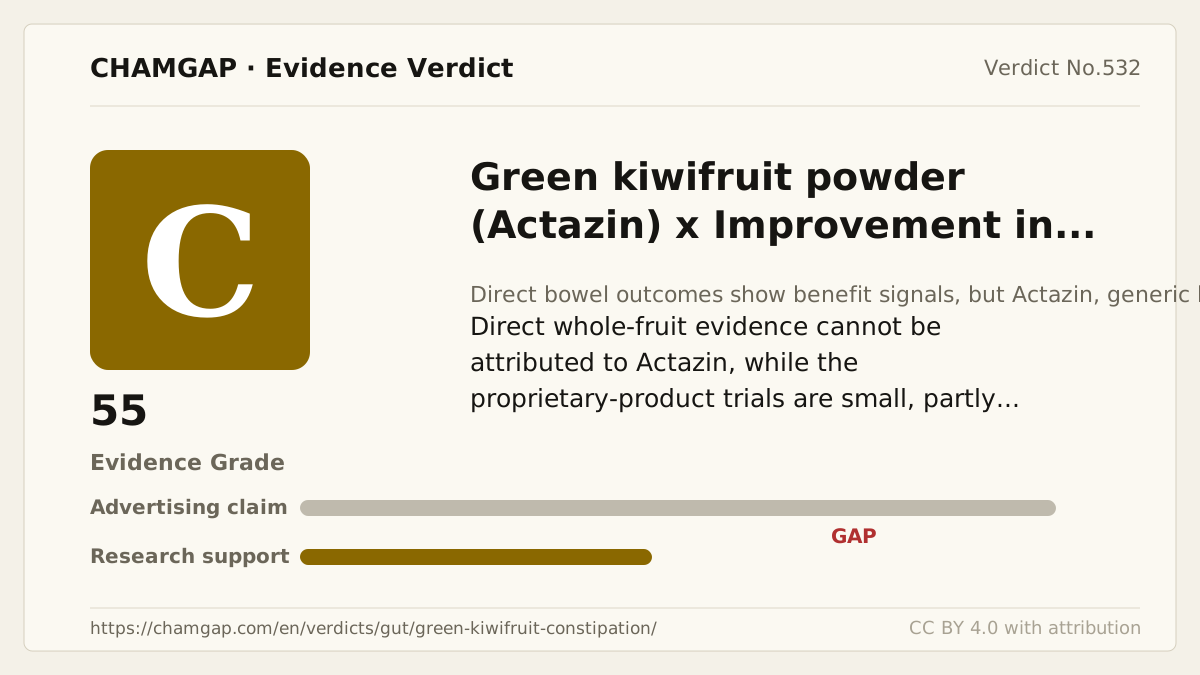
[Chamgap] Green kiwifruit powder x functional constipation — Evidence Grade C·55. 5 cited sources checked. Source: https://chamgap.com/en/verdicts/gut/green-kiwifruit-constipation/ · CC BY 4.0CC BY 4.0 — free to use with attribution; do not distort grades, numbers, or verdict meaning.
What this document does and does not do
Chamgap is an information source. It reports what research has and has not confirmed; it does not tell readers what to take or buy. That decision belongs to readers and, when needed, medical or legal professionals. This verdict reflects literature available up to the search date and may change as new research appears. Nothing here is medical advice.