
Fruit granola,
does it really help with Greater bowel-movement frequency than a cornflake breakfast?
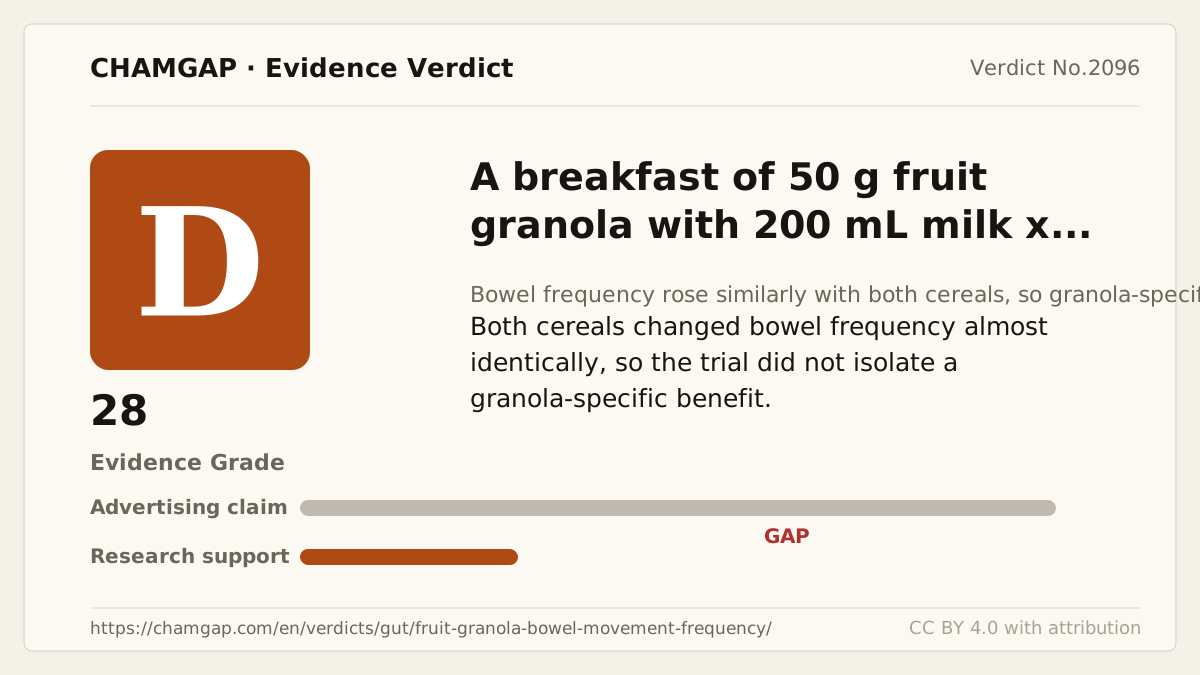
research showsThe grade is D. In a four-week trial of 68 randomized adults, the 67 completers changed from 0.81 plus or minus 0.21 to 0.90 plus or minus 0.26 bowel movements per day with granola and from 0.83 plus or minus 0.19 to 0.91 plus or minus 0.17 with cornflakes. No between-group superiority estimate or confidence interval supported a granola-specific effect.
ads claimHigher fiber content is a composition fact; superior bowel efficacy over cornflakes is a separate health claim. This study established the former but not the latter.
Useful facts when choosing a product
- The full test breakfasts supplied 4.5 versus 2.7 g fiber, 10.7 versus 8.7 g protein, and 0.4 versus 0.9 g salt, equivalent to about 157 versus 354 mg sodium.
- Both breakfasts included 200 mL milk and provided 341 kcal. The original label for the table item was not confirmed; it may represent Japanese available carbohydrate excluding fiber, so it cannot be asserted to mean total sugars. Saturated fat was not reported separately.
- Verdict 532 is C with 55 points for green-kiwifruit powder in functional constipation; this verdict concerns a commercial cereal comparison in healthy adults.
Chamgap Semantic Classification Code
Candidate index · review held
F.breakfast-of-fruit-granola-with-milk.food.greater-bowel-movement-frequency-than-a-cornflake-breakfast.assess.UNKFoods and beverages > breakfast of fruit granola with milk > Food consumption > Greater bowel-movement frequency than a cornflake breakfast > Association or change assessment > Unknown
An automated migration candidate, not an issued permanent code; exact claim scope remains under review. This machine-generated migration candidate helps retrieval but is not a permanent assignment. The original verdict ID and URL remain authoritative.
What the research actually shows
Yamauchi and colleagues randomized 68 healthy adults with three to seven weekly bowel movements to 50 g fruit granola or 57.3 g cornflakes, each with 200 mL milk. One participant left after a positive COVID-19 test, and 67 completers were analyzed. Registered primary fecal IgA was null, and prespecified secondary bowel frequency was 0.90 plus or minus 0.26 versus 0.91 plus or minus 0.17 per day. Calbee alone funded the study and participated in design and manuscript review; employee and founder relationships with Metagen were also disclosed.
Why this is classified as D (28)
A manufacturer-funded, small, four-week completer trial failed its primary outcome and did not show between-group bowel superiority, giving D with 28 points.
Counterpoint. D does not deny that granola contains fiber; it means product-specific superiority was not demonstrated.
Rejudgment record. Cross-check applied — Cross-checked registry outcomes, completer count, within- and between-group bowel results, test-food composition, and Calbee involvement
| Endpoint | P | Symptom or function itself is the target - including patient reports and performance tests |
| Replication | R1 | Single confirmatory trial |
| Independence | I0 | Evidence comes only from manufacturer studies |
| Effect size | E0 | Null |
| Precision | CX | No pooled confidence interval could be confirmed |
Stored derived and displayed grades match; this is not a current recalculation or validity check (D).
Sub-claim grades by effect
This ingredient is marketed for several effects. A single overall grade blends strong and weak claims together, so each effect is graded separately here. The overall grade reflects the strongest disconfirming or core claim.
| Effect (sub-claim) | Grade | Basis |
|---|---|---|
| Greater bowel frequency than cornflakes | D | Four-week values and changes were almost identical, with no reported superiority. |
Cross-check — AI research and Codex final gate
Evidence Table
| Study | Design | Sample | Funding | Endpoint | Result | Weight |
|---|---|---|---|---|---|---|
| Yamauchi Y et al., 2024 | Double-blind randomized parallel food trial | 68 randomized and 67 completers analyzed | Sole Calbee funding with design and manuscript review; Metagen employee and founder relationships | Primary fecal IgA; secondary defecation measures | At four weeks, 0.90 plus or minus 0.26 versus 0.91 plus or minus 0.17 bowel movements per day; no superiority estimate or CI | Direct product comparison but small, short, completer evidence |
Receipt — 2 References
All 2 cited sources were verified for existence at the original page (as of 2026-08-03).
Final verification and publication gate: Codex · Evidence date: 2026-08-03 · Corrections: none
Cite this verdict
[Chamgap] Fruit granola x improved bowel-movement frequency — Evidence Grade D·28. 2 cited sources checked. Source: https://chamgap.com/en/verdicts/gut/fruit-granola-bowel-movement-frequency/ · CC BY 4.0CC BY 4.0 — free to use with attribution; do not distort grades, numbers, or verdict meaning.
What this document does and does not do
Chamgap is an information source. It reports what research has and has not confirmed; it does not tell readers what to take or buy. That decision belongs to readers and, when needed, medical or legal professionals. This verdict reflects literature available up to the search date and may change as new research appears. Nothing here is medical advice.