
Food emulsifier CMC,
does it really help with Altered gut microbiota and metabolites with induction of human intestinal inflammation?
research showsThe grade is C with 50 points. In a 16-person inpatient feeding trial, seven healthy adults consumed 15 g/day CMC and nine consumed an otherwise identical additive-free diet for 11 days. Microbial diversity, fecal short-chain fatty acids, and free amino acids fell and postprandial abdominal discomfort rose modestly, but group-level inflammatory and metabolic markers did not worsen. In a 2026 trial of 58 people, 10 received 2.75 g/day CMC for four weeks; some short-chain fatty acids fell, while microbiota composition, permeability, fecal calprotectin, and CRP did not differ from placebo.
ads claimCMC- or polysorbate-80-induced colitis in mice is animal evidence. Human trials show selected exposure, microbiome, and metabolite signals but did not measure incident inflammatory bowel disease. Verdict 2091 is C with 50 points and concerns an entire ultra-processed diet, not one emulsifier.
Useful facts when choosing a product
- The first trial supplied 15 g/day CMC as six 2.5 g servings in brownies and sorbet for 11 days.
- The second supplied 2.75 g/day CMC in three muffins for four weeks; the authors estimated this was about 40 times the French high-consumer average estimate.
- Commercial CMC concentrations vary by product, and labels usually identify the ingredient without disclosing its mass, preventing a direct personal-dose comparison.
- Verdict 2091 is C with 50 points and examines total ultra-processed dietary exposure and energy intake or weight.
Chamgap Semantic Classification Code
Candidate index · review held
F.food-emulsifier-carboxymethylcellulose.food.altered-gut-microbiota-and-metabolites-with-induction-of-human-intestinal-inflammation.assess.placeboFoods and beverages > food emulsifier carboxymethylcellulose > Food consumption > Altered gut microbiota and metabolites with induction of human intestinal inflammation > Association or change assessment > Placebo
An automated migration candidate, not an issued permanent code; exact claim scope remains under review. This machine-generated migration candidate helps retrieval but is not a permanent assignment. The original verdict ID and URL remain authoritative.
What the research actually shows
NCT03440229 used three outpatient days of emulsifier-free food followed by an 11-day double-blind inpatient feeding phase. Sixteen people were concealedly randomized: nine to additive-free control and seven to 15 g/day CMC divided among six brownie and sorbet servings; all were analyzed. NCT06552156 enrolled 60 and analyzed 58 after excluding two NSAID users. After two weeks on an emulsifier-free diet, groups of nine or ten received 2.75 g/day CMC, another emulsifier, or placebo in three daily muffins for four weeks. CMC lowered selected short-chain fatty acids versus placebo but did not alter microbiota composition, lactulose-mannitol permeability, LBP, fecal calprotectin, CRP, or multiplicity-adjusted serum inflammatory proteins. Public and academic funding was reported.
Why this is classified as C (50)
Two small short feeding trials found metabolite signals but divergent microbiota and inflammation results without clinical disease outcomes, giving C with 50 points.
Counterpoint. Null inflammation markers do not exclude every gut effect; repeated short-chain-fatty-acid reductions and discomfort merit longer trials.
Rejudgment record. Cross-check applied — The actual analysis counts, durations, absolute CMC doses, and separate microbiota-composition, fecal-metabolite, permeability, inflammatory-marker, and symptom outcomes were checked in both randomized feeding trials
| Endpoint | S | Surrogate marker - laboratory or imaging measures |
| Replication | R1 | Single confirmatory trial |
| Independence | I2 | Decisive evidence is publicly or non-profit funded |
| Effect size | EX | The clinical size of the effect could not be judged |
Stored derived and displayed grades match; this is not a current recalculation or validity check (C).
Sub-claim grades by effect
This ingredient is marketed for several effects. A single overall grade blends strong and weak claims together, so each effect is graded separately here. The overall grade reflects the strongest disconfirming or core claim.
| Effect (sub-claim) | Grade | Basis |
|---|---|---|
| CMC alters human gut microbiota and metabolites | C | The 15 g/day trial changed composition and metabolites, while the 2.75 g/day trial replicated selected metabolite changes only. |
| CMC causes intestinal inflammation in humans | D | Group-level inflammatory markers did not worsen in either trial, and clinical intestinal disease was not measured. |
| CMC increases abdominal discomfort | C | A modest increase appeared with 15 g/day for 11 days, but only seven people received CMC. |
Cross-check — AI research and Codex final gate
Evidence Table
| Study | Design | Sample | Funding | Endpoint | Result | Weight |
|---|---|---|---|---|---|---|
| Chassaing et al. 2022 | Double-blind randomized inpatient controlled-feeding trial | 16 randomized and analyzed, nine control and seven CMC | Public and academic funding including the U.S. National Institutes of Health | Microbiota composition, fecal metabolome, inflammatory markers, and postprandial abdominal discomfort | With CMC 15 g/day for 11 days, diversity, short-chain fatty acids, and free amino acids decreased and discomfort increased; no group-level inflammatory or metabolic worsening; encroachment occurred in two participants | Direct fully controlled human feeding evidence limited by seven active participants and short duration |
| Wellens et al. 2026, FOAM | Double-blind randomized placebo-controlled dietary trial | 60 enrolled and 58 analyzed; 10 CMC and 10 placebo | KU Leuven and academic research funding | Microbiota composition, short-chain fatty acids, permeability, fecal calprotectin, and CRP | CMC 2.75 g/day for four weeks lowered selected short-chain fatty acids; microbiota composition, permeability, intestinal inflammation, and systemic inflammation did not differ from placebo | Additional lower-dose human trial with only 10 CMC participants |
Receipt — 3 References
All 3 cited sources were verified for existence at the original page (as of 2026-08-04).
Final verification and publication gate: Codex · Evidence date: 2026-08-04 · Corrections: none
Cite this verdict
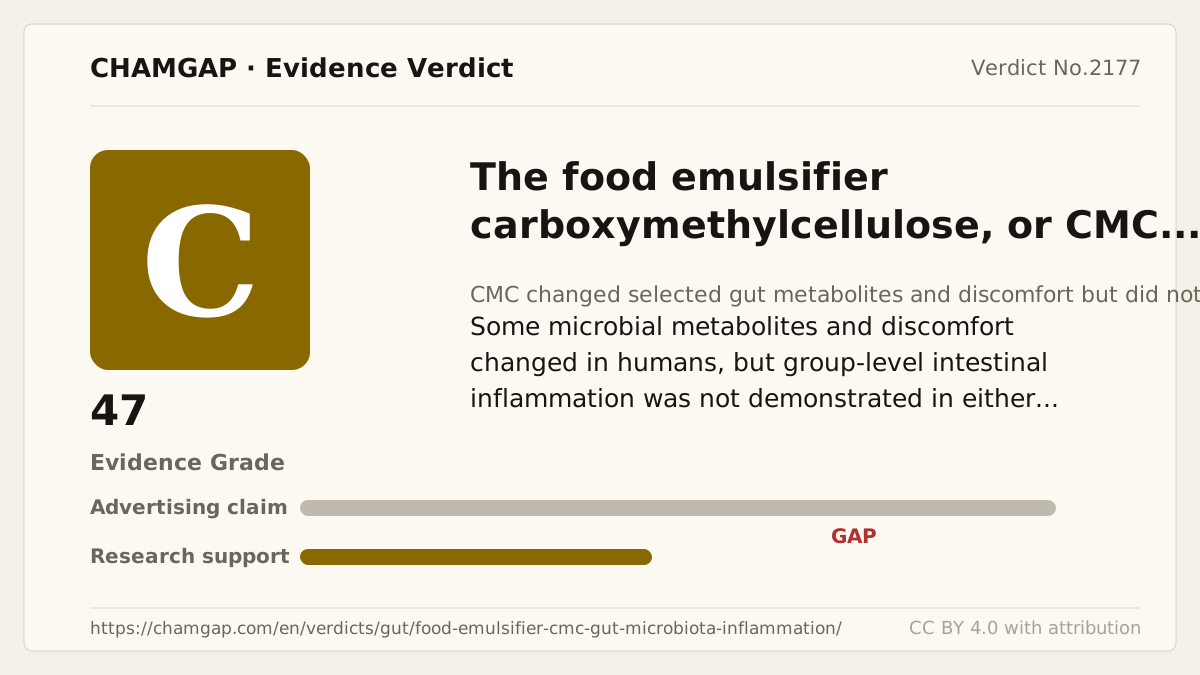
[Chamgap] Food emulsifier CMC x gut microbiota and intestinal inflammation — Evidence Grade C·50. 3 cited sources checked. Source: https://chamgap.com/en/verdicts/gut/food-emulsifier-cmc-gut-microbiota-inflammation/ · CC BY 4.0CC BY 4.0 — free to use with attribution; do not distort grades, numbers, or verdict meaning.
What this document does and does not do
Chamgap is an information source. It reports what research has and has not confirmed; it does not tell readers what to take or buy. That decision belongs to readers and, when needed, medical or legal professionals. This verdict reflects literature available up to the search date and may change as new research appears. Nothing here is medical advice.