
Dupilumab,
does it really help with Improvement of dysphagia in adults and adolescents with eosinophilic esophagitis?
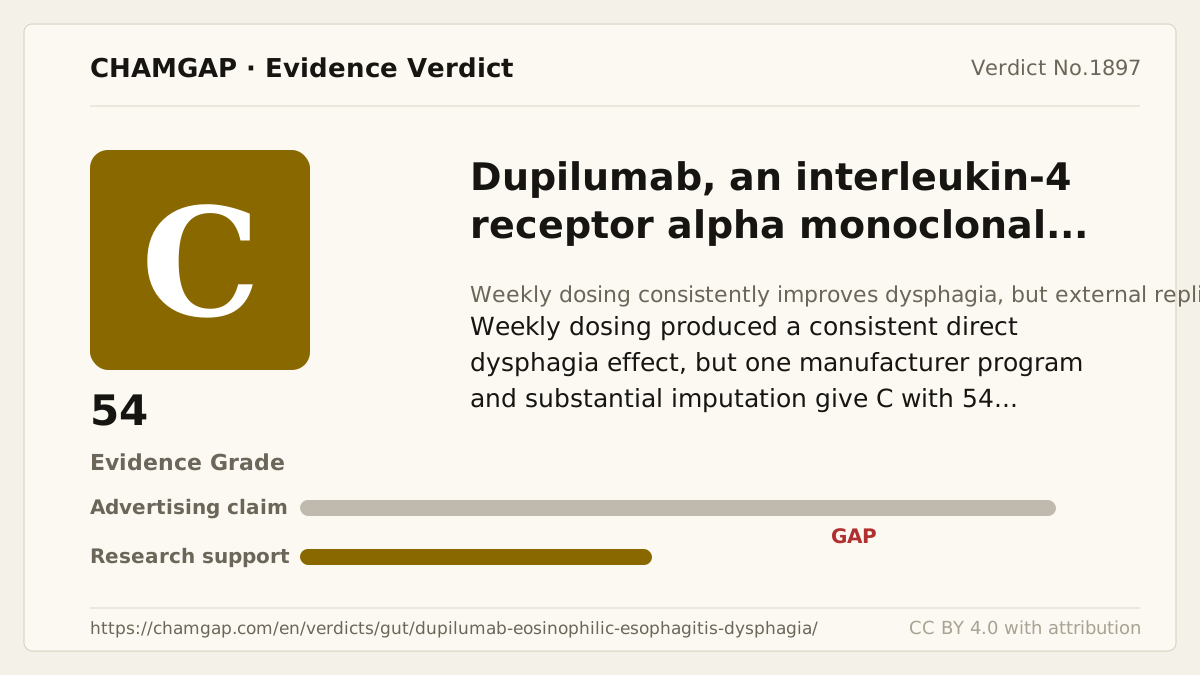
research showsThe grade is C. In 81 Part A and 240 Part B participants, weekly dosing met both co-primary endpoints of histologic remission and DSQ. The DSQ differences were -12.32 points (95% CI -19.11 to -5.54) in Part A and -9.92 (-14.81 to -5.02) in Part B, a statistically large and consistent direct symptom effect. One Sanofi-Regeneron program and substantial imputation limit the verdict to C with 50 points.
ads claimReducing tissue eosinophils cannot be equated automatically with eliminating food impaction. Verified symptom efficacy concerns weekly dosing for 24 weeks; the histologic success of every-two-week dosing cannot be advertised as the same dysphagia benefit.
Useful facts when choosing a product
- There is no separate physical or chemical claim; reduction of patient-experienced dysphagia and food impaction is the graded claim.
- Part A randomized and analyzed 81 participants, and Part B randomized and analyzed 240; the DSQ primary endpoint succeeded for weekly dosing in both.
- Dupilumab is a prescription biologic; injection-site reactions, conjunctivitis, upper respiratory infections, and rare hypersensitivity should be reviewed with the prescriber.
Chamgap Semantic Classification Code
Candidate index · review held
M.dupilumab.subcutaneous.dysphagia-and-adolescents-with-eosinophilic-esophagitis.improve.placeboMedicinal interventions > Dupilumab > Subcutaneous > dysphagia and adolescents with eosinophilic esophagitis > Improvement claim > Placebo
An automated migration candidate, not an issued permanent code; exact claim scope remains under review. This machine-generated migration candidate helps retrieval but is not a permanent assignment. The original verdict ID and URL remain authoritative.
What the research actually shows
Weekly dosing met both co-primary endpoints of histologic remission and DSQ in Part A with 81 participants and Part B with 240. Part B DSQ imputation involved 19/78 placebo, 17/80 weekly, and 19/81 every-two-week participants, above 15% in every group. Every-two-week DSQ was -0.51 (95% CI -5.42 to 4.41), P=0.84, but that result is not a split co-primary failure for the weekly claim. Parts A and B belonged to one Sanofi-Regeneron program and were not counted as external replication.
Why this is classified as C (50)
The direct dysphagia effect was statistically large and consistent across two cohorts, but decisive evidence comes from one manufacturer program and DSQ imputation exceeded 15%, giving C with 50 points.
Counterpoint. C does not mean absence of symptom benefit. A pragmatic long-term trial independent of manufacturers could support upgrading if it replicates reduced dysphagia and food impaction.
Rejudgment record. Cross-check applied — Both histologic remission and direct dysphagia co-primary endpoints succeeded for weekly dosing in both parts, but all evidence belongs to one Sanofi-Regeneron program and symptom imputation exceeded 15%
| Endpoint | P | Symptom or function itself is the target - including patient reports and performance tests |
| Replication | R1 | Single confirmatory trial |
| Independence | I0 | Evidence comes only from manufacturer studies |
| Effect size | E+ | Meets the clinically important threshold |
Stored derived and displayed grades match; this is not a current recalculation or validity check (C).
Sub-claim grades by effect
This ingredient is marketed for several effects. A single overall grade blends strong and weak claims together, so each effect is graded separately here. The overall grade reflects the strongest disconfirming or core claim.
| Effect (sub-claim) | Grade | Basis |
|---|---|---|
| Improvement of dysphagia at week 24 with weekly dosing | C | The effect was statistically large and consistent in both cohorts, but no widely validated between-group threshold exists. |
| Achievement of histologic remission at week 24 | C | Histologic remission was positive with weekly and every-two-week dosing, but evidence came from the manufacturer program. |
| Improvement of dysphagia with every-two-week dosing | D | The DSQ difference was -0.51 points with P=0.84, so the primary endpoint failed. |
Cross-check — AI research and Codex final gate
Evidence Table
| Study | Design | Sample | Funding | Endpoint | Result | Weight |
|---|---|---|---|---|---|---|
| Dellon ES et al. 2022 LIBERTY EoE TREET Parts A and B | Two cohorts of a multicenter double-blind randomized placebo-controlled phase 3 trial | Part A randomized and analyzed 81 for co-primary endpoints; Part B randomized and analyzed 240 | Manufacturer funding and design involvement from Sanofi and Regeneron Pharmaceuticals | Co-primary endpoints of histologic remission and change in DSQ at week 24 | Weekly DSQ differences were -12.32 in Part A (95% CI -19.11 to -5.54) and -9.92 in Part B (-14.81 to -5.02), both P<0.001. Every-two-week dosing was -0.51 (-5.42 to 4.41), P=0.84. | Pivotal manufacturer-funded phase 3 symptom evidence |
| Hudgens S et al. 2017 DSQ validation | Psychometric validation of a patient-reported instrument using phase 2 trial data | 93 participants for baseline DSQ and 90 for PGIC anchor analyses | Data from a Shire development program with Shire employees among the authors | Interpretation of within-person DSQ change | The -6.5-point value is a PGIC-anchored within-person change, not a threshold for between-group means. | Supportive validation that cannot be repurposed as a between-group threshold |
Receipt — 2 References
All 2 cited sources were verified for existence at the original page (as of 2026-07-24).
Final verification and publication gate: Codex · Evidence date: 2026-07-24 · Corrections: none
Cite this verdict
[Chamgap] Dupilumab x improvement of dysphagia in eosinophilic esophagitis — Evidence Grade C·50. 2 cited sources checked. Source: https://chamgap.com/en/verdicts/gut/dupilumab-eosinophilic-esophagitis-dysphagia/ · CC BY 4.0CC BY 4.0 — free to use with attribution; do not distort grades, numbers, or verdict meaning.
What this document does and does not do
Chamgap is an information source. It reports what research has and has not confirmed; it does not tell readers what to take or buy. That decision belongs to readers and, when needed, medical or legal professionals. This verdict reflects literature available up to the search date and may change as new research appears. Nothing here is medical advice.