
Drinking about 1.4 L of coffee daily,
does it really help with Prevention of incident invasive colon cancer?
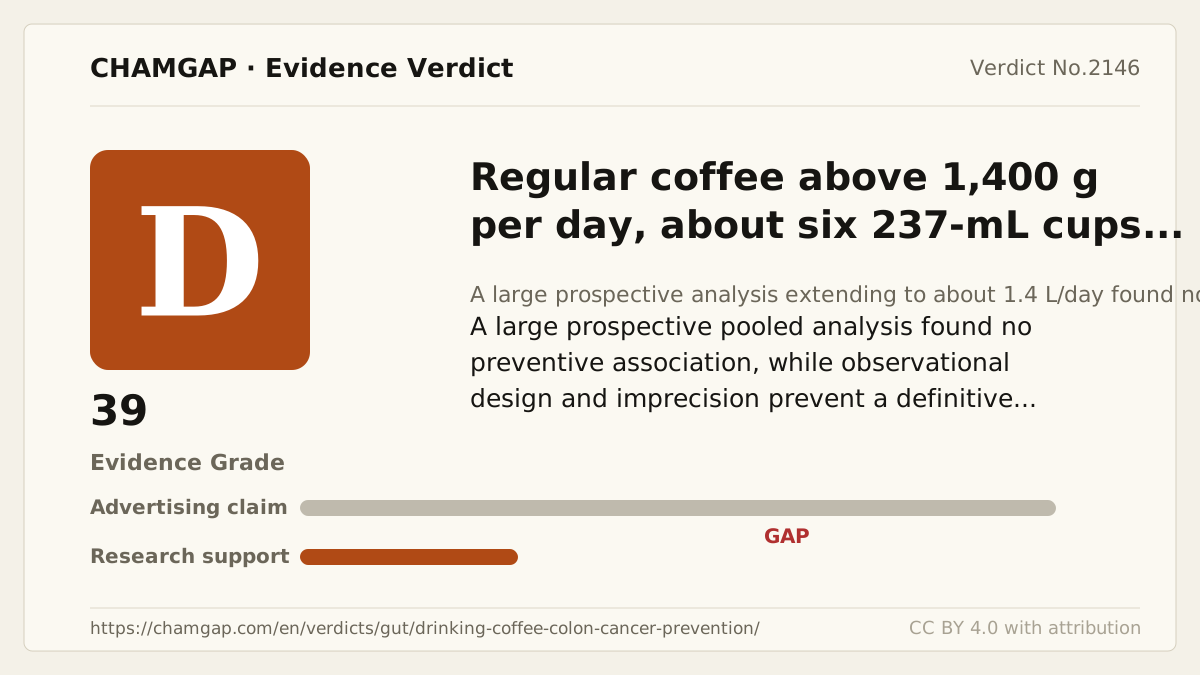
research showsThe grade is D. An individual-participant pooled analysis of 13 prospective cohorts included 731,441 people and 5,604 invasive colon cancers. Compared with non-drinkers, intake above 1,400 g/day had a relative risk of 1.07 (95% CI 0.89 to 1.30). This large observational result did not support prevention, but it was not randomized and the interval still allowed some benefit, giving D with 34 points.
ads claimThe presence of caffeine and polyphenols in coffee does not establish cancer prevention. Even the roughly 1.4-L group did not have less colon cancer than non-drinkers in this analysis.
Useful facts when choosing a product
- The highest category exceeded 1,400 g/day, described as about six 8-oz cups or 1.4 L.
- Brewing method and study-specific caffeine content were not measured or reported; decaffeinated coffee was not consistently separated.
- The FDA's general range for 12 fl oz of regular brewed non-specialty coffee is 113 to 247 mg caffeine; this was not a measurement of cohort beverages.
Chamgap Semantic Classification Code
Candidate index · review held
F.regular-coffee-above-1.food.incident-invasive-colon-cancer.prevent.UNKFoods and beverages > Regular coffee above 1 > Food consumption > incident invasive colon cancer > Occurrence-prevention claim > Unknown
An automated migration candidate, not an issued permanent code; exact claim scope remains under review. This machine-generated migration candidate helps retrieval but is not a permanent assignment. The original verdict ID and URL remain authoritative.
What the research actually shows
Zhang pooled individual data from 13 prospective cohorts, 11 of which supplied coffee data. Among 731,441 people, 5,604 invasive colon cancers occurred. More than 1,400 g/day versus none gave 1.07 (0.89 to 1.30), P for trend .68; per 250 g, estimates were 0.99 (0.97 to 1.02) overall, 0.99 (0.96 to 1.02) proximal, and 0.99 (0.96 to 1.03) distal. Rectal cancer was not an endpoint. Cohort estimates straddled 1, while between-study heterogeneity for the highest category was not significant, P>.20.
Why this is classified as D (34)
A large prospective pooled analysis was null, but nonrandomized design and an interval allowing some benefit give D with 34 points.
Counterpoint. This verdict does not address recurrence or survival after diagnosis, other cancers, or coffee extracts.
Rejudgment record. Cross-check applied — A pooled individual-participant analysis of 13 prospective cohorts was null for incident invasive colon cancer while its interval still allowed some benefit
| Endpoint | H | Hard endpoint - actual events such as death |
| Replication | R1 | Single confirmatory trial |
| Independence | I2 | Decisive evidence is publicly or non-profit funded |
| Effect size | E0 | Null |
| Precision | C0 | The confidence interval leaves room for benefit |
Stored derived and displayed grades match; this is not a current recalculation or validity check (D).
Sub-claim grades by effect
This ingredient is marketed for several effects. A single overall grade blends strong and weak claims together, so each effect is graded separately here. The overall grade reflects the strongest disconfirming or core claim.
| Effect (sub-claim) | Grade | Basis |
|---|---|---|
| Prevention of incident invasive colon cancer | D | The highest-intake RR was 1.07 (0.89 to 1.30), showing no preventive association. |
| Prevention of proximal or distal colon cancer | D | The pivotal pooled analysis found no material difference by tumor site. |
Cross-check — AI research and Codex final gate
Evidence Table
| Study | Design | Sample | Funding | Endpoint | Result | Weight |
|---|---|---|---|---|---|---|
| Zhang et al. 2010 individual-participant pooled analysis | Pooled analysis of 13 prospective cohorts | 731,441 analyzed with 5,604 invasive colon cancers | NIH CA55075 and nonprofit research support | Incident invasive colon cancer | >1,400 g/day versus none: RR 1.07 (95% CI 0.89 to 1.30), P trend=.68 | Decisive large prospective evidence |
| Gan et al. 2017 prospective-cohort meta-analysis | Dose-response meta-analysis of prospective cohorts | 19 prospective cohort studies, 2,046,575 participants, 22,629 colorectal cancers | Funding could not be confirmed in the accessible record | Incident colorectal, colon, and rectal cancer | Four cups/day was associated with about 7% lower colon-cancer risk, while rectal cancer was not significant | Indirect, non-comparable discordance |
Receipt — 3 References
All 3 cited sources were verified for existence at the original page (as of 2026-08-04).
Final verification and publication gate: Codex · Evidence date: 2026-08-04 · Corrections: none
Cite this verdict
[Chamgap] Drinking about 1.4 L of coffee daily x colon-cancer prevention — Evidence Grade D·34. 3 cited sources checked. Source: https://chamgap.com/en/verdicts/gut/drinking-coffee-colon-cancer-prevention/ · CC BY 4.0CC BY 4.0 — free to use with attribution; do not distort grades, numbers, or verdict meaning.
What this document does and does not do
Chamgap is an information source. It reports what research has and has not confirmed; it does not tell readers what to take or buy. That decision belongs to readers and, when needed, medical or legal professionals. This verdict reflects literature available up to the search date and may change as new research appears. Nothing here is medical advice.