
Dried dill-leaf powder,
does it really help with Relief of colonic-motility-related symptoms in adults with type 2 diabetes?
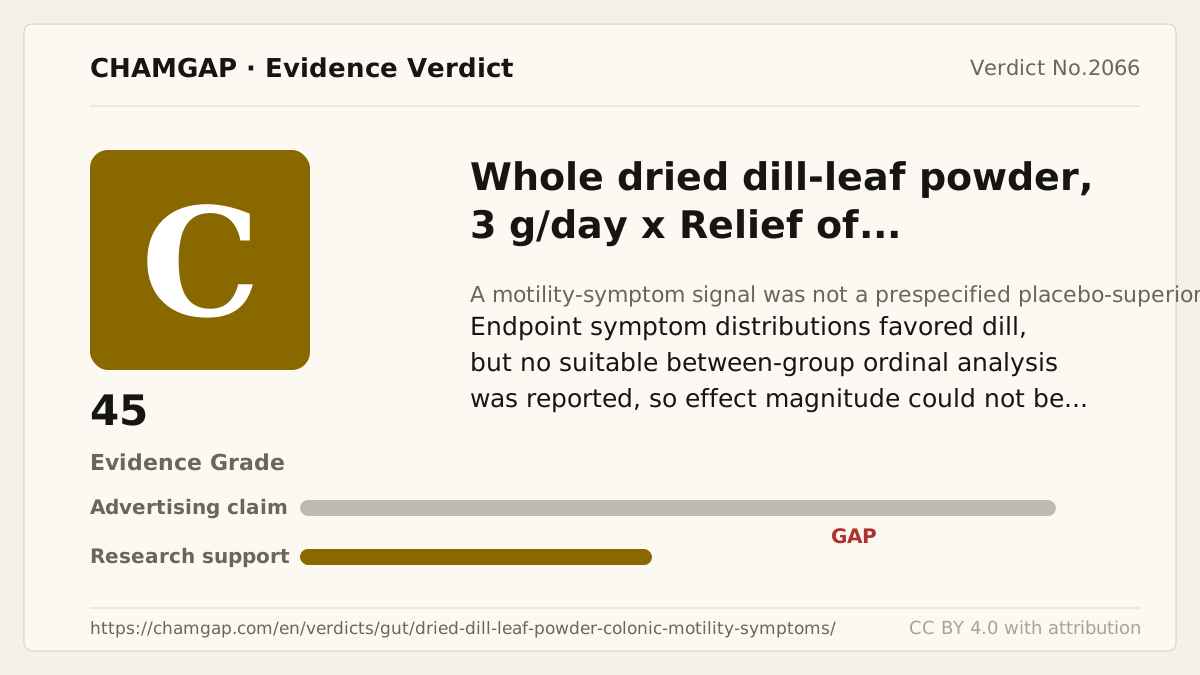
research showsThe grade is C with 50 points. An eight-week trial assigned 48 people, excluded six, and analyzed 21 per group. Only one of five gastrointestinal items improved within the dill group, but no between-group ordinal test or analysis of individual change was reported, so treatment-effect magnitude could not be judged.
ads claimThree grams of dried leaf is about 3 teaspoons, 1 tablespoon, or 24 pinches. It is culinary, but high for daily seasoning, and a within-group change must not be marketed as superiority over placebo.
Useful facts when choosing a product
- The intervention was milled whole dried dill leaf, not an extract.
- Three grams is about 3 teaspoons, 1 tablespoon, or 24 pinches.
- Verdict 501 is B with 70 points and concerns bisacodyl treatment of chronic constipation; this verdict concerns dried dill leaf and an exploratory motility symptom.
Chamgap Semantic Classification Code
Candidate index · review held
S.whole-dried-dill-leaf-powder.UNK.colonic-motility-related-symptoms-with-type-2-diabetes.relieve.placeboSupplements and nutraceuticals > Whole dried dill-leaf powder > Unknown > colonic-motility-related symptoms with type 2 diabetes > Symptom-relief claim > Placebo
An automated migration candidate, not an issued permanent code; exact claim scope remains under review. This machine-generated migration candidate helps retrieval but is not a permanent assignment. The original verdict ID and URL remain authoritative.
What the research actually shows
Haidari 2020 assigned 48 adults with type 2 diabetes and gastrointestinal symptoms to dried dill-leaf powder, 3 g/day, or starch placebo for eight weeks. Six participants were excluded and only 21 per group were analyzed. The original registry record could not be checked, while the paper included gastrointestinal symptoms in its study purpose and eligibility criteria. LDL, reported as the registered primary outcome, was positive: change −9.76±19.08 versus +3.09±14.07 mg/dL, between-group P=0.017 and adjusted P=0.040. Funding was Ahvaz Jundishapur University of Medical Sciences grant NRC-9617.
Why this is classified as C (50)
The endpoint distribution is a signal, but an appropriate between-group effect size cannot be calculated and this was a single 42-person, eight-week completer analysis, giving C with 50 points.
Counterpoint. Dill extracts, seeds, and lipid or glucose outcomes were not pooled into this symptom verdict.
Rejudgment record. Cross-check applied — Ordinal endpoint distributions and within-group findings were assessed alongside the absence of a suitable between-group ordinal analysis and the small, short completer design
| Endpoint | P | Symptom or function itself is the target - including patient reports and performance tests |
| Replication | R1 | Single confirmatory trial |
| Independence | I2 | Decisive evidence is publicly or non-profit funded |
| Effect size | EX | The clinical size of the effect could not be judged |
Stored derived and displayed grades match; this is not a current recalculation or validity check (C).
Sub-claim grades by effect
This ingredient is marketed for several effects. A single overall grade blends strong and weak claims together, so each effect is graded separately here. The overall grade reflects the strongest disconfirming or core claim.
| Effect (sub-claim) | Grade | Basis |
|---|---|---|
| Relief of colonic-motility-related symptoms | C | Endpoint distributions favored dill, but this was not a prespecified between-group confirmatory analysis. |
Cross-check — AI research and Codex final gate
Evidence Table
| Study | Design | Sample | Funding | Endpoint | Result | Weight |
|---|---|---|---|---|---|---|
| Haidari F et al. 2020 | Double-blind placebo-controlled single-center trial | 48 assigned, 24 per group; six excluded and 42 completers analyzed, 21 per group | Ahvaz Jundishapur University of Medical Sciences grant NRC-9617 | Five gastrointestinal symptom items scored 0, 1, or 2 | Within-group P values for colonic motility were 0.010 with dill and 0.317 with placebo. Endpoint distributions were 10, 10, and 1 at scores 0, 1, and 2 with dill versus 7, 4, and 10 with placebo; no appropriate between-group ordinal test was reported. | Exploratory symptom signal |
Receipt — 1 References
All 1 cited sources were verified for existence at the original page (as of 2026-08-03).
Final verification and publication gate: Codex · Evidence date: 2026-08-03 · Corrections: none
Cite this verdict
[Chamgap] Dried dill-leaf powder x colonic-motility-related symptoms — Evidence Grade C·50. 1 cited sources checked. Source: https://chamgap.com/en/verdicts/gut/dried-dill-leaf-powder-colonic-motility-symptoms/ · CC BY 4.0CC BY 4.0 — free to use with attribution; do not distort grades, numbers, or verdict meaning.
What this document does and does not do
Chamgap is an information source. It reports what research has and has not confirmed; it does not tell readers what to take or buy. That decision belongs to readers and, when needed, medical or legal professionals. This verdict reflects literature available up to the search date and may change as new research appears. Nothing here is medical advice.