
Dioctahedral smectite,
does it really help with Shorter recovery time from acute watery diarrhea in adults?
research showsDioctahedral smectite is rated D for shortening recovery from acute watery diarrhea in adults. An initial randomized double-blind placebo-controlled trial of 346 adults was positive, with median recovery of 53.8 versus 69.0 hours, but the larger 858-person phase 4 ADIASE trial using the same dose and recovery definition found 66.0 versus 68.6 hours and a null prespecified primary analysis (P=0.2524). The overall stool-count measure was also null (P=0.4294). Both trials were Ipsen-affiliated and there is no independent replication, so the larger direct failure takes precedence and yields D with 34 points. Pediatric meta-analysis is indirect for the adult claim, while constipation and adsorption of other oral medicines remain separate safety issues.
ads claimDescriptions of toxin and pathogen adsorption and the positive initial 346-person trial can be expanded into established faster recovery, eradication of infection, or prevention of dehydration. The larger ADIASE trial did not establish superiority for adult recovery or overall stool counts, and diosmectite does not replace rehydration.
Useful facts when choosing a product
- Dioctahedral smectite is a minimally absorbed adsorbent aluminum-magnesium silicate used as a nonprescription symptomatic treatment for acute diarrhea.
- The pivotal adult trial used 6 g, equivalent to two 3-g sachets, three times daily for up to four days, but the local product label and pharmacist's instructions determine actual dosing and duration.
- Replacing both fluid and electrolytes is the central treatment for acute watery diarrhea, and diosmectite does not replace oral rehydration.
- It can adsorb other oral medicines and reduce their absorption, so simultaneous dosing should be avoided according to the product label; constipation calls for stopping treatment or discussing dose reduction.
Chamgap Semantic Classification Code
Candidate index · review held
M.dioctahedral-smectite.UNK.shorter-recovery-time-from-acute-watery-diarrhea.assess.placeboMedicinal interventions > Dioctahedral smectite > Unknown > Shorter recovery time from acute watery diarrhea > Association or change assessment > Placebo
An automated migration candidate, not an issued permanent code; exact claim scope remains under review. This machine-generated migration candidate helps retrieval but is not a permanent assignment. The original verdict ID and URL remain authoritative.
What the research actually shows
Khediri and colleagues randomized 346 adults to diosmectite 6 g three times daily or placebo and reported median recovery of 53.8 versus 69.0 hours in the intention-to-treat analysis (P=0.029). The subsequent phase 4 ADIASE trial randomized 858 participants and analyzed 853; with the same dose and the same definition of a formed stool followed by a nonwatery stool, the primary endpoint was null at 66.0 versus 68.6 hours (P=0.2524). Overall stool counts were also null (P=0.4294). Both adult trials were Ipsen-affiliated rather than independent replications. A meta-analysis by Das and colleagues of 13 pediatric randomized trials with 2,164 children reported shorter diarrhea duration, but it is indirect for adults and was not used as adult replication.
Why this is classified as D (34)
The larger 858-person ADIASE trial, using the same dose and recovery definition, failed to replicate the positive recovery result from the initial 346-person double-blind trial. ADIASE was null for recovery at 66.0 versus 68.6 hours (P=0.2524) and for overall stool counts (P=0.4294), and both studies were Ipsen-affiliated rather than independent replications. The larger direct randomized null result supports D with 34 points. Constipation and adsorption of oral medicines are independent safety issues.
Counterpoint. A short course could still provide symptomatic benefit to some individuals, but mean efficacy was not replicated in the larger direct trial. Severe dehydration, immunocompromise, older age, persistent symptoms, or travel- and antibiotic-associated diarrhea warrant evaluation of the cause.
Rejudgment record. Cross-check reflected — Applied D under the rule for a null large randomized trial because the 858-person ADIASE study, larger than the initial positive 346-person trial and using the same dose and recovery definition, was null for recovery at 66.0 versus 68.6 hours (P=0.2524) and for overall stool counts (P=0.4294); both trials were Ipsen-affiliated and independent replication is absent
Sub-claim grades by effect
This ingredient is marketed for several effects. A single overall grade blends strong and weak claims together, so each effect is graded separately here. The overall grade reflects the strongest disconfirming or core claim.
| Effect (sub-claim) | Grade | Basis |
|---|---|---|
| Shorter recovery time from acute watery diarrhea in adults | D | The larger 858-person ADIASE trial failed to replicate the initial 346-person positive result (P=0.2524). |
| Reduction in stool output and frequency during acute diarrhea | D | The overall stool-count measure in ADIASE was null (P=0.4294). |
| Reduction in dehydration, hospitalization, or need for intravenous fluids | ? | The pivotal adult trial did not establish these hard outcomes, and no confirmatory human efficacy evidence was identified. |
Cross-check — AI research and Codex final gate
Evidence Table
| Study | Design | Sample | Funding | Endpoint | Result | Weight |
|---|---|---|---|---|---|---|
| Khediri et al. 2011 adult randomized trial | Multicenter randomized double-blind placebo-controlled parallel-group trial | 346 randomized and 329 in the intention-to-treat analysis | Funded by Ipsen; two authors were employees and other investigators received study-related compensation | Time to recovery defined by a formed stool followed by a nonwatery stool | Median recovery was 53.8 versus 69.0 hours, a 15.2-hour difference (P=0.029). | Initial positive adult signal not replicated in the larger subsequent trial |
| ADIASE phase 4 trial, NCT02704091 | Multicenter randomized double-blind placebo-controlled parallel-group phase 4 trial | 858 randomized and 853 in the intention-to-treat analysis | Sponsored by Ipsen Pharma SAS | Time to recovery defined by a formed stool followed by a nonwatery stool, plus overall stool counts | Median recovery was 66.0 versus 68.6 hours (P=0.2524), and overall stool counts were also null (P=0.4294). | Larger key direct adult trial that failed to replicate the initial positive result |
| Das et al. 2015 pediatric meta-analysis | Systematic review and meta-analysis of diosmectite versus placebo randomized trials | 13 randomized trials and 2,164 children | Academic meta-analysis; many component trials were open label with concern for publication bias | Diarrhea duration, day-5 cure, stool output, frequency, and adverse events | The mean difference in diarrhea duration was -23.39 hours (95% CI -28.77 to -18.01), but certainty was low. | Supports direction of effect but is indirect for adults |
Receipt — 3 References
All 3 cited sources were verified for existence at the original page (as of 2026-07-21).
Final verification and publication gate: Codex · Evidence date: 2026-07-21 · Corrections: none
Cite this verdict
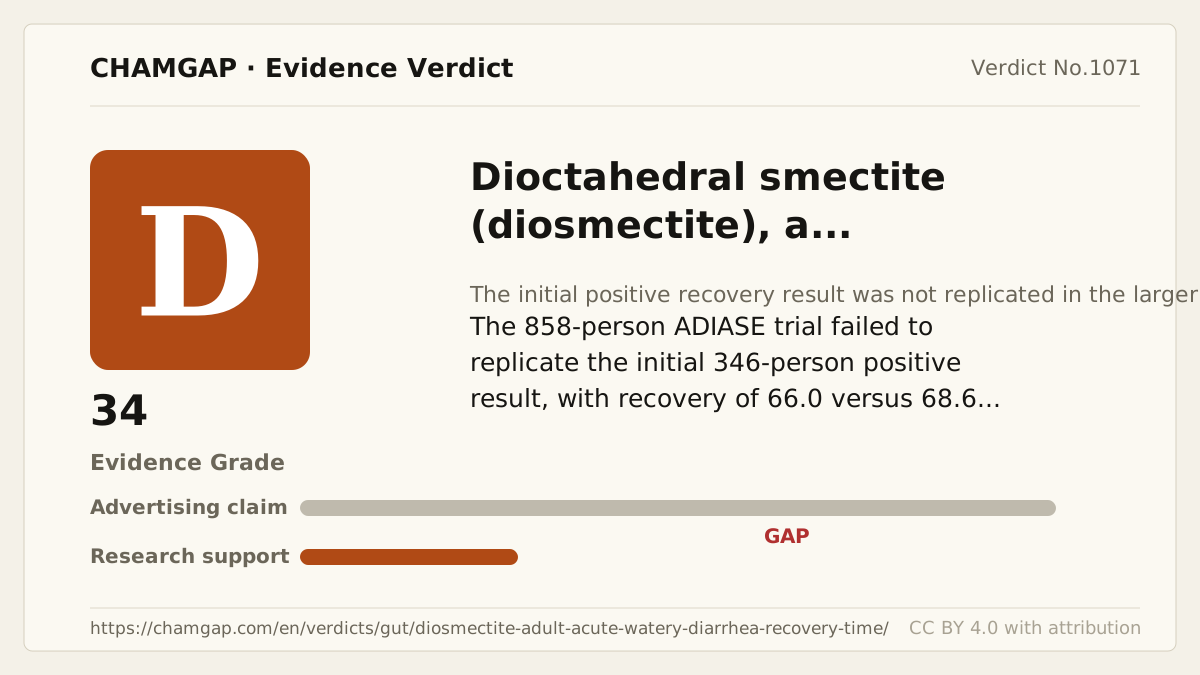
[Chamgap] Dioctahedral smectite x shorter recovery time from acute watery diarrhea in adults — Evidence Grade D·34. 3 cited sources checked. Source: https://chamgap.com/en/verdicts/gut/diosmectite-adult-acute-watery-diarrhea-recovery-time/ · CC BY 4.0CC BY 4.0 — free to use with attribution; do not distort grades, numbers, or verdict meaning.
What this document does and does not do
Chamgap is an information source. It reports what research has and has not confirmed; it does not tell readers what to take or buy. That decision belongs to readers and, when needed, medical or legal professionals. This verdict reflects literature available up to the search date and may change as new research appears. Nothing here is medical advice.