
Decaffeinated coffee, 300 mL,
does it really help with Reduced three-hour postprandial esophageal acid exposure in reflux disease?
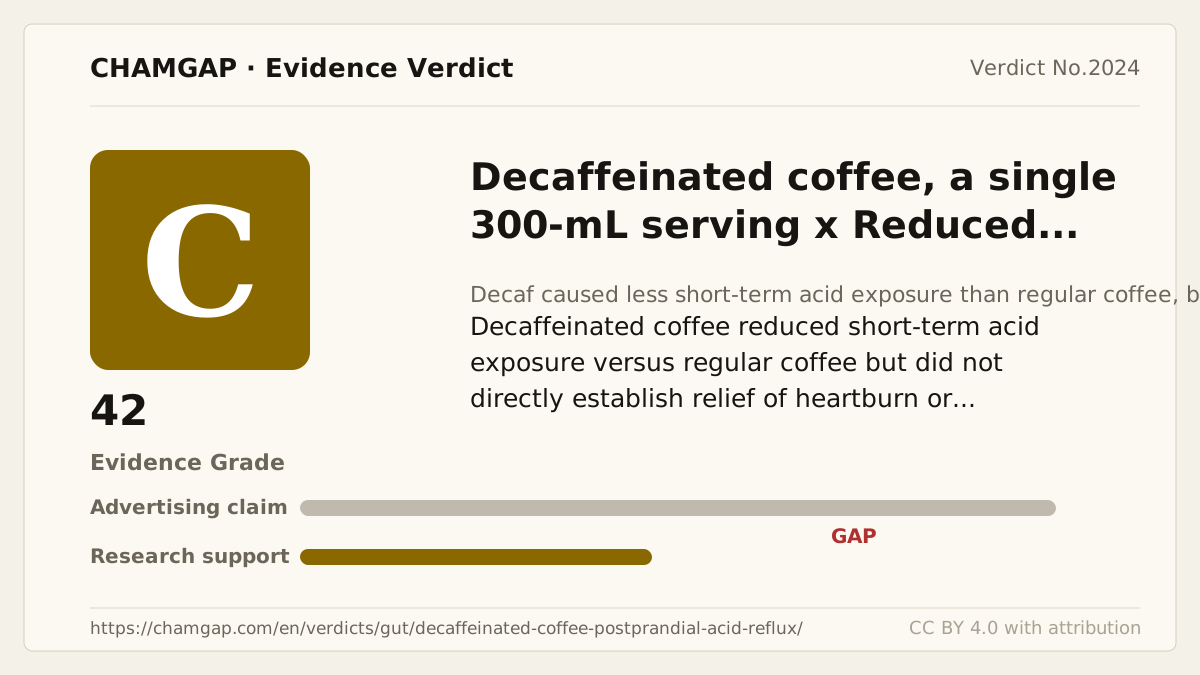
research showsThe grade is C with 50 points. In a double-blind crossover trial, 17 reflux patients drank regular and decaffeinated coffee in randomized order. Median post-meal time with esophageal pH below 4 was 17.9% versus 3.1%, favoring decaf. The trial measured pH rather than symptoms, used one dose in 17 people, and allows assumption-dependent approximations but not a defensible reconstruction of the paired crossover effect.
ads claimDecaf is not necessarily caffeine-free, while this particular trial also found less acid exposure than after regular coffee. Both can be true, but a pH result should not be converted into symptom treatment for every reflux patient.
Useful facts when choosing a product
- The trial supplied 300 mL, about 1.25 cups, once with a standardized breakfast.
- Measured caffeine for the trial products was not found in accessible reporting. The FDA's general range of 2 to 15 mg per 240 mL of decaf coffee is not a value for this trial product.
- Lowell described coffee in Korea in 1884, so the story that Korea's first coffee was consumed during the 1896 royal refuge cannot be repeated as fact.
- Verdict 1037 is D with 33 points for coffee and liver disease, verdict 106 is C with 48 points for green-coffee extract and weight, and verdict 1070 is ? for mushroom coffee and energy. Verdict 2024 asks a different question about decaf as a beverage and post-meal acid reflux.
Chamgap Semantic Classification Code
Candidate index · review held
F.decaffeinated-coffee.food.postprandial-esophageal-acid-exposure-in-reflux-disease.reduce.UNKFoods and beverages > Decaffeinated coffee > Food consumption > postprandial esophageal acid exposure in reflux disease > Reduction claim > Unknown
An automated migration candidate, not an issued permanent code; exact claim scope remains under review. This machine-generated migration candidate helps retrieval but is not a permanent assignment. The original verdict ID and URL remain authoritative.
What the research actually shows
The dose was 300 mL, about 1.25 standard 240-mL cups. A 1997 trial had no prospective registration number, and accessible abstract and bibliographic material did not report funding or conflicts. Manufacturer funding was not inferred.
Why this is classified as C (50)
Acid exposure was significantly lower than after regular coffee, but the outcome was a test surrogate in a 17-person single-dose trial. Assumption-dependent estimation is possible, but the paired crossover effect cannot be reconstructed defensibly; small size and acute duration yield C with 50 points.
Counterpoint. A sufficiently large repeat-consumption trial with symptoms and quality of life as primary outcomes is needed.
Rejudgment record. Cross-check applied — The primary abstract and related randomized trial were cross-checked for the 17-person crossover design, 300-mL dose, three-hour pH outcome, median-and-range reporting, and lack of symptom outcomes
| Endpoint | S | Surrogate marker - laboratory or imaging measures |
| Replication | R1 | Single confirmatory trial |
| Independence | I2 | Decisive evidence is publicly or non-profit funded |
| Effect size | EX | The clinical size of the effect could not be judged |
Stored derived and displayed grades match; this is not a current recalculation or validity check (C).
Sub-claim grades by effect
This ingredient is marketed for several effects. A single overall grade blends strong and weak claims together, so each effect is graded separately here. The overall grade reflects the strongest disconfirming or core claim.
| Effect (sub-claim) | Grade | Basis |
|---|---|---|
| Decaffeinated coffee can still contain small amounts of caffeine | ? | This is a composition fact, not a graded clinical outcome. |
| Decaffeinated coffee reduces postprandial acid exposure versus regular coffee | C | It was positive on a pH surrogate in a 17-person single-dose trial. |
Cross-check — AI research and Codex final gate
Evidence Table
| Study | Design | Sample | Funding | Endpoint | Result | Weight |
|---|---|---|---|---|---|---|
| Pehl C et al., Alimentary Pharmacology & Therapeutics, 1997 | Double-blind randomized single-dose crossover trial | All 17 reflux patients consumed both beverages | Not reported in accessible abstract and bibliographic material | Fraction of three postprandial hours with esophageal pH below 4 | Regular 17.9% (0.7-56.6) versus decaf 3.1% (0-49.9), medians and ranges, P<0.05 | Direct positive evidence, but an acute test surrogate in a very small sample |
Receipt — 3 References
All 3 cited sources were verified for existence at the original page (as of 2026-08-03).
Final verification and publication gate: Codex · Evidence date: 2026-08-03 · Corrections: none
Cite this verdict
[Chamgap] Decaffeinated coffee, 300 mL x reduced postprandial acid reflux — Evidence Grade C·50. 3 cited sources checked. Source: https://chamgap.com/en/verdicts/gut/decaffeinated-coffee-postprandial-acid-reflux/ · CC BY 4.0CC BY 4.0 — free to use with attribution; do not distort grades, numbers, or verdict meaning.
What this document does and does not do
Chamgap is an information source. It reports what research has and has not confirmed; it does not tell readers what to take or buy. That decision belongs to readers and, when needed, medical or legal professionals. This verdict reflects literature available up to the search date and may change as new research appears. Nothing here is medical advice.