
Regular coffee 100 mL three times daily,
does it really help with Shorter time to first bowel movement?
research showsThe grade is C. In an open randomized trial of 80 patients, patient-reported first bowel movement occurred at 60.4±21.3 hours with coffee versus 74.0±21.6 hours with water, a mean 13.6 hours earlier (P=.006). Every other patient-experienced endpoint was null, and avoidable nonblinding combined with a sample below 200 gives 56 points.
ads claimBoth regular and decaffeinated coffee accelerated recovery in trials, so caffeine alone cannot explain the result. Earlier stool must not be marketed as proven improvement in hospitalization or complications.
Useful facts when choosing a product
- Muller used 100 mL black coffee standardized with capsules and a commercial machine three times daily; the article did not define it as espresso or report caffeine milligrams.
- A 105-patient trial compared 100 mL caffeinated coffee, decaf, and water three times daily; decaf produced the earliest stool.
- The FDA general range for 12 fl oz regular brewed coffee is 113 to 247 mg caffeine; this was not an assay of trial coffee.
Chamgap Semantic Classification Code
Candidate index · review held
P.regular-coffee.procedural.shorter-time-to-first-bowel-movement.assess.UNKProcedures, devices and tests > Regular coffee > Procedural > Shorter time to first bowel movement > Association or change assessment > Unknown
An automated migration candidate, not an issued permanent code; exact claim scope remains under review. This machine-generated migration candidate helps retrieval but is not a permanent assignment. The original verdict ID and URL remain authoritative.
What the research actually shows
NCT01079442 registered time from the end of surgery to first bowel movement as the primary endpoint, matching the report. Yang 2022 pooled four colorectal-surgery randomized trials and 312 participants at -10.36 hours (-14.61 to -6.11): three coffee trials by Muller, Dulskas, and Hasler-Gehrer, plus one caffeine-citrate solution trial by Parnasa. Zhu 2022 included six trials and 416 participants; five pooled first-bowel-movement trials gave -15.03 hours (-17.79 to -12.26), with 0% heterogeneity. Its six trials were five coffee studies by Muller, Dulskas, Piric, Hasler-Gehrer, and Hayashi, plus one caffeine-citrate solution study. No caffeine-capsule trial was included. Controls were water for Muller and Dulskas, decaffeinated tea for Hasler-Gehrer, and an aroma-matched solution for Parnasa. Teams in different countries and institutions repeated the direction, but distinct funding across trials could not be confirmed, so replication was not raised. Muller funding could not be confirmed.
Why this is classified as C (50)
Only first bowel movement changed; all other patient-experienced endpoints were null, and avoidable nonblinding of patient reporting combined with an 80-person sample, giving C with 50 points.
Counterpoint. Timing of oral intake, aspiration risk, cardiac status, and caffeine sensitivity require the surgical team's judgment; this is not a self-treatment recommendation.
Rejudgment record. Cross-check applied — Only first bowel movement improved; avoidable nonblinding of patient reporting and an 80-person sample combined while other patient-experienced outcomes were null
| Endpoint | P | Symptom or function itself is the target - including patient reports and performance tests |
| Replication | R1 | Single confirmatory trial |
| Independence | I1 | Mixed funding sources |
| Effect size | E+ | Meets the clinically important threshold |
Stored derived and displayed grades match; this is not a current recalculation or validity check (C).
Sub-claim grades by effect
This ingredient is marketed for several effects. A single overall grade blends strong and weak claims together, so each effect is graded separately here. The overall grade reflects the strongest disconfirming or core claim.
| Effect (sub-claim) | Grade | Basis |
|---|---|---|
| Earlier first bowel movement after colorectal surgery | B | Multiple RCTs and pooled evidence supported a roughly 10-to-15-hour reduction. |
| Earlier first flatus | D | The pooled RCT result was not significant. |
| Fewer postoperative complications | D | Meta-analysis found no difference. |
Cross-check — AI research and Codex final gate
Evidence Table
| Study | Design | Sample | Funding | Endpoint | Result | Weight |
|---|---|---|---|---|---|---|
| Müller et al. 2012 | Multicenter open-label parallel randomized trial | 80 randomized, 40 versus 40; analyzed 40 versus 39 | Original funding could not be confirmed in the accessible record | Time from surgery to first bowel movement, registered and published primary endpoint | 60.4±21.3 versus 74.0±21.6 hours, P=.006 | Prospectively registered pivotal trial |
| Dulskas et al. 2015 | Single-center three-arm randomized trial | 105 randomized and 90 analyzed | Original funding not confirmed | Time to first bowel movement, primary endpoint | Decaf 3.00±1.50 days, regular coffee 3.75±1.53, water 4.14±1.14; P<.05 | Follow-up trial showing caffeine is not the sole active component |
| Yang et al. 2022 meta-analysis | Random-effects meta-analysis of four colorectal-surgery RCTs | 312 participants | Chung Shan Medical University Hospital CSH-2018-C-030 | Time to first bowel movement | Mean 10.36 hours earlier (95% CI 6.11 to 14.61 hours earlier), I²=0% | Consistency synthesis |
Receipt — 5 References
All 5 cited sources were verified for existence at the original page (as of 2026-08-04).
Final verification and publication gate: Codex · Evidence date: 2026-08-04 · Corrections: none
Cite this verdict
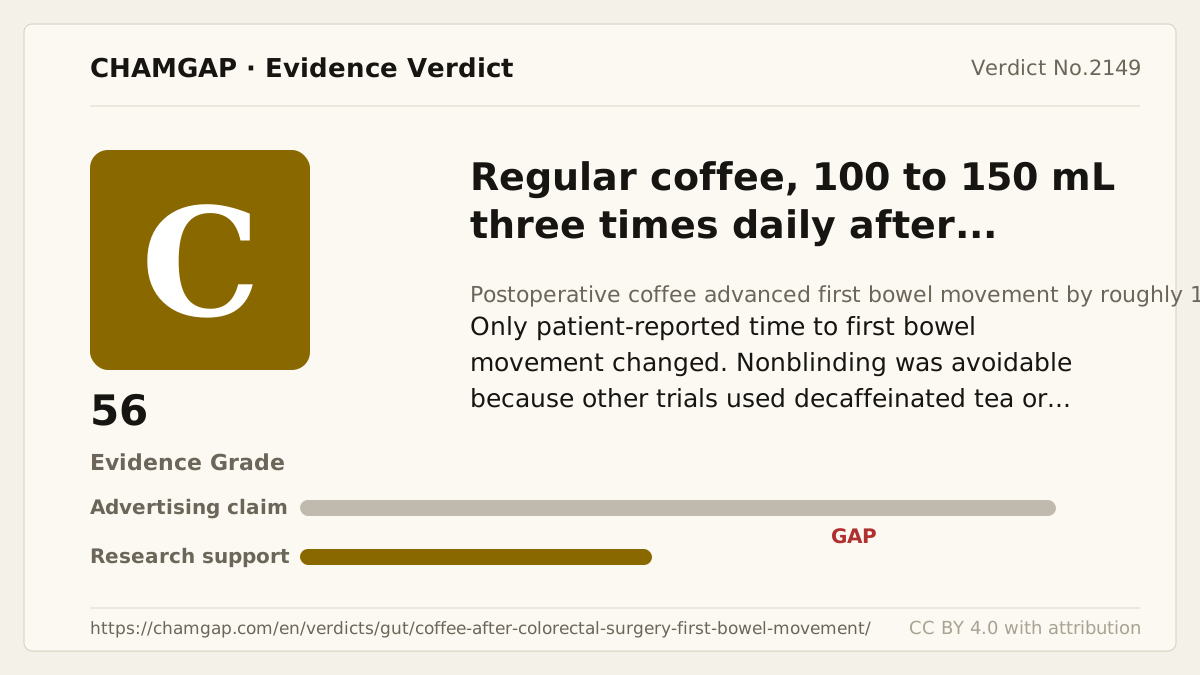
[Chamgap] Regular coffee 100 mL three times daily x earlier bowel movement after colorectal surgery — Evidence Grade C·50. 5 cited sources checked. Source: https://chamgap.com/en/verdicts/gut/coffee-after-colorectal-surgery-first-bowel-movement/ · CC BY 4.0CC BY 4.0 — free to use with attribution; do not distort grades, numbers, or verdict meaning.
What this document does and does not do
Chamgap is an information source. It reports what research has and has not confirmed; it does not tell readers what to take or buy. That decision belongs to readers and, when needed, medical or legal professionals. This verdict reflects literature available up to the search date and may change as new research appears. Nothing here is medical advice.