
Clostridium butyricum MIYAIRI 588,
does it really help with Improvement of abdominal pain and bowel symptoms in diarrhea-predominant irritable bowel syndrome?
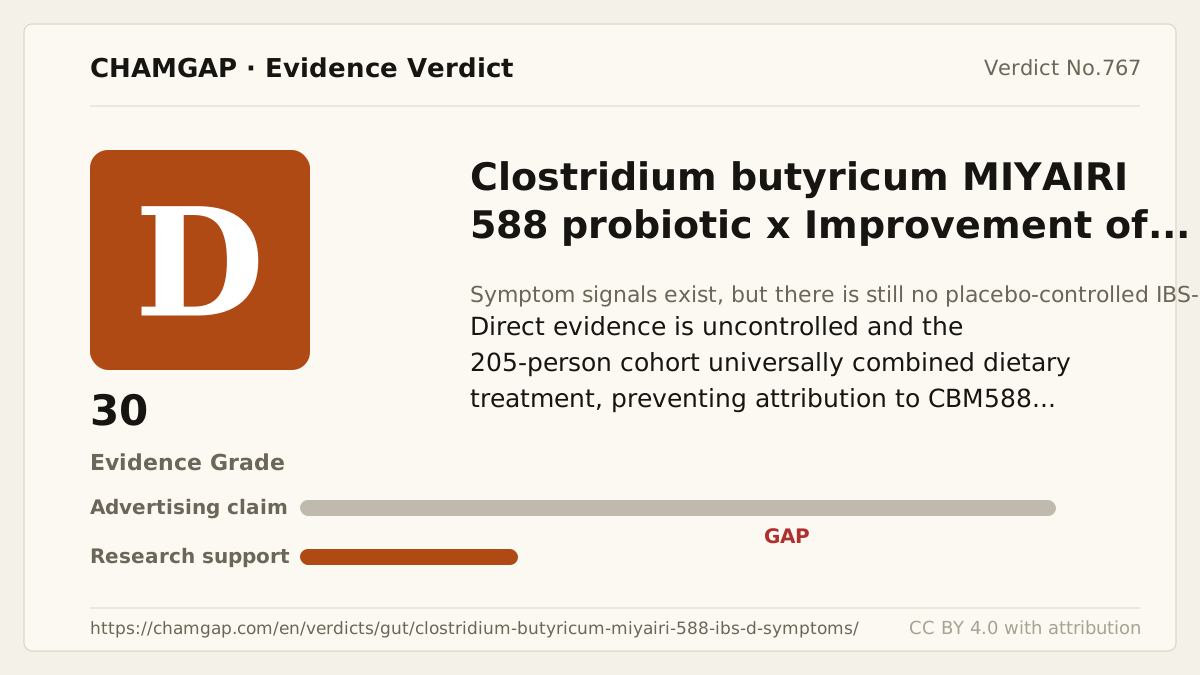
research showsD. Direct IBS-D evidence for MIYAIRI 588 consists only of a 24-person single-arm before-and-after study and a 205-person open-label single-arm study. Neither had a control group, and every participant in the 205-person study also followed a low-fiber, low-residue diet, so improvements in pain and bowel symptoms cannot be attributed to CBM588 alone. The 2018 placebo-controlled trial evaluated ATaiNing, a different C. butyricum product. With no controlled direct efficacy evidence, the record is preclinical, uncontrolled, and attribution-limited, yielding D with 30 points.
ads claimMarketing presents butyrate production or microbiome change as a proven cause of normalized pain and diarrhea. Current direct clinical studies are uncontrolled before-and-after comparisons that cannot separate diet, regression, natural fluctuation, and product effects.
Useful facts when choosing a product
- MIYAIRI 588 is a live, spore-forming, butyrate-producing C. butyricum strain; it does not automatically share clinical effects with other C. butyricum products.
- The 205-person 2025 study used three Butirrisan tablets daily for eight weeks. The tested batch contained 1.5×10^7 CFU per tablet, although the labeled minimum was 4.5×10^5 CFU per tablet at expiry.
- CFU, storage, excipients, and viable survival vary by product, so a study dose and a marketed product should not be treated as identical without checking the label.
- Worsening pain, blood in stool, weight loss, nocturnal diarrhea, or fever requires medical assessment rather than IBS self-treatment.
Chamgap Semantic Classification Code
Candidate index · review held
S.clostridium-butyricum-miyairi-588-probiotic.UNK.abdominal-pain-and-bowel-symptoms-in-diarrhea-predominant-irritable-bowel-syndrome.improve.placeboSupplements and nutraceuticals > Clostridium butyricum MIYAIRI 588 probiotic > Unknown > abdominal pain and bowel symptoms in diarrhea-predominant irritable bowel syndrome > Improvement claim > Placebo
An automated migration candidate, not an issued permanent code; exact claim scope remains under review. This machine-generated migration candidate helps retrieval but is not a permanent assignment. The original verdict ID and URL remain authoritative.
What the research actually shows
Bertuccioli 2025 gave a CBM588 product to 24 people with IBS-D for three months and reported lower IBS-SSS scores, but there was no control group. Di Pierro 2025 treated 205 people for eight weeks with the same strain plus a low-fiber, low-residue diet and reported large reductions in diarrhea, pain, and stool frequency; the study was open-label and single-arm, and results were broadly similar to a differently treated historical cohort from the prior quarter. Sun 2018 randomized 200 participants to ATaiNing or placebo for four weeks and found significant differences in total IBS-SSS change and stool frequency but not abdominal pain or stool form. That trial provides indirect species-level support, not a strain-specific randomized test of MIYAIRI 588.
Why this is classified as D (30)
D. Direct MIYAIRI 588 evidence is limited to uncontrolled studies of 24 and 205 participants, and every participant in the latter also followed a low-fiber, low-residue diet. The lack of a control group and universal concurrent diet prevent attribution to CBM588, while the 200-person randomized trial tested another C. butyricum product. Preclinical, uncontrolled, attribution-limited evidence gives D with 30 points.
Counterpoint. Adjunctive benefit is possible for some patients, but the evidence does not support replacing diet or standard IBS-D care or generalizing to every butyrate-producing probiotic.
Rejudgment record. Reassessment (cross-check reflected) — Direct MIYAIRI 588 human evidence is limited to uncontrolled single-arm studies of 24 and 205 participants, and every participant in the 205-person study followed a concurrent low-fiber, low-residue diet, preventing attribution to CBM588 alone. The placebo-controlled trial tested another C. butyricum product, so preclinical, uncontrolled, attribution-limited evidence warrants D
Sub-claim grades by effect
This ingredient is marketed for several effects. A single overall grade blends strong and weak claims together, so each effect is graded separately here. The overall grade reflects the strongest disconfirming or core claim.
| Effect (sub-claim) | Grade | Basis |
|---|---|---|
| Improvement of abdominal pain and bowel symptoms in IBS-D | D | Direct single-arm studies provide before-and-after signals, but no controlled MIYAIRI 588 efficacy evidence exists. |
| Attribution is impossible with a single-arm design and concurrent diet | ? | Every participant in the 205-person study followed a low-fiber, low-residue diet, so improvement cannot be isolated as a CBM588-only effect. |
| Extension from strain-specific evidence to general gut health | ? | Results from another C. butyricum product and undefined gut-health claims cannot be generalized as MIYAIRI 588 efficacy. |
Cross-check — AI research and Codex final gate
Evidence Table
| Study | Design | Sample | Funding | Endpoint | Result | Weight |
|---|---|---|---|---|---|---|
| Bertuccioli A et al. 2025 | Prospective single-arm before-and-after clinical evaluation | 24 participants with IBS-D | No external funding reported; evaluated the commercial Butirrisan product | Three-month IBS-SSS and component symptoms | IBS-SSS, pain, bloating, and life interference improved from baseline, but there was no control group. | Direct but highly limited |
| Di Pierro F et al. 2025 | Prospective open-label single-arm real-world study | 205 participants with IBS-D | No external funding reported; commercial product with concurrent diet intervention | Eight-week diarrhea, pain, stool frequency, IBS-SSS, and quality of life | All outcomes improved markedly from baseline, but there was no placebo control and a low-fiber, low-residue diet was applied concurrently. | Direct signal with limited causal inference |
| Sun YY et al. 2018 | Multicenter randomized double-blind placebo-controlled trial | 200 participants with IBS-D; 166 completed | Chinese public grants; authors declared no competing interests | Four-week IBS-SSS, pain, stool frequency, and Bristol stool form | Total IBS-SSS and stool frequency were positive, but pain and stool form were not significant, and the product was ATaiNing rather than MIYAIRI 588. | Indirect species-level randomized evidence |
Receipt — 4 References
All 4 cited sources were verified for existence at the original page (as of 2026-07-20).
Final verification and publication gate: Codex · Evidence date: 2026-07-20 · Corrections: none
Cite this verdict
[Chamgap] Clostridium butyricum MIYAIRI 588 x improved abdominal pain and bowel symptoms in IBS-D — Evidence Grade D·30. 4 cited sources checked. Source: https://chamgap.com/en/verdicts/gut/clostridium-butyricum-miyairi-588-ibs-d-symptoms/ · CC BY 4.0CC BY 4.0 — free to use with attribution; do not distort grades, numbers, or verdict meaning.
What this document does and does not do
Chamgap is an information source. It reports what research has and has not confirmed; it does not tell readers what to take or buy. That decision belongs to readers and, when needed, medical or legal professionals. This verdict reflects literature available up to the search date and may change as new research appears. Nothing here is medical advice.