
Caregiver-delivered infant massage,
does it really help with Improved crying and sleep in infantile colic?
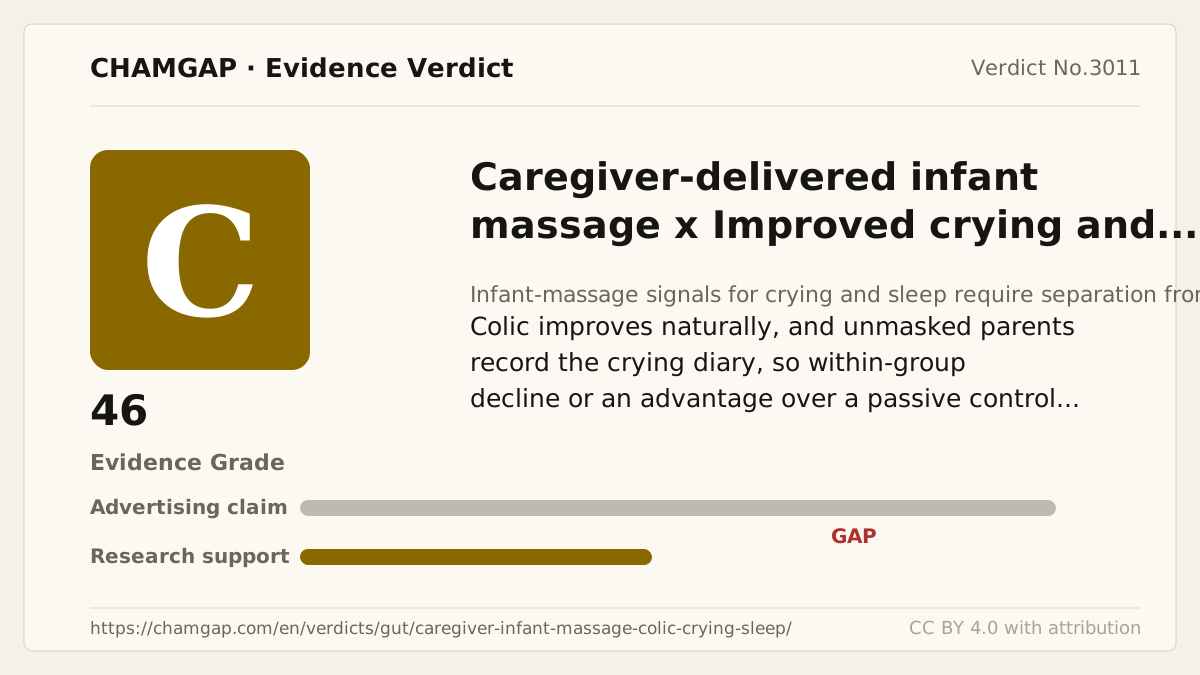
research showsGrade C with 46 points. In a 58-infant trial, three-week crying fell 48% with massage and 47% with crib vibration. A positive 100-infant one-week massage-versus-rocking study used referral-day allocation, had a major baseline crying imbalance of 4.96 versus 3.00 hours, and relied on parent diaries, leaving the net massage effect unresolved.
ads claimThe claim that a few massages cure colic removes natural improvement, caregiver expectations, and control-intervention differences.
Useful facts when choosing a product
- Massage and crib vibration produced nearly identical crying reductions in one trial.
- Positive studies were short and depended on parent-recorded crying.
- Massage, kangaroo care, and rocking are distinct interventions.
Chamgap Semantic Classification Code
Permanent code issued
X.caregiver-infant-massage.behavioral.infant-colic-crying-duration.reduce.crib-vibrationBehaviors, exposures and policies > Caregiver-delivered infant massage > Behavioral delivery > Improved crying and sleep in infantile colic > Reduction claim > Crib vibration
Codex retrospectively verified the principal intervention, delivery, population, endpoint, and comparator from the existing reviewed verdict and issued a permanent semantic code. Secondary outcomes on the page are not transferred as separate claims. The code identifies the intervention and claim; it never contains the evidence grade, score, or safety result.
Exact Claim Classification
These independent facets prevent evidence from different forms, routes, populations, effects, and comparators from being mixed.
| Intervention class | X · Behavior, exposure, or policy |
|---|---|
| Canonical ingredient or intervention | Caregiver-delivered infant massage |
| Source or part used | Plant source not applicable; specified behavior or training |
| Formulation or processing | Caregiver-delivered infant massage |
| Route | Behavioral delivery |
| Dose | Caregiver-delivered infant massage |
| Duration | Three weeks |
| Population | 58 infants |
| Effect or condition | Improved crying and sleep in infantile colic |
| Primary endpoint | Three-week total and colicky crying |
| Comparator | Crib vibration |
| Duplicate-detection key | caregiver-infant-massage|behavioral|58 infants|infant-colic-crying-duration|Three weeks |
What the research actually shows
Caregivers were taught a specified massage protocol and compared with crib vibration, rocking, kangaroo care, or usual care. Studies using oil were not interpreted as evidence for an oil ingredient.
Why this is classified as C (46)
No reliable prespecified net effect or independence strength was verified; referral-day allocation, baseline imbalance, unmasked parent diaries, and one-week follow-up give C with 46 points.
Counterpoint. The 48% versus 47% result against crib vibration shows that not all colic improvement can be attributed to massage.
Rejudgment record. Cross-check applied — Incorporated referral-day allocation, baseline imbalance, parent diaries, and natural history; excluded same-cohort reanalysis, lavender combinations, and professional delivery from replication credit
| Endpoint | P | Symptom or function itself is the target - including patient reports and performance tests |
| Replication | R1 | Single confirmatory trial |
| Independence | I1 | Mixed funding sources |
| Effect size | EX | The clinical size of the effect could not be judged |
| Precision | CX | No pooled confidence interval could be confirmed |
Stored derived and displayed grades match; this is not a current recalculation or validity check (C).
Sub-claim grades by effect
This ingredient is marketed for several effects. A single overall grade blends strong and weak claims together, so each effect is graded separately here. The overall grade reflects the strongest disconfirming or core claim.
| Effect (sub-claim) | Grade | Basis |
|---|---|---|
| Reduced crying in infantile colic | C | There are signals versus rocking or usual care but not versus crib vibration. |
| Increased sleep duration | C | Reported in a short parent-diary trial; durability is uncertain. |
Cross-check — AI research and Codex final gate
Evidence Table
| Study | Design | Sample | Funding | Endpoint | Result | Weight |
|---|---|---|---|---|---|---|
| Huhtala V et al. 2000 | Randomized massage-versus-crib-vibration trial | 58 infants | Specific funding and conflicts unverified | Three-week total and colicky crying | Crying reduction 48% versus 47%; no massage-specific benefit | Contrary active-control evidence |
| Sheidaei A et al. 2016 | Quasi-random referral-day massage-versus-rocking trial | 100 infants, all completed | Institutional support acknowledged; independent funding unverified | One-week crying frequency, duration, and sleep | Favorable end-point crying with baseline imbalance in crying, 4.96 versus 3.00 h, and sleep, 9.22 versus 12.24 h; adjusted net effect unclear | Positive trial at high risk of bias |
Receipt — 2 References
All 2 cited sources were verified for existence at the original page (as of 2026-09-07).
Final verification and publication gate: Codex · Evidence date: 2026-09-07 · Corrections: none
Cite this verdict
[Chamgap] Caregiver Infant Massage for Colic—Results Depend on the Active Control and Parent-Diary Bias Is Substantial — Evidence Grade C·46. 2 cited sources checked. Source: https://chamgap.com/en/verdicts/gut/caregiver-infant-massage-colic-crying-sleep/ · CC BY 4.0CC BY 4.0 — free to use with attribution; do not distort grades, numbers, or verdict meaning.
What this document does and does not do
Chamgap is an information source. It reports what research has and has not confirmed; it does not tell readers what to take or buy. That decision belongs to readers and, when needed, medical or legal professionals. This verdict reflects literature available up to the search date and may change as new research appears. Nothing here is medical advice.