
Capecitabine,
does it really help with Prevention of recurrence and death as adjuvant monotherapy after complete resection of stage III colon cancer?
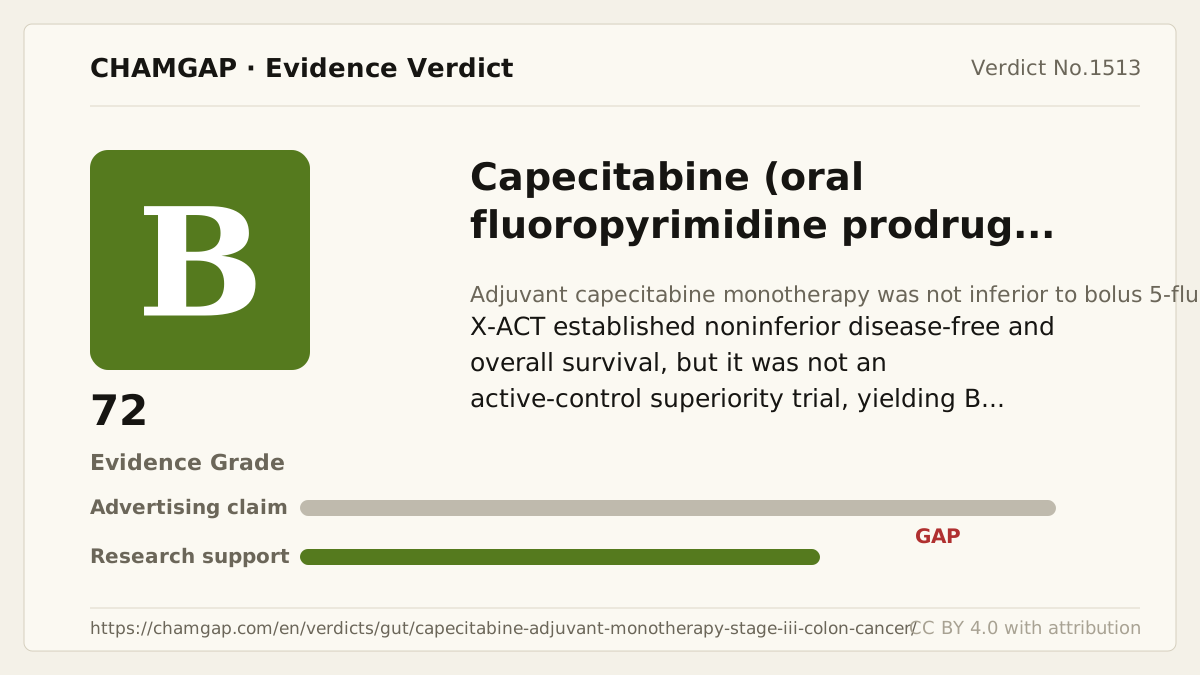
research showsAdjuvant capecitabine monotherapy is rated B after complete resection of stage III colon cancer. The phase III X-ACT trial randomized 1,987 participants to oral capecitabine or bolus 5-fluorouracil plus leucovorin and met prespecified noninferiority criteria for disease-free and overall survival. At long-term follow-up, hazard ratios were 0.88 for disease-free survival and 0.86 for overall survival, but the primary design and conclusion established noninferiority to an active control rather than superiority. Dependence on one pivotal active-control trial and the noninferiority boundary yield B with 72 points.
ads claimOral convenience and noninferiority can be expanded into superiority over all injectable combination therapy or universally lower toxicity. The comparator was bolus 5-fluorouracil plus leucovorin, while hand-foot syndrome and diarrhea are important capecitabine toxicities.
Useful facts when choosing a product
- Capecitabine is an oral fluoropyrimidine prescription anticancer medicine converted to 5-fluorouracil in the body.
- X-ACT evaluated adjuvant monotherapy for 24 weeks across eight three-week cycles after surgery.
- The pivotal comparator was Mayo Clinic bolus 5-fluorouracil plus leucovorin, not an oxaliplatin-containing combination.
- Hand-foot syndrome, diarrhea, stomatitis, myelosuppression, and cardiotoxicity can occur, and DPD deficiency markedly increases the risk of severe or fatal toxicity.
Chamgap Semantic Classification Code
Candidate index · review held
M.capecitabine.oral.recurrence-and-death-as-adjuvant-monotherapy-after-complete-resection-of-stage-iii-colon-cancer.prevent.activeMedicinal interventions > Capecitabine > Oral > recurrence and death as adjuvant monotherapy after complete resection of stage III colon cancer > Occurrence-prevention claim > Active comparator
An automated migration candidate, not an issued permanent code; exact claim scope remains under review. This machine-generated migration candidate helps retrieval but is not a permanent assignment. The original verdict ID and URL remain authoritative.
What the research actually shows
The 2005 X-ACT report by Twelves randomized 1,987 patients with completely resected Dukes C, now stage III, colon cancer to capecitabine 1,250 mg per square meter twice daily for 14 days followed by seven days off for eight cycles, or bolus 5-fluorouracil plus leucovorin. The primary disease-free survival endpoint met noninferiority with a hazard ratio of 0.87, and relapse-free survival was also noninferior. The 2012 final analysis at a median 6.9 years reported hazard ratios of 0.88 for disease-free survival and 0.86 for overall survival, both within prespecified noninferiority margins. This evidence compares monotherapy with older bolus therapy and is separate from trials of oxaliplatin combinations.
Why this is classified as B (72)
A large phase III randomized trial directly established noninferior disease-free and overall survival versus active-control 5-fluorouracil plus leucovorin. It did not reproduce ingredient-specific superiority versus placebo or no treatment and depends on one pivotal trial, so the active-control noninferiority boundary yields B with 72 points.
Counterpoint. This verdict concerns adjuvant capecitabine monotherapy after complete resection of stage III colon cancer. It does not combine evidence from residual breast cancer, metastatic disease, rectal cancer, or capecitabine-oxaliplatin combinations.
Rejudgment record. New verdict — Accepted noninferiority for disease-free and overall survival in X-ACT, but did not relabel active-control noninferiority as superiority and applied the single-pivotal-trial ceiling for grade B
Sub-claim grades by effect
This ingredient is marketed for several effects. A single overall grade blends strong and weak claims together, so each effect is graded separately here. The overall grade reflects the strongest disconfirming or core claim.
| Effect (sub-claim) | Grade | Basis |
|---|---|---|
| Noninferior disease-free survival versus standard 5-fluorouracil plus leucovorin after complete resection of stage III colon cancer | B | X-ACT met the prespecified noninferiority criterion but did not establish superiority. |
| Noninferior overall survival versus standard 5-fluorouracil plus leucovorin after complete resection of stage III colon cancer | B | The long-term hazard ratio of 0.86 was within the prespecified noninferiority margin. |
| Reduced recurrence and death versus modern oxaliplatin-containing therapy after complete resection of stage III colon cancer | C | X-ACT did not directly make this comparison, so monotherapy results cannot establish benefit over an oxaliplatin-containing regimen. |
Cross-check — AI research and Codex final gate
Evidence Table
| Study | Design | Sample | Funding | Endpoint | Result | Weight |
|---|---|---|---|---|---|---|
| Twelves C et al. 2005 X-ACT | Multicenter phase III randomized active-controlled noninferiority trial | 1,987 patients with completely resected stage III colon cancer | F. Hoffmann-La Roche | Disease-free survival, relapse-free survival, and overall survival | Disease-free survival met noninferiority versus 5-fluorouracil plus leucovorin with a hazard ratio of 0.87. | Pivotal active-control noninferiority trial |
| Twelves C et al. 2012 X-ACT final analysis | Long-term final analysis of the same randomized trial | 1,004 capecitabine and 983 5-fluorouracil plus leucovorin recipients | F. Hoffmann-La Roche | Disease-free and overall survival at a median follow-up of 6.9 years | Hazard ratios were 0.88 for disease-free survival and 0.86 for overall survival, meeting prespecified noninferiority margins. | Long-term confirmation; not an independent trial |
Receipt — 2 References
All 2 cited sources were verified for existence at the original page (as of 2026-07-23).
Final verification and publication gate: Codex · Evidence date: 2026-07-23 · Corrections: none
Cite this verdict
[Chamgap] Capecitabine x prevention of recurrence and death after resection of stage III colon cancer — Evidence Grade B·72. 2 cited sources checked. Source: https://chamgap.com/en/verdicts/gut/capecitabine-adjuvant-monotherapy-stage-iii-colon-cancer/ · CC BY 4.0CC BY 4.0 — free to use with attribution; do not distort grades, numbers, or verdict meaning.
What this document does and does not do
Chamgap is an information source. It reports what research has and has not confirmed; it does not tell readers what to take or buy. That decision belongs to readers and, when needed, medical or legal professionals. This verdict reflects literature available up to the search date and may change as new research appears. Nothing here is medical advice.