
Bone-broth protein,
does it really help with Improvement of leaky gut and intestinal permeability and restoration of the intestinal barrier?
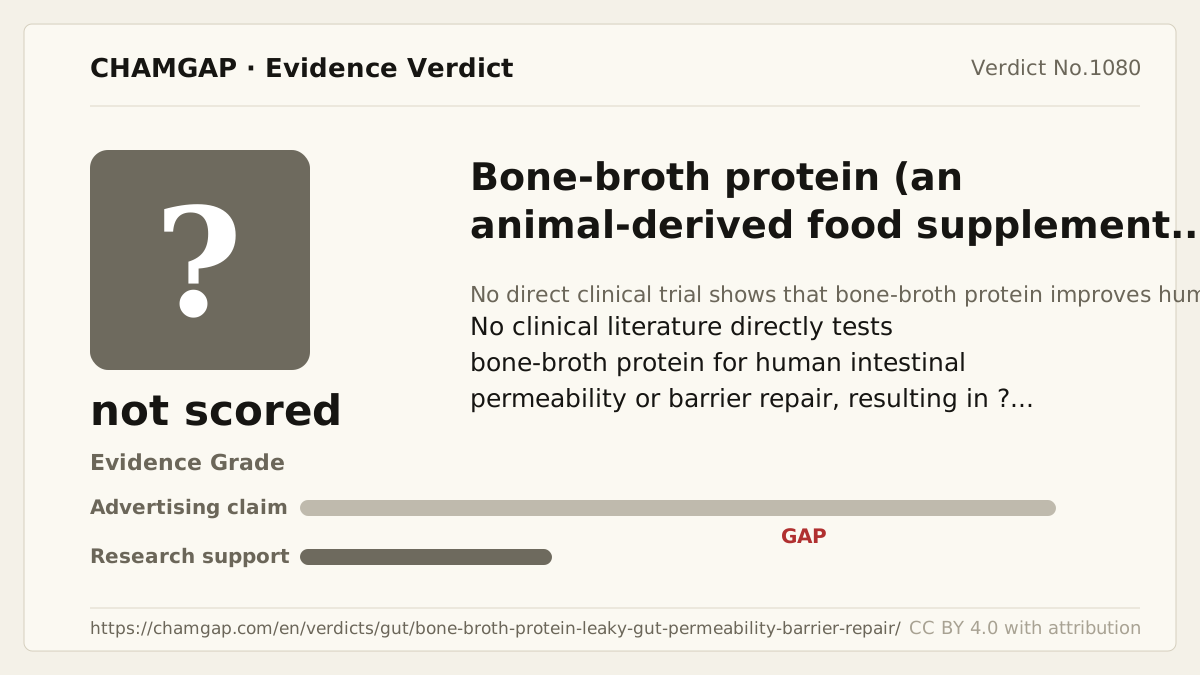
research showsBone-broth protein is rated ? for improving leaky gut or intestinal permeability and restoring the intestinal barrier in humans. A 2025 narrative review by Mayo Clinic authors connected amino-acid and mineral mechanisms with animal and component studies, but did not provide a human trial in which a bone-broth protein product was administered and a validated permeability test or clinical disease outcome was assessed. A 2024 systematic review of diet and permeability in healthy people included 12 eligible studies, none involving bone broth or bone-broth protein. Direct human efficacy literature is therefore absent and no numeric score can be assigned.
ads claimMarketing turns the presence of collagen, gelatin, glutamine, and glycine into a claim that the product coats the intestine and seals holes. Ingested proteins are digested, and the presence of an ingredient alone does not establish tissue exposure, a clinical effect, or equivalence across brands.
Useful facts when choosing a product
- Bone-broth protein is sold as a food supplement made by concentrating and drying liquid prepared from animal bones and connective tissues, and its collagen-derived amino-acid composition and protein content can vary with source material and processing.
- Bone broth, powdered bone-broth protein, and purified collagen peptides are not the same products, so evidence from one category should not automatically be transferred to another.
- Some products can contain substantial sodium, flavorings, sweeteners, or allergenic ingredients, making the nutrition label and ingredient list important.
- A small analysis found more lead in some broths than in their source water, while a 2017 controlled study judged lead and cadmium exposure per serving to be low. This conflict supports product-specific contamination testing and attention to variation rather than a uniform toxicity conclusion.
Chamgap Semantic Classification Code
Candidate index · review held
S.bone-broth-protein.UNK.leaky-gut-and-intestinal-permeability-and-restoration-of-the-intestinal-barrier.improve.UNKSupplements and nutraceuticals > Bone-broth protein > Unknown > leaky gut and intestinal permeability and restoration of the intestinal barrier > Improvement claim > Unknown
An automated migration candidate, not an issued permanent code; exact claim scope remains under review. This machine-generated migration candidate helps retrieval but is not a permanent assignment. The original verdict ID and URL remain authoritative.
What the research actually shows
Matar, Abdelnaem, and Camilleri 2025 narratively reviewed bone-broth constituents and evidence involving the intestinal barrier and inflammation. The main direct bone-broth studies were in colitis mice and other preclinical settings, while human evidence largely concerned individual amino acids or nutrients, preventing isolation of a clinical bone-broth protein effect. Nascimento 2024 systematically reviewed dietary and nutritional interventions that measured permeability in healthy people, identifying some results for inulin and probiotics but no bone-broth or bone-broth-protein intervention. Cleveland Clinic nutrition specialists similarly note that direct research on bone broth remains sparse. A valid product trial would need to use a defined product and outcomes such as a lactulose-to-mannitol test, multisugar permeability testing, validated tight-junction measures, or disease-specific clinical outcomes rather than the loose marketing term leaky gut.
Why this is classified as ?
Evidence exists for bone-broth composition and animal models, but no efficacy trial was found that administered a bone-broth protein product to humans and measured a validated permeability test, intestinal-barrier marker, or relevant clinical symptom. Ingredient mechanisms and preclinical studies cannot substitute for a product-level clinical result, so the grade is ? and the score is null. Lead, sodium, allergens, and product variability are separate safety issues.
Counterpoint. Enjoying bone broth as a protein-containing food or warm drink is different from using it as a treatment for leaky gut. Persistent diarrhea, abdominal pain, weight loss, or blood in stool requires evaluation for an underlying condition rather than substitution with an unproven powder.
Rejudgment record. New verdict — Applied ? after comparing the 2025 review of bone broth and gut-barrier biology with the 2024 systematic review of diet and human permeability and finding no human efficacy trial that administered a bone-broth protein product and evaluated permeability, barrier repair, or leaky-gut outcomes; component and animal evidence was not upgraded to product-level clinical efficacy
Sub-claim grades by effect
This ingredient is marketed for several effects. A single overall grade blends strong and weak claims together, so each effect is graded separately here. The overall grade reflects the strongest disconfirming or core claim.
| Effect (sub-claim) | Grade | Basis |
|---|---|---|
| Improved intestinal permeability | ? | No human trial has administered bone-broth protein and performed a validated intestinal-permeability test. |
| Restoration of the intestinal barrier | ? | No human clinical literature validates tight-junction or mucosal repair at the product level. |
| Improvement of leaky gut | ? | No human bone-broth-protein study defines this nonstandard term using validated biomarkers, symptoms, or disease outcomes. |
Cross-check — AI research and Codex final gate
Evidence Table
| Study | Design | Sample | Funding | Endpoint | Result | Weight |
|---|---|---|---|---|---|---|
| Matar A et al. 2025 | Narrative review of bone-broth constituents and intestinal-barrier biology | Zero direct human bone-broth-protein interventions; synthesis of human component, animal, and mechanistic literature | No relevant conflicts of interest reported; external funding details were not specified in the PubMed record | Intestinal-barrier integrity, permeability, inflammation, and bone-broth constituents | The review proposed potential benefits of bone-broth constituents but presented no human intestinal-permeability or barrier trial of the product itself and encouraged further research. | Evidence-gap assessment for direct human research |
| de Souza Marinho do Nascimento D et al. 2024 | Systematic review of diet and intestinal permeability in healthy people | 3,725 records retrieved and 12 eligible studies; zero bone-broth interventions | Academic research; the article reported no conflicts of interest | Human intestinal-permeability tests including lactulose-to-mannitol measures | The review included interventions such as inulin and probiotics but no bone broth or bone-broth protein, and found no strong evidence for dietary interventions overall. | Scope assessment of human permeability literature |
| Monro JA et al. 2013 and Hsu DJ et al. 2017 | Two experimental analyses of metal content in bone broth | A small analysis of three chicken broths plus controlled cooking experiments and commercial or homemade samples | Food-contamination and composition research rather than product-efficacy trials; funding was not reported in the PubMed abstracts | Concentrations of lead, cadmium, and essential metals | The small 2013 analysis found more lead in some broths than in source water, while the 2017 controlled study judged lead and cadmium risk per serving to be low. | Product-variation and safety context |
Receipt — 5 References
All 5 cited sources were verified for existence at the original page (as of 2026-07-21).
Final verification and publication gate: Codex · Evidence date: 2026-07-21 · Corrections: none
Cite this verdict
[Chamgap] Bone-broth protein x leaky gut, intestinal permeability, and barrier repair — Evidence Grade ?. 5 cited sources checked. Source: https://chamgap.com/en/verdicts/gut/bone-broth-protein-leaky-gut-permeability-barrier-repair/ · CC BY 4.0CC BY 4.0 — free to use with attribution; do not distort grades, numbers, or verdict meaning.
What this document does and does not do
Chamgap is an information source. It reports what research has and has not confirmed; it does not tell readers what to take or buy. That decision belongs to readers and, when needed, medical or legal professionals. This verdict reflects literature available up to the search date and may change as new research appears. Nothing here is medical advice.