
Alcohol hand sanitizer use,
does it really help with Lower incidence of travelers' diarrhea?
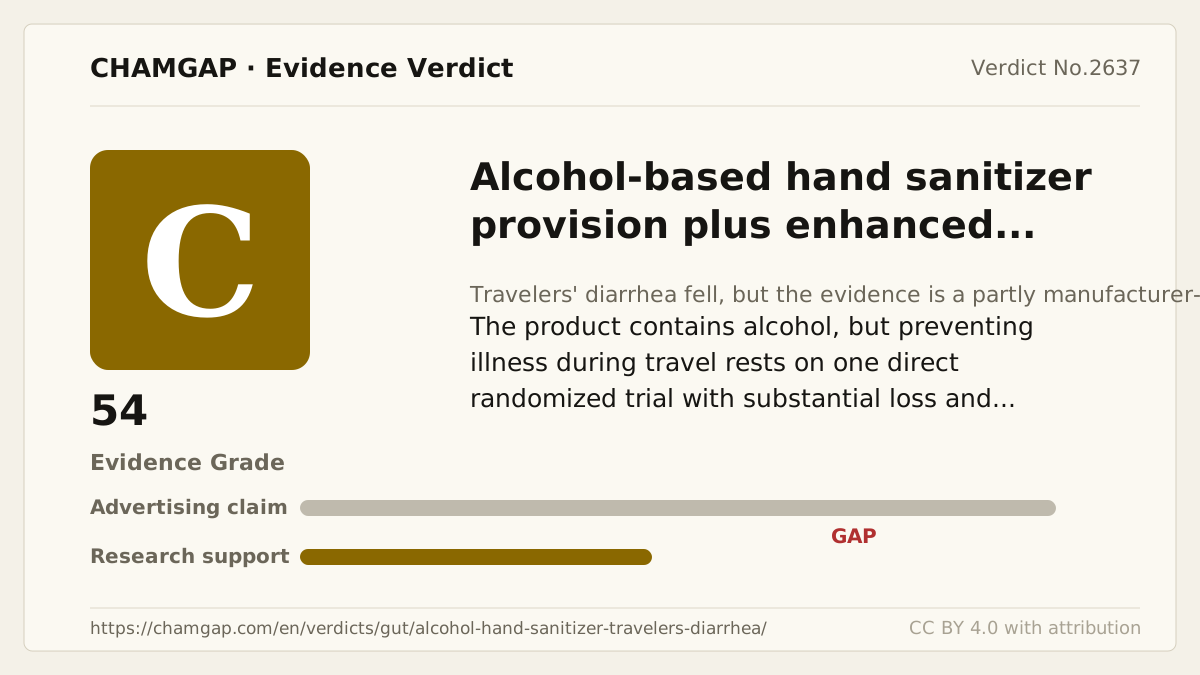
research showsThe grade is C with 54 points. A 2019 randomized trial reported an odds ratio of 0.54 (95% CI 0.30 to 0.97) for WHO-defined travelers' diarrhea. Outcome data were available for only 222 of 279 randomized participants, and 74% of controls also used hand gel. Gel provision and education were bundled, so their effects cannot be separated.
ads claimThe evidence cannot isolate sanitizer alone. Food and water hygiene, handwashing, destination, and travel style matter, and sanitizer does not fully replace soap and water.
Useful facts when choosing a product
- The 2019 intervention bundled Sterillium provision with enhanced hand-hygiene education.
- Only 222 of 279 randomized participants entered the travelers' diarrhea analysis, leaving 57, or 20.4%, without endpoint data.
- Gautret was not an author of the 2019 trial, so the author teams did not overlap.
Chamgap Semantic Classification Code
Candidate index · review held
X.alcohol-based-hand-sanitizer-provision-plus-enhanced-hand-hygiene-education-during-international-travel.behavioral.incidence-of-travelers-diarrhea.reduce.UNKBehaviors, exposures and policies > Alcohol-based hand sanitizer provision plus enhanced hand-hygiene education during international travel > Behavioral delivery > incidence of travelers' diarrhea > Reduction claim > Unknown
An automated migration candidate, not an issued permanent code; exact claim scope remains under review. This machine-generated migration candidate helps retrieval but is not a permanent assignment. The original verdict ID and URL remain authoritative.
What the research actually shows
Kuenzli and colleagues randomized 279 people and analyzed travelers' diarrhea data for 222, 104 versus 118. The OR for WHO-defined travelers' diarrhea was 0.54 (0.30-0.97). The trial was registered as NCT03306407 and partly funded by IVF Hartmann AG, which also supplied Sterillium; the company reportedly had no operational role. Henriey, Delmont, and Gautret prospectively surveyed 200 returning travelers: about 65 users versus 135 nonusers had diarrhea or vomiting rates of 17% versus 30%, OR 0.47 (0.21-0.97). Authors did not overlap across the papers, but funding for the observational study was not found in the accessible record.
Why this is classified as C (54)
A direct disease-event reduction is credible, but one partly manufacturer-funded RCT with substantial attrition, contamination, and self-report plus noncomparable observational support gives C with 54 points.
Counterpoint. The estimate reflects an education package amid heavy control use, not a pure product effect.
Rejudgment record. Cross-check applied — Cross-checked authorship, design, registration, funding, randomized and analyzed counts, and control contamination in both papers
| Endpoint | H | Hard endpoint - actual events such as death |
| Replication | R1 | Single confirmatory trial |
| Independence | I1 | Mixed funding sources |
| Effect size | E+ | Meets the clinically important threshold |
Stored derived and displayed grades match; this is not a current recalculation or validity check (C).
Sub-claim grades by effect
This ingredient is marketed for several effects. A single overall grade blends strong and weak claims together, so each effect is graded separately here. The overall grade reflects the strongest disconfirming or core claim.
| Effect (sub-claim) | Grade | Basis |
|---|---|---|
| Fewer cases of travelers' diarrhea | C | The direct RCT was positive but limited by attrition, contamination, and a bundled intervention. |
| Effect of sanitizer alone | ? | Sanitizer was bundled with education, so component effects were not separated. |
Cross-check — AI research and Codex final gate
Evidence Table
| Study | Design | Sample | Funding | Endpoint | Result | Weight |
|---|---|---|---|---|---|---|
| Kuenzli E et al. 2019 | Multicenter randomized controlled trial | 279 randomized; 222 analyzed for the endpoint (104 versus 118) | Partly funded by IVF Hartmann AG, which supplied Sterillium; no reported operational role | WHO-defined travelers' diarrhea | OR 0.54 (95% CI 0.30-0.97) | Pivotal direct randomized evidence |
| Henriey D, Delmont J, Gautret P. 2014 | Prospective observational study | 200 returning travelers; about 65 users | Not identified in the accessible record | Diarrhea or vomiting | 17% versus 30%, OR 0.47 (0.21-0.97) | Supportive observational evidence with self-selected exposure |
Receipt — 2 References
All 2 cited sources were verified for existence at the original page (as of 2026-08-15).
Final verification and publication gate: Codex · Evidence date: 2026-08-15 · Corrections: none
Cite this verdict
[Chamgap] Alcohol hand sanitizer use x travelers' diarrhea — Evidence Grade C·54. 2 cited sources checked. Source: https://chamgap.com/en/verdicts/gut/alcohol-hand-sanitizer-travelers-diarrhea/ · CC BY 4.0CC BY 4.0 — free to use with attribution; do not distort grades, numbers, or verdict meaning.
What this document does and does not do
Chamgap is an information source. It reports what research has and has not confirmed; it does not tell readers what to take or buy. That decision belongs to readers and, when needed, medical or legal professionals. This verdict reflects literature available up to the search date and may change as new research appears. Nothing here is medical advice.