
Albendazole,
does it really help with Parasitological cure of intestinal soil-transmitted nematode infections including ascariasis and hookworm?
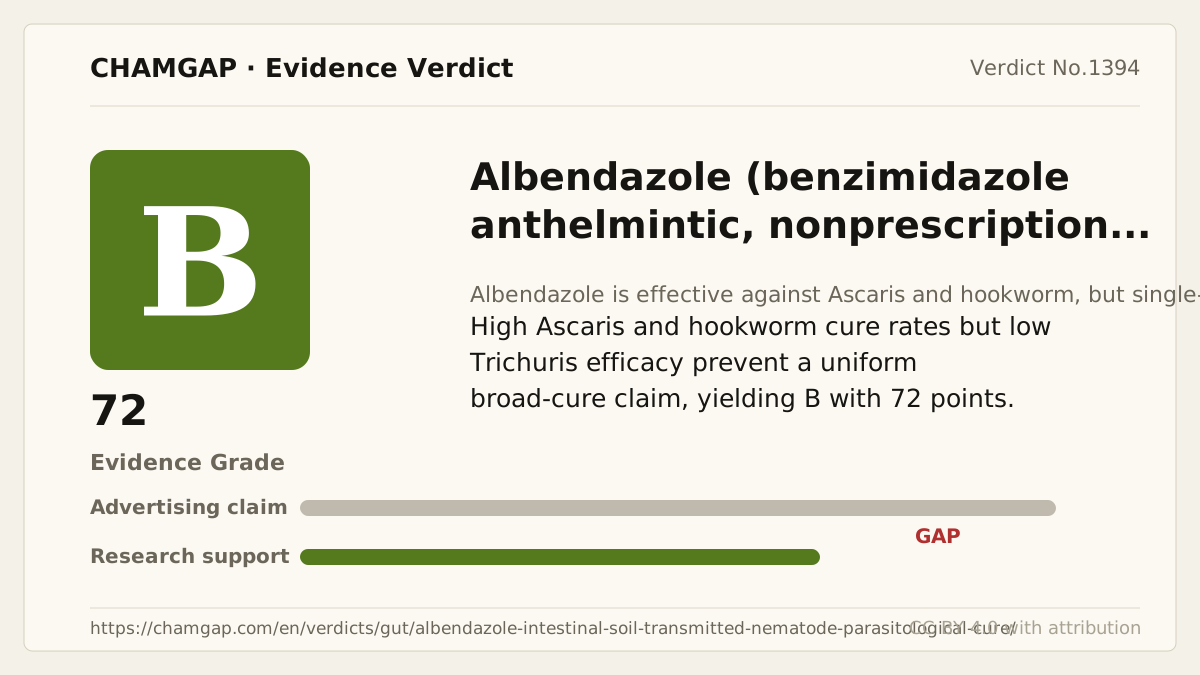
research showsAlbendazole is rated B because it has established parasitological cure efficacy against ascariasis and hookworm. A 2017 network meta-analysis estimated single-dose cure rates of about 95.7% for Ascaris and 79.5% for hookworm, but only about 30.7% for Trichuris. Stool egg clearance is a direct cure endpoint and many randomized trials support efficacy, but large species-specific variation and poor Trichuris performance prevent an A grade.
ads claimMarketing may simplify the result to one tablet clearing every intestinal parasite, but cure varies substantially with species, regimen, and reinfection.
Useful facts when choosing a product
- Albendazole is a benzimidazole anthelmintic used for selected intestinal nematodes; product-specific indications and directions take priority.
- A 400-mg single dose is common in soil-transmitted helminth control, but species and clinical context may require repeat or alternative treatment.
- Short courses are generally tolerated, although abdominal pain, nausea, headache, and transient liver-enzyme elevations can occur.
- It is generally avoided in early pregnancy, and prolonged high-dose treatment requires liver and rare bone-marrow toxicity monitoring.
Chamgap Semantic Classification Code
Candidate index · review held
M.albendazole.UNK.parasitological-cure-of-intestinal-soil-transmitted-nematode-infections-including-ascariasis-and-hookworm.assess.UNKMedicinal interventions > Albendazole > Unknown > Parasitological cure of intestinal soil-transmitted nematode infections including ascariasis and hookworm > Association or change assessment > Unknown
An automated migration candidate, not an issued permanent code; exact claim scope remains under review. This machine-generated migration candidate helps retrieval but is not a permanent assignment. The original verdict ID and URL remain authoritative.
What the research actually shows
Moser, Schindler, and Keiser synthesized 55 single-dose randomized trials from 1960 through 2016. All studied medicines worked well against Ascaris, and albendazole performed best against hookworm, while every single-dose option had low Trichuris cure. A randomized trial by Steinmann and colleagues likewise found strong Ascaris efficacy but limitations against hookworm and Trichuris, with some improvement from repeated dosing.
Why this is classified as B (72)
Randomized evidence on parasitological cure shows about 95.7% efficacy for Ascaris and 79.5% for hookworm, but only about 30.7% for Trichuris. Species heterogeneity and a clear low-efficacy area support B with 72 points.
Counterpoint. For confirmed Ascaris or hookworm infection, evidence for direct cure is substantial; the error is assuming identical efficacy against every parasite.
Rejudgment record. New verdict — Species-specific evaluation of parasitological cure in a 55-trial network meta-analysis, recognizing high Ascaris and hookworm efficacy but low Trichuris efficacy
Sub-claim grades by effect
This ingredient is marketed for several effects. A single overall grade blends strong and weak claims together, so each effect is graded separately here. The overall grade reflects the strongest disconfirming or core claim.
| Effect (sub-claim) | Grade | Basis |
|---|---|---|
| Parasitological cure of Ascaris infection | B | Single-dose albendazole cure was about 95.7%. |
| Parasitological cure of hookworm infection | B | Cure was 79.5%, the highest among comparators but not complete. |
| Parasitological cure of Trichuris infection | C | Single-dose cure was low at about 30.7%. |
Cross-check — AI research and Codex final gate
Evidence Table
| Study | Design | Sample | Funding | Endpoint | Result | Weight |
|---|---|---|---|---|---|---|
| Moser W, Schindler C, and Keiser J. 2017 | Systematic review and network meta-analysis of randomized trials | 55 trials | Public and academic support including the Swiss National Science Foundation | Species-specific parasitological cure and egg-reduction rates | Albendazole cure was about 95.7% for Ascaris, 79.5% for hookworm, and 30.7% for Trichuris. | Key synthesis |
| Steinmann P et al. 2011 | Randomized comparison of single- and three-dose albendazole and mebendazole | 314 infected participants in China | Public and academic research support | Species-specific cure and egg-reduction rates | Single-dose treatment was strong for Ascaris but limited for hookworm and Trichuris cure, with some improvement from repeated dosing. | Direct confirmation of species variation |
Receipt — 2 References
All 2 cited sources were verified for existence at the original page (as of 2026-07-23).
Final verification and publication gate: Codex · Evidence date: 2026-07-23 · Corrections: none
Cite this verdict
[Chamgap] Albendazole x parasitological cure of intestinal soil-transmitted nematode infections — Evidence Grade B·72. 2 cited sources checked. Source: https://chamgap.com/en/verdicts/gut/albendazole-intestinal-soil-transmitted-nematode-parasitological-cure/ · CC BY 4.0CC BY 4.0 — free to use with attribution; do not distort grades, numbers, or verdict meaning.
What this document does and does not do
Chamgap is an information source. It reports what research has and has not confirmed; it does not tell readers what to take or buy. That decision belongs to readers and, when needed, medical or legal professionals. This verdict reflects literature available up to the search date and may change as new research appears. Nothing here is medical advice.