
Adalimumab,
does it really help with Induction and maintenance of clinical remission in moderate-to-severe Crohn disease?
research showsAdalimumab increased both induction and maintenance of Crohn disease remission over placebo, but decisive evidence is concentrated in the Abbott manufacturer program, yielding C. CLASSIC-I analyzed all 299 randomized participants; week-4 CDAI below 150 remission was 36% with 160/80 mg versus 12% with placebo, P=0.001, meeting the primary endpoint. CHARM began open-label induction in 854 participants and rerandomized 778; its prespecified primary analysis comprised 499 induction responders. Remission at weeks 26 and 56 was 40% and 36% every other week, 47% and 41% weekly, and 17% and 12% with placebo, meeting both co-primary endpoints. Induction and maintenance are separated as distinct efficacy claims.
ads claimMarketing may imply that starting injections cures Crohn disease or that every patient maintains long-term remission. The maintenance primary analysis selected initial induction responders, and week-56 remission was 36% to 41% despite significant superiority to placebo.
Useful facts when choosing a product
- CLASSIC-I administered 160/80 mg at weeks 0 and 2; CHARM maintenance used 40 mg every other week or weekly from week 4.
- CDAI below 150 defines clinical remission using abdominal pain, stool frequency, general well-being, weight, and laboratory components. This verdict does not grade endoscopic mucosal healing.
- Verdict 1051, which is B with 78 points, evaluates vedolizumab clinical response and remission in ulcerative colitis across GEMINI, a Cochrane synthesis, and VARSITY; verdict 1282, which is B with 74 points, evaluates the hard endpoint of colectomy in pooled ACT 1 and 2 infliximab data. Those verdicts also have manufacturer-centered limitations, but they include broader multiple-trial synthesis or a hard endpoint. Here induction and maintenance are separate subclaims, each without confirmation beyond Abbott funding, so R1 and I0 make the evidence structure, not merely the disease label, different.
Chamgap Semantic Classification Code
Candidate index · review held
M.adalimumab.subcutaneous.induction-and-maintenance-of-clinical-remission-in-moderate-to-severe-crohn-disease.maintain.placeboMedicinal interventions > Adalimumab > Subcutaneous > Induction and maintenance of clinical remission in moderate-to-severe Crohn disease > Maintenance claim > Placebo
An automated migration candidate, not an issued permanent code; exact claim scope remains under review. This machine-generated migration candidate helps retrieval but is not a permanent assignment. The original verdict ID and URL remain authoritative.
What the research actually shows
CLASSIC-I randomized 299 anti-TNF-naive adults among four groups and analyzed all 299 by intention to treat. Week-4 CDAI below 150 remission was 36% with 160/80 mg versus 12% with placebo, P=0.001, meeting the primary endpoint. CHARM started open-label induction in 854 and rerandomized 778 to placebo, every-other-week, or weekly treatment. The co-primary analysis comprised 499 participants with at least a 70-point CDAI induction response: remission at week 26 was 17% versus 40% and 47%, and at week 56 it was 12% versus 36% and 41%, each P<0.001. CLASSIC-II enrolled 276 but rerandomized and analyzed only 55 participants in remission at two time points; week-56 remission was 44% versus 79% and 83%, each P<0.05, in this small selected cohort. Abbott sponsored all three trials, and neither induction nor maintenance had independent confirmation from a different funding source.
Why this is classified as C (50)
Induction and maintenance primary endpoints succeeded with clinically substantial effects. Each separate subclaim lacks confirmation from multiple funding sources, giving R1; decisive randomized evidence is confined to Abbott-sponsored trials, giving I0, and the four-week induction trial adds B1. The formula yields C with 50 points.
Counterpoint. Screening for latent tuberculosis, hepatitis B, and other infection risks plus vaccination review is required. Serious infection, demyelinating disease, worsening heart failure, and malignancy signals warrant clinician monitoring; these safety issues are separate from efficacy grading.
Rejudgment record. Cross-check applied — Each separate induction or maintenance subclaim lacked confirmation from multiple funding sources, decisive evidence was limited to Abbott-sponsored trials, and induction lasted four weeks, giving P, R1, I0, E+, and B1
| Endpoint | P | Symptom or function itself is the target - including patient reports and performance tests |
| Replication | R1 | Single confirmatory trial |
| Independence | I0 | Evidence comes only from manufacturer studies |
| Effect size | E+ | Meets the clinically important threshold |
Stored derived and displayed grades match; this is not a current recalculation or validity check (C).
Sub-claim grades by effect
This ingredient is marketed for several effects. A single overall grade blends strong and weak claims together, so each effect is graded separately here. The overall grade reflects the strongest disconfirming or core claim.
| Effect (sub-claim) | Grade | Basis |
|---|---|---|
| Induction of clinical remission at four weeks in anti-TNF-naive Crohn disease | C | The CLASSIC-I primary endpoint succeeded in 299 intention-to-treat participants, but the trial was four weeks and manufacturer-sponsored. |
| Maintenance of clinical remission at week 26 among induction responders | C | CHARM found 40% to 47% versus 17% among 499 responders. |
| Maintenance of clinical remission at week 56 among induction responders | C | CHARM succeeded with 36% to 41% versus 12%, but decisive evidence is manufacturer-only. |
Cross-check — AI research and Codex final gate
Evidence Table
| Study | Design | Sample | Funding | Endpoint | Result | Weight |
|---|---|---|---|---|---|---|
| Hanauer SB et al. 2006 CLASSIC-I | Phase 3 randomized double-blind placebo-controlled dose-ranging trial | 299 randomized; 299 analyzed by intention to treat | Manufacturer-sponsored by Abbott Laboratories with Abbott employee coauthors | Clinical remission with CDAI below 150 at week 4 | 36% with 160/80 mg versus 12% with placebo, P=0.001; the primary endpoint succeeded. | Pivotal induction trial with four-week duration |
| Colombel JF et al. 2007 CHARM | Open-label induction followed by phase 3 randomized double-blind placebo-controlled maintenance | 854 began induction; 778 rerandomized; 499 induction responders in the prespecified primary analysis | Manufacturer-sponsored with data management and statistical analysis by Abbott Laboratories | Co-primary CDAI below 150 remission at weeks 26 and 56 among induction responders | Placebo 17% and 12%, every other week 40% and 36%, weekly 47% and 41%; each P<0.001, meeting both co-primary endpoints. | Pivotal large maintenance trial |
| Sandborn WJ et al. 2007 CLASSIC-II | Open-label lead-in followed by randomized double-blind placebo-controlled maintenance | 276 entered; 55 in remission at two time points were rerandomized and analyzed by intention to treat | Manufacturer-sponsored with study drug supplied by Abbott Laboratories | Maintenance of CDAI below 150 remission through week 56 | Placebo 44%, every other week 79%, and weekly 83%; each P<0.05, meeting the primary endpoint. | Small selected-cohort supportive replication |
Receipt — 3 References
All 3 cited sources were verified for existence at the original page (as of 2026-07-24).
Final verification and publication gate: Codex · Evidence date: 2026-07-24 · Corrections: none
Cite this verdict
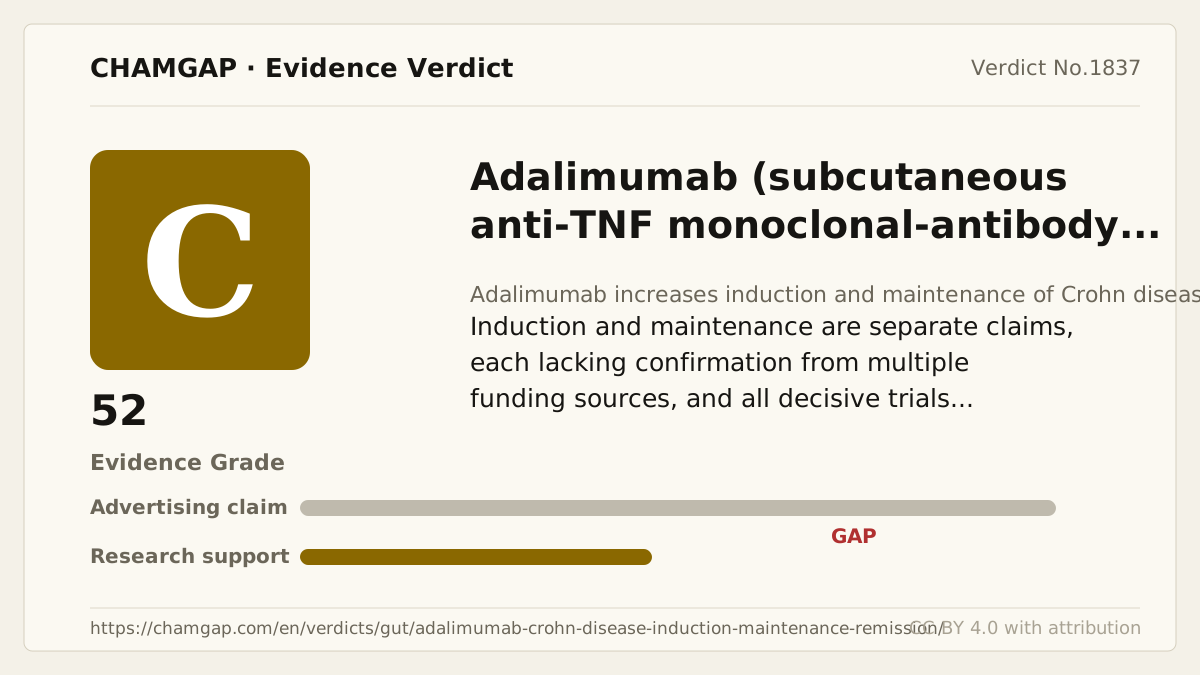
[Chamgap] Adalimumab x induction and maintenance of clinical remission in moderate-to-severe Crohn disease — Evidence Grade C·50. 3 cited sources checked. Source: https://chamgap.com/en/verdicts/gut/adalimumab-crohn-disease-induction-maintenance-remission/ · CC BY 4.0CC BY 4.0 — free to use with attribution; do not distort grades, numbers, or verdict meaning.
What this document does and does not do
Chamgap is an information source. It reports what research has and has not confirmed; it does not tell readers what to take or buy. That decision belongs to readers and, when needed, medical or legal professionals. This verdict reflects literature available up to the search date and may change as new research appears. Nothing here is medical advice.