
Abdominal castor-oil pack,
does it really help with Improvement of constipation?
research showsThe grade is C. The identified human study followed 35 nursing-home residents for seven baseline days, applied packs for three days, and observed four more days. Bowel-movement frequency and stool amount did not change; consistency, straining, and complete evacuation improved, but no control group existed to estimate a between-group effect.
ads claimThis verdict concerns a pack applied to abdominal skin, not oral castor oil. Verdict 1079 is ? for a liver-area pack, verdict 1475 is C with 48 points for oral use and labor onset, and verdict 649 is ? for scalp application. Site, route, and indication differ.
Useful facts when choosing a product
- The identified study was an uncontrolled before-and-after study of 35 participants.
- Observation comprised seven baseline days, three treatment days, and four follow-up days.
- Frequency and amount did not improve; consistency, straining, and complete evacuation improved over time.
Chamgap Semantic Classification Code
Candidate index · review held
K.abdominal-castor-oil-pack.UNK.constipation.improve.baselineFolk and alternative interventions > abdominal castor-oil pack > Unknown > constipation > Improvement claim > Within-group baseline comparison
An automated migration candidate, not an issued permanent code; exact claim scope remains under review. This machine-generated migration candidate helps retrieval but is not a permanent assignment. The original verdict ID and URL remain authoritative.
What the research actually shows
Arslan and Eser studied 35 older residents in two Turkish nursing homes. The 14-day single-group repeated-measures design used seven baseline days, a 60-minute abdominal pack on each of three days, and four post-treatment days. Bowel frequency and stool amount did not improve, while consistency, straining, and complete evacuation did. Publicly accessible reporting did not provide a separate controlled result for laxative use, and a between-group calculation is impossible because there was no control group.
Why this is classified as C (46)
Patient-relevant symptom signals exist, but no comparator or between-group magnitude is available, giving C with 46 points.
Counterpoint. The uncontrolled study is not definitive proof of no effect either.
Rejudgment record. Cross-check applied — Some symptom signals in a 35-person uncontrolled before-and-after study, without a comparator or estimable between-group magnitude
| Endpoint | P | Symptom or function itself is the target - including patient reports and performance tests |
| Replication | R1 | Single confirmatory trial |
| Independence | I1 | Mixed funding sources |
| Effect size | EX | The clinical size of the effect could not be judged |
Stored derived and displayed grades match; this is not a current recalculation or validity check (C).
Sub-claim grades by effect
This ingredient is marketed for several effects. A single overall grade blends strong and weak claims together, so each effect is graded separately here. The overall grade reflects the strongest disconfirming or core claim.
| Effect (sub-claim) | Grade | Basis |
|---|---|---|
| Increased bowel-movement frequency | D | No significant within-group change was found. |
| Improved consistency, straining, and complete evacuation | C | Symptoms improved over time, but there was no control group. |
Cross-check — AI research and Codex final gate
Evidence Table
| Study | Design | Sample | Funding | Endpoint | Result | Weight |
|---|---|---|---|---|---|---|
| Arslan GG and Eser I, 2011 | Uncontrolled single-group before-and-after repeated-measures study | 35 nursing-home residents | Unable to verify | Bowel frequency, stool amount and consistency, straining, and complete evacuation | Frequency and amount were null; consistency, straining, and complete evacuation improved over time. No between-group effect can be calculated. | Only direct human study |
Receipt — 1 References
All 1 cited sources were verified for existence at the original page (as of 2026-08-07).
Final verification and publication gate: Codex · Evidence date: 2026-08-07 · Corrections: none
Cite this verdict
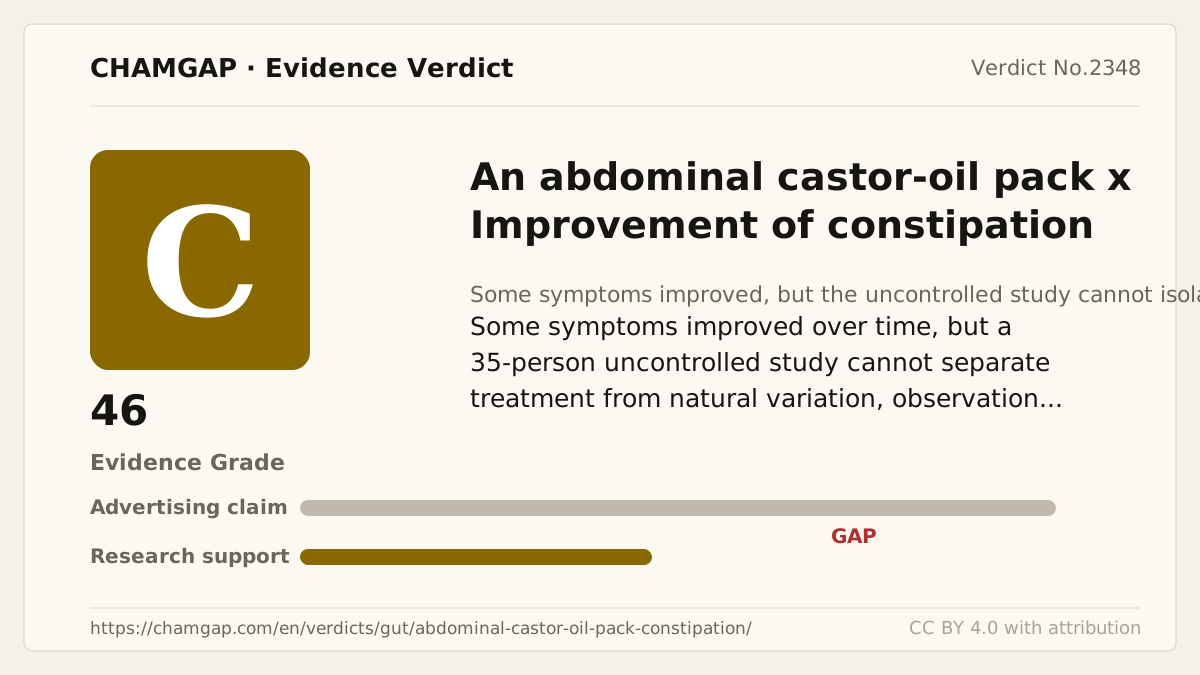
[Chamgap] Abdominal castor-oil pack x constipation — Evidence Grade C·46. 1 cited sources checked. Source: https://chamgap.com/en/verdicts/gut/abdominal-castor-oil-pack-constipation/ · CC BY 4.0CC BY 4.0 — free to use with attribution; do not distort grades, numbers, or verdict meaning.
What this document does and does not do
Chamgap is an information source. It reports what research has and has not confirmed; it does not tell readers what to take or buy. That decision belongs to readers and, when needed, medical or legal professionals. This verdict reflects literature available up to the search date and may change as new research appears. Nothing here is medical advice.