
Wrist splint,
does it really help with Symptom improvement and avoidance of surgery in primary carpal tunnel syndrome?
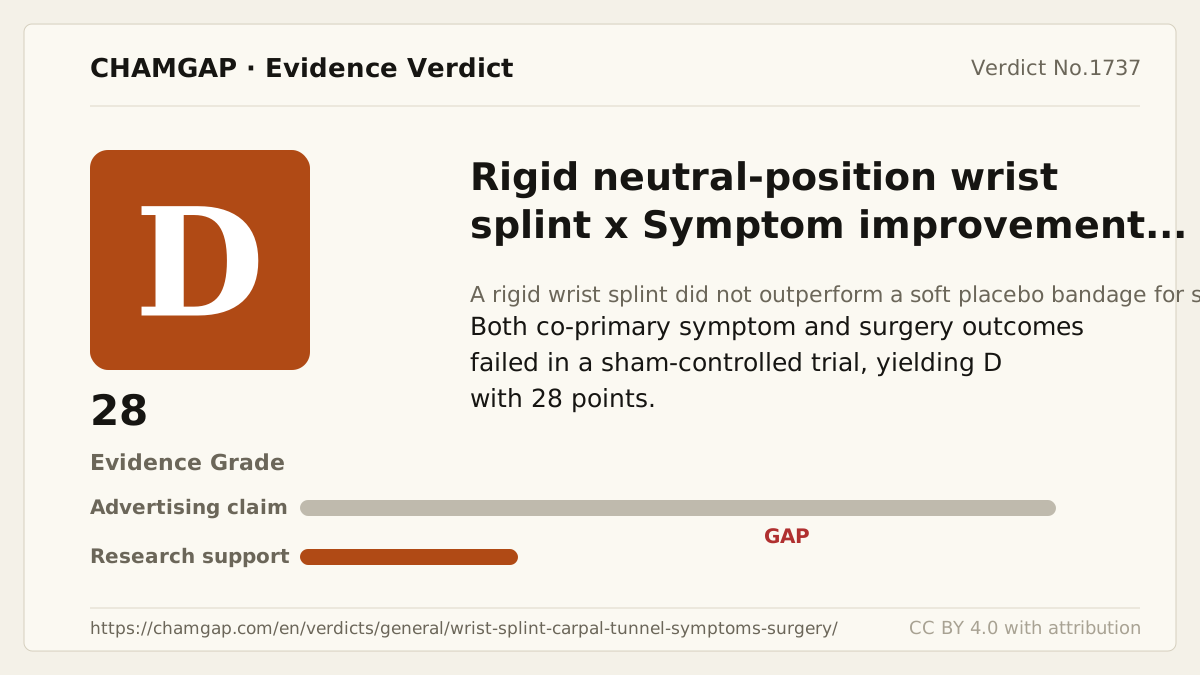
research showsWrist splinting is rated D with 28 points because both co-primary outcomes failed in the most rigorous sham-controlled trial. The trial randomized 142 participants; the actual 12-week symptom analysis included 138, and one-year surgical status was analyzed in all 142. The CTS-6 change difference was 0.08 points with P=0.478, far below the 0.9-point MCID, and surgery rates were also similar at 57.1% and 51.4%.
ads claimA common explanation says that neutral immobilization relieves nerve pressure, reliably improves symptoms, and prevents surgery. The mechanism is plausible, but sham-controlled 12-week symptoms and one-year surgery results did not support those claims.
Useful facts when choosing a product
- The pivotal trial used a neutral-position rigid splint with a metal support, worn at night and during the day when possible.
- The control was a thin soft neoprene bandage that allowed full wrist motion.
- The 142 randomized participants should be distinguished from 138 in the actual 12-week symptom analysis and 142 with known surgical status.
- Both splint and placebo-bandage groups reported minor local irritation or rash, but no serious adverse event occurred.
Chamgap Semantic Classification Code
Candidate index · review held
UNK.rigid-neutral-position-wrist-splint.UNK.symptom-improvement-and-avoidance-of-surgery-in-primary-carpal-tunnel-syndrome.improve.MULTIUnknown > Rigid neutral-position wrist splint > Unknown > Symptom improvement and avoidance of surgery in primary carpal tunnel syndrome > Improvement claim > Multiple: primary unresolved
An automated migration candidate, not an issued permanent code; exact claim scope remains under review. This machine-generated migration candidate helps retrieval but is not a permanent assignment. The original verdict ID and URL remain authoritative.
What the research actually shows
Atroshi and colleagues randomized 142 previously untreated patients with primary idiopathic carpal tunnel syndrome to a rigid neutral splint or soft placebo bandage. The 12-week CTS-6 analysis included 138 participants, while surgical status at one year was available for all 142. The prespecified co-primary outcomes were symptoms at 12 weeks and surgery within one year, and both failed. The 2023 Cochrane review examined 29 earlier trials with 1,937 participants but considered long-term symptom and surgery-conversion evidence very uncertain or compatible with no effect. The new sham trial directly addressed that gap but did not confirm efficacy.
Why this is classified as D (28)
In the most rigorous publicly funded sham-controlled trial, the higher-ranked co-primary CTS-6 outcome failed with P=0.478 and was far below its MCID. The lower-ranked co-primary surgery outcome was also null, and the six-week secondary signal did not justify upgrading. Direct human evidence with primary failure gives D with 28 points.
Counterpoint. A low-cost trial of splinting may still be reasonable for mild symptoms when surgery is being deferred. Persistent sensory loss, weakness, or thenar atrophy requires specialist assessment.
Rejudgment record. Cross-check applied — Atroshi 2026 in NEJM Evidence randomized 142 participants, analyzed CTS-6 at 12 weeks in 138, and established surgical status in all 142. Both co-primary outcomes failed confirmation: the between-group CTS-6 difference was 0.08 (95% CI -0.15 to 0.31; MCID 0.9), and surgery RR was 1.10 (95% CI 0.81 to 1.48). Swedish public and foundation sources funded the trial, with no commercial support.
Sub-claim grades by effect
This ingredient is marketed for several effects. A single overall grade blends strong and weak claims together, so each effect is graded separately here. The overall grade reflects the strongest disconfirming or core claim.
| Effect (sub-claim) | Grade | Basis |
|---|---|---|
| Improvement in carpal tunnel symptoms at 12 weeks | D | The between-group CTS-6 change difference was 0.08 points with P=0.478 and missed the 0.9-point MCID. |
| Avoidance of carpal tunnel release through one year | D | Surgery rates were 57.1% and 51.4%, with RR 1.10 and no difference. |
| Improvement in upper-limb function | D | QuickDASH changes were similar between groups at both 12 and 52 weeks. |
Cross-check — AI research and Codex final gate
Evidence Table
| Study | Design | Sample | Funding | Endpoint | Result | Weight |
|---|---|---|---|---|---|---|
| Atroshi I et al. 2026 | Randomized parallel-group placebo-bandage-controlled clinical trial | 142 randomized (70 rigid splint and 72 placebo bandage); 138 in the actual 12-week CTS-6 analysis; surgical status for 142 at one year | Southern Healthcare Region R&D, Swedish governmental ALF funding, and Lions Foundation Skane; sponsored by Region Skane and not manufacturer-led | Co-primary outcomes of 12-week CTS-6 change and surgery within one year | The CTS-6 difference was 0.08 points (P=0.478) and surgery RR was 1.10 (95% CI 0.81 to 1.48), so both co-primary outcomes failed. | Pivotal contemporary sham-controlled trial |
| Karjalainen TV et al. 2023 | Cochrane systematic review | 29 trials and 1,937 participants; two long-term symptom trials with 144 and three surgery-conversion trials with 243 | Review funding was inadequately reported; no evidence of manufacturer leadership | Symptoms, function, global improvement, and conversion to surgery | Long-term symptom evidence was very uncertain, and the effect on conversion to surgery was compatible with no benefit. | Assessment of uncertainty in earlier evidence |
Receipt — 2 References
All 2 cited sources were verified for existence at the original page (as of 2026-07-24).
Final verification and publication gate: Codex · Evidence date: 2026-07-24 · Corrections: none
Cite this verdict
[Chamgap] Wrist splint x symptom improvement and avoidance of surgery in carpal tunnel syndrome — Evidence Grade D·28. 2 cited sources checked. Source: https://chamgap.com/en/verdicts/general/wrist-splint-carpal-tunnel-symptoms-surgery/ · CC BY 4.0CC BY 4.0 — free to use with attribution; do not distort grades, numbers, or verdict meaning.
What this document does and does not do
Chamgap is an information source. It reports what research has and has not confirmed; it does not tell readers what to take or buy. That decision belongs to readers and, when needed, medical or legal professionals. This verdict reflects literature available up to the search date and may change as new research appears. Nothing here is medical advice.