
Widex Zen Therapy package,
does it really help with Reduced distress and functional handicap from chronic tinnitus?
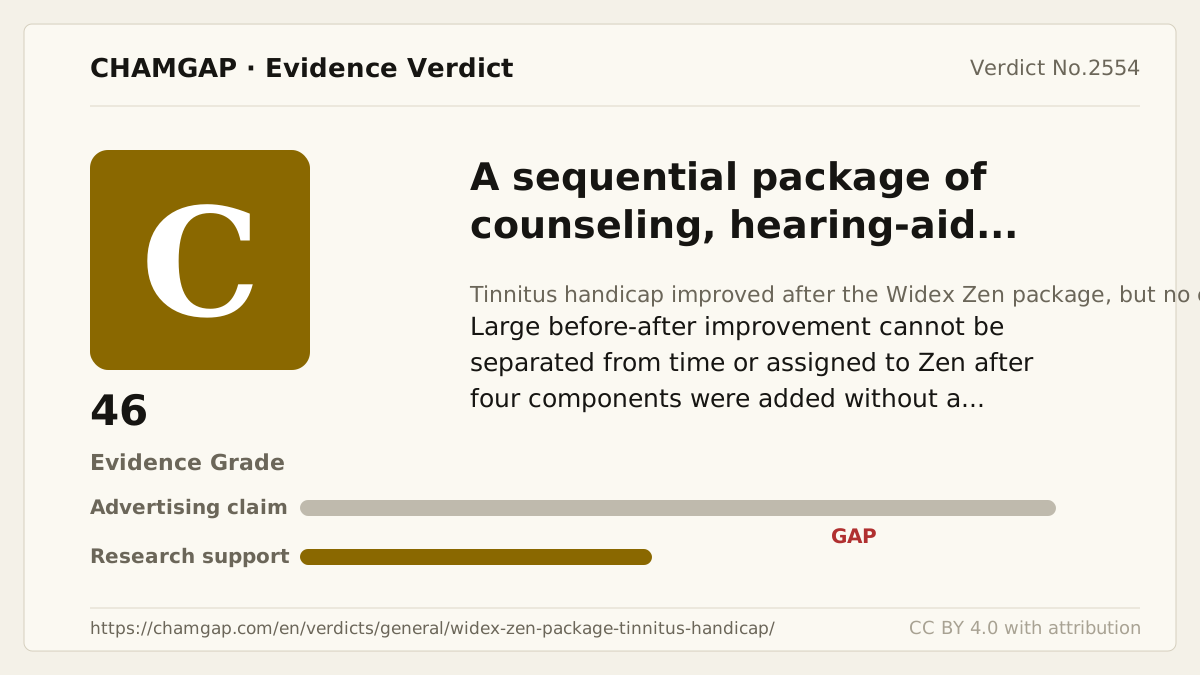
research showsThe grade is C. The only peer-reviewed original study was a 20-person single-arm pilot; all completed, but three with poor adherence were excluded, leaving 17 analyzed. Mean TFI fell from 62 to 34 by six months, but counseling, amplification, behavioral treatment, and Zen were added in fixed sequence without a concurrent control, so the unique between-group effect of Zen or the package cannot be calculated. A nonindexed trade-media report does not establish replication, giving C with 46 points.
ads claimZen fractal tones genuinely exist as a hearing-aid sound option within the package. The observed before-after improvement cannot be converted into a Zen-only effect or promised without counseling and amplification.
Useful facts when choosing a product
- Widex Zen uses a semirandom recursive algorithm to generate harmonically related, nonrepeating fractal tones through hearing aids.
- All 20 Tyler participants completed, but only 17 were analyzed after adherence exclusions.
- The The Herzfeld et al. report presented completer data for 24 of 32 in the nonindexed trade outlet Hearing Review.
Chamgap Semantic Classification Code
Candidate index · review held
X.sequential-package-of-counseling.behavioral.distress-and-functional-handicap-from-chronic-tinnitus.reduce.UNKBehaviors, exposures and policies > sequential package of counseling > Behavioral delivery > distress and functional handicap from chronic tinnitus > Reduction claim > Unknown
An automated migration candidate, not an issued permanent code; exact claim scope remains under review. This machine-generated migration candidate helps retrieval but is not a permanent assignment. The original verdict ID and URL remain authoritative.
What the research actually shows
Tyler RS, Deshpande AK, Lau CC, and Kuk F followed 20 participants for 12 months while sequentially adding informational counseling, hearing aids, brief tinnitus activities treatment, and Zen. The sample of 20 was far below 200. All 20 completed 12 months, but three were excluded for device nonuse and missed visits, leaving a 17-person completer analysis. Those two facts alone support axis 6 B2. The absence of a concurrent control, which prevents recovery of a between-group effect size, was assigned only to axis 4 EX. Widex partially funded the study, and Lau and Kuk were affiliated with Widex ORCA-USA; those facts support axis 3 I0 and were not counted again under axis 6. Herzfeld et al. 2014 reported six-month THI 51→21 and TFI 53→25 among 24 completers from 32 enrolled, but it was an uncontrolled, nonindexed Hearing Review trade article without a PMID, DOI, or registration.
Why this is classified as C (46)
Human improvement signals exist, but no concurrent comparison permits recovery of a between-group effect size, giving EX. B2 rests only on the pivotal sample of 20 and the 17-person completer analysis after three exclusions despite all 20 completing 12 months. Widex funding and affiliations are confined to axis 3 I0, giving C with 46 points.
Counterpoint. C does not establish ineffectiveness; it means the design cannot estimate efficacy beyond time and expectation effects.
Rejudgment record. Cross-check applied — We cross-checked the analyzed denominator, sequential uncontrolled design, funding, and the trade report's indexing, identifiers, and completer denominator.
| Endpoint | P | Symptom or function itself is the target - including patient reports and performance tests |
| Replication | R1 | Single confirmatory trial |
| Independence | I0 | Evidence comes only from manufacturer studies |
| Effect size | EX | The clinical size of the effect could not be judged |
Stored derived and displayed grades match; this is not a current recalculation or validity check (C).
Sub-claim grades by effect
This ingredient is marketed for several effects. A single overall grade blends strong and weak claims together, so each effect is graded separately here. The overall grade reflects the strongest disconfirming or core claim.
| Effect (sub-claim) | Grade | Basis |
|---|---|---|
| Reduced tinnitus handicap after the Widex Zen package | C | Before-after reduction occurred without a concurrent control. |
| Unique effect of Zen fractal tones alone | ? | Zen was added after counseling, amplification, and behavioral treatment, preventing isolation. |
Cross-check — AI research and Codex final gate
Evidence Table
| Study | Design | Sample | Funding | Endpoint | Result | Weight |
|---|---|---|---|---|---|---|
| Tyler RS, Deshpande AK, Lau CC, Kuk F, 2017 | Twelve-month single-arm fixed-sequence intervention pilot | 20 enrolled and completed; 17 analyzed after adherence exclusions | Partially funded by Widex; Lau and Kuk affiliated with Widex ORCA-USA | TFI, THI, and tinnitus loudness and annoyance scales | Mean TFI 62→34; no concurrent control, so between-group and Zen-specific effects cannot be calculated | Only peer-reviewed human original report, but unable to attribute efficacy |
| Herzfeld M, Ciurlia-Guy E, Sweetow R, 2014 Hearing Review clinical report | Six-month multicenter single-arm completer report | 32 enrolled and 24 included in completer analysis | No separate funding statement confirmed; nonindexed trade media | THI and TFI | THI 51→21 and TFI 53→25; no control group or confidence interval | Supportive report not counted as replication |
Receipt — 2 References
All 2 cited sources were verified for existence at the original page (as of 2026-08-14).
Final verification and publication gate: Codex · Evidence date: 2026-08-14 · Corrections: none
Cite this verdict
[Chamgap] Widex Zen Therapy package x reduction of tinnitus handicap — Evidence Grade C·46. 2 cited sources checked. Source: https://chamgap.com/en/verdicts/general/widex-zen-package-tinnitus-handicap/ · CC BY 4.0CC BY 4.0 — free to use with attribution; do not distort grades, numbers, or verdict meaning.
What this document does and does not do
Chamgap is an information source. It reports what research has and has not confirmed; it does not tell readers what to take or buy. That decision belongs to readers and, when needed, medical or legal professionals. This verdict reflects literature available up to the search date and may change as new research appears. Nothing here is medical advice.