
Wholegrain intake,
does it really help with Lower all-cause mortality?
research showsThe grade is C. In two large US cohorts, the highest wholegrain quintile had an approximately 9% lower mortality hazard than the lowest, HR 0.91, 95% CI 0.88 to 0.95. Wholegrains were observed rather than assigned, so a causal longevity effect is not established.
ads claimThe accurate conclusion is lower mortality among people reporting more wholegrains. It cannot be rewritten as proof that adding wholegrains extends everyone's life.
Useful facts when choosing a product
- The exposure combined whole wheat, oats, corn, rye, barley, buckwheat, brown rice, and other wholegrains.
- The category combines gluten-containing wheat, barley, and rye with grains such as rice that do not contain gluten. Product-specific allergy, gluten, and arsenic features cannot be recovered from the aggregate exposure.
- NIH supported the NHS and HPFS; no grain-board or milling-industry funding was identified.
- Verdict 2011 is D with 30 points for pressure-cooked parboiled brown rice and HbA1c. It shares a grain family but studies a specific brown-rice replacement and a surrogate outcome, unlike this aggregate wholegrain-mortality association.
- Wholegrain is a modern aggregate category across many grains; no specific classical chronology was verified.
Chamgap Semantic Classification Code
Candidate index · review held
UNK.wholegrain-intake.oral.all-cause-mortality.reduce.UNKUnknown > Wholegrain intake > Oral > all-cause mortality > Reduction claim > Unknown
An automated migration candidate, not an issued permanent code; exact claim scope remains under review. This machine-generated migration candidate helps retrieval but is not a permanent assignment. The original verdict ID and URL remain authoritative.
What the research actually shows
The 2015 JAMA Internal Medicine paper was cross-checked with dietary-validation sources. The paper states that food-frequency questionnaires were validated against diet records but does not report an item-specific coefficient for total wholegrains. Values from a separate biomarker study were not used as this cohort's wholegrain validation coefficient. Multiple analyses of total, cardiovascular, cancer, and grain fractions lacked a verified multiplicity correction.
Why this is classified as C (56)
A publicly funded large prospective cohort found an all-cause mortality association whose confidence interval excluded 1. This remains one observational cohort without a reported item-specific total-wholegrain validation coefficient, with multiple analyses and residual confounding, yielding C with 56 points.
Counterpoint. Results may depend on which refined food wholegrains replace. This was neither an add-on trial nor a direct trial of one specified grain replacing refined grain.
Rejudgment record. Cross-check applied — Assessed death ascertainment, confidence intervals excluding 1, repeated diet measures, extensive adjustment, missing item-specific total-wholegrain validity, and multiple comparisons
| Endpoint | H | Hard endpoint - actual events such as death |
| Replication | R1 | Single confirmatory trial |
| Independence | I2 | Decisive evidence is publicly or non-profit funded |
| Effect size | E+ | Meets the clinically important threshold |
Stored derived and displayed grades match; this is not a current recalculation or validity check (C).
Sub-claim grades by effect
This ingredient is marketed for several effects. A single overall grade blends strong and weak claims together, so each effect is graded separately here. The overall grade reflects the strongest disconfirming or core claim.
| Effect (sub-claim) | Grade | Basis |
|---|---|---|
| Wholegrain intake reduces all-cause mortality | C | A large inverse association was observed, but causation is unconfirmed. |
| All wholegrain products share the same safety properties | C | Gluten, allergy, and contaminant profiles differ by grain and cannot be inferred from the aggregate exposure. |
Cross-check — AI research and Codex final gate
Evidence Table
| Study | Design | Sample | Funding | Endpoint | Result | Weight |
|---|---|---|---|---|---|---|
| Wu H et al., 2015 | Observational analysis of two prospective cohorts with repeated diet measures | 118,085 participants; 2,727,006 person-years; 26,920 deaths | US National Institutes of Health | All-cause mortality | Highest versus lowest quintile HR 0.91 (0.88 to 0.95); per 28 g/day HR 0.95 (0.93 to 0.98) | Large hard-outcome analysis, but observational |
Receipt — 2 References
All 2 cited sources were verified for existence at the original page (as of 2026-08-03).
Final verification and publication gate: Codex · Evidence date: 2026-08-03 · Corrections: none
Cite this verdict
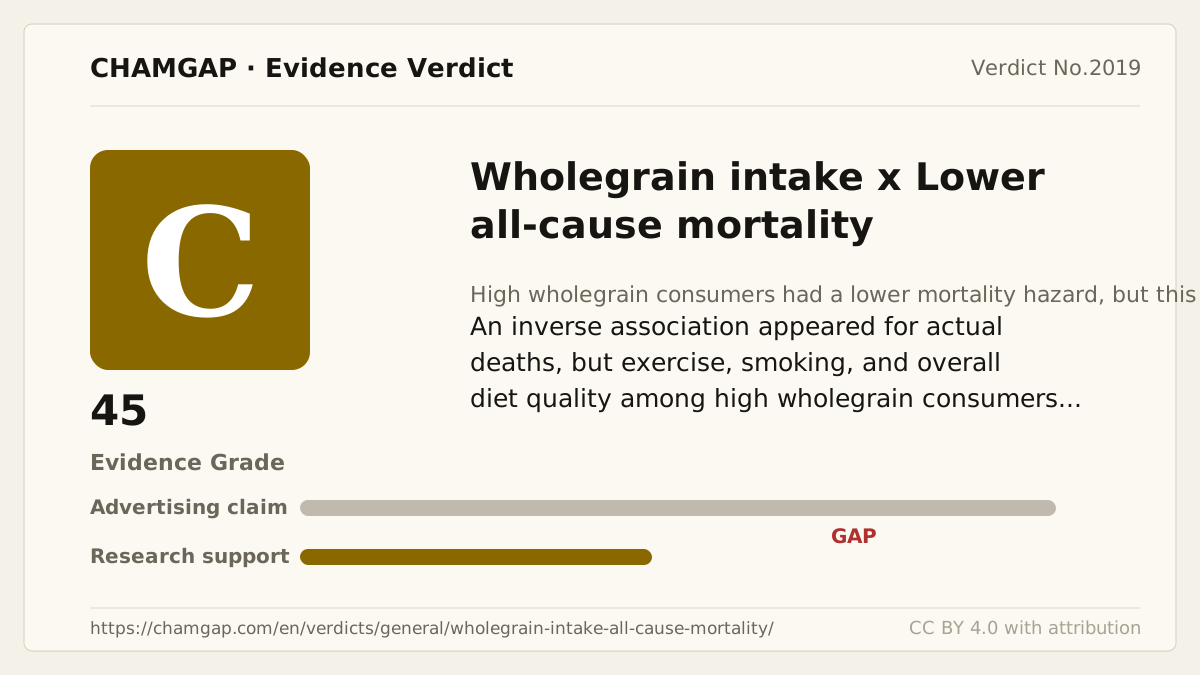
[Chamgap] Wholegrain intake x lower all-cause mortality — Evidence Grade C·56. 2 cited sources checked. Source: https://chamgap.com/en/verdicts/general/wholegrain-intake-all-cause-mortality/ · CC BY 4.0CC BY 4.0 — free to use with attribution; do not distort grades, numbers, or verdict meaning.
What this document does and does not do
Chamgap is an information source. It reports what research has and has not confirmed; it does not tell readers what to take or buy. That decision belongs to readers and, when needed, medical or legal professionals. This verdict reflects literature available up to the search date and may change as new research appears. Nothing here is medical advice.