
Whole Swiss chard,
does it really help with Correction of iron-deficiency anemia?
research showsThe grade is ?. It is a compositional fact that 100 g of raw Swiss chard contains about 1.80 mg of iron. No human study was found, however, that fed chard as whole food, juice, or extract and measured hemoglobin or ferritin. There is no score because human evidence linking iron content to anemia correction is absent.
ads claimIron on a food-composition table and recovery of laboratory values in an iron-deficient patient are different statements. Content, absorbed dose, cause of deficiency, and treatment requirement must be separated.
Useful facts when choosing a product
- USDA National Nutrient Database SR28 lists 0.65 mg iron in a 36-g cup of raw Swiss chard, equivalent to about 1.80 mg per 100 g.
- The NIH Office of Dietary Supplements identifies vegetable iron as nonheme iron and gives approximate bioavailability of 14% to 18% for mixed diets and 5% to 12% for vegetarian diets. Phytate and some polyphenols inhibit absorption, whereas vitamin C enhances it.
- Chard leaves contain high measured oxalate. A human vegetable-meal study found low iron bioavailability from Beta vulgaris greens and lower absorption after calcium oxalate was added. These are composition facts, not efficacy grades.
- On 2026-08-02, PubMed exact query 「(("Swiss chard"[Title/Abstract] OR chard[Title/Abstract] OR "Beta vulgaris var. cicla"[Title/Abstract]) AND (anemia[Title/Abstract] OR anaemia[Title/Abstract] OR hemoglobin[Title/Abstract] OR ferritin[Title/Abstract]))」 yielded 0 eligible human chard studies after excluding beetroot, animals, composition studies, and mixed-leafy-vegetable interventions.
- The human Beta vulgaris supplement trial found in 2024 tested red beetroot supplementation, not Swiss-chard leaves or stalks.
- On 2026-08-02, 51 searches across trial registries, major bibliographic databases, and English, Turkish, Spanish, Hindi, and Arabic terms found 0 human studies measuring hemoglobin or ferritin after Swiss chard alone.
- Mingyi Bielu records epidemic high fever, Donguibogam warns of stomach upset from excess intake, Pliny considered chard less wholesome than cabbage, and Gerard wrote that it offered little nourishment. None records anemia or hematopoiesis.
- Classical beta and East Asian leaf-vegetable entries should not be mistranslated as the thick-rooted table beet developed later in Europe.
Chamgap Semantic Classification Code
Candidate index · review held
F.whole-swiss-chard.food.correction-of-iron-deficiency-anemia.assess.UNKFoods and beverages > Whole Swiss chard > Food consumption > Correction of iron-deficiency anemia > Association or change assessment > Unknown
An automated migration candidate, not an issued permanent code; exact claim scope remains under review. This machine-generated migration candidate helps retrieval but is not a permanent assignment. The original verdict ID and URL remain authoritative.
What the research actually shows
It has not been tested in humans. The only hematopoietic intervention involving chard-like leaves and stalks was Gheith 2018, a phenylhydrazine anemia experiment in male rats using a 30% hydroethanolic extract. In a South African child trial, Swiss chard was merely a reference dish during sensory testing; the randomized intervention was a different African leafy-vegetable mixture containing at least 80% amaranth. That mixture did not significantly improve hemoglobin or ferritin, but it is not a chard efficacy trial. A 2024 human Beta vulgaris supplement trial tested red beetroot supplementation, not Swiss-chard leaves or stalks. This verdict concerns the food itself, not an extract.
Why this is classified as ?
No human study measured hemoglobin or ferritin after Swiss-chard intake, so the grade is ? and the score is null.
Counterpoint. Measured iron content is real; a measured treatment effect is not yet available.
Rejudgment record. Cross-check applied — Fifty-one multilingual searches found no human study measuring hemoglobin or ferritin after Swiss chard alone
Sub-claim grades by effect
This ingredient is marketed for several effects. A single overall grade blends strong and weak claims together, so each effect is graded separately here. The overall grade reflects the strongest disconfirming or core claim.
| Effect (sub-claim) | Grade | Basis |
|---|---|---|
| Iron content of raw Swiss chard | ? | About 1.80 mg per 100 g is a composition fact, not a clinical grade. |
| Correction of iron-deficiency anemia by whole Swiss chard | ? | No human study measured this outcome. |
| Hematopoietic effect of chard leaf and stalk extract | ? | Tested only in rats with phenylhydrazine-induced anemia, not humans. |
Cross-check — AI research and Codex final gate
Evidence Table
| Study | Design | Sample | Funding | Endpoint | Result | Weight |
|---|---|---|---|---|---|---|
| Gheith I and El-Mahmoudy A. 2018 | Extract experiment in male rats with phenylhydrazine-induced anemia | 30 male albino rats | Academic animal experiment | Red cells, hemoglobin, hematocrit, and related measures | Animal blood indices improved with extract | Excluded because it used animals and extract rather than whole chard in humans |
| van der Hoeven M et al. 2016 | Randomized mixed-leafy-vegetable feeding trial in South African children | 86 intervention and 81 control participants | Academic and public research | Hemoglobin, ferritin, retinol, and zinc | The mixture did not significantly improve hemoglobin or ferritin | Excluded because chard was only a sensory reference, not the intervention |
Receipt — 4 References
All 4 cited sources were verified for existence at the original page (as of 2026-08-02).
Final verification and publication gate: Codex · Evidence date: 2026-08-02 · Corrections: none
Cite this verdict
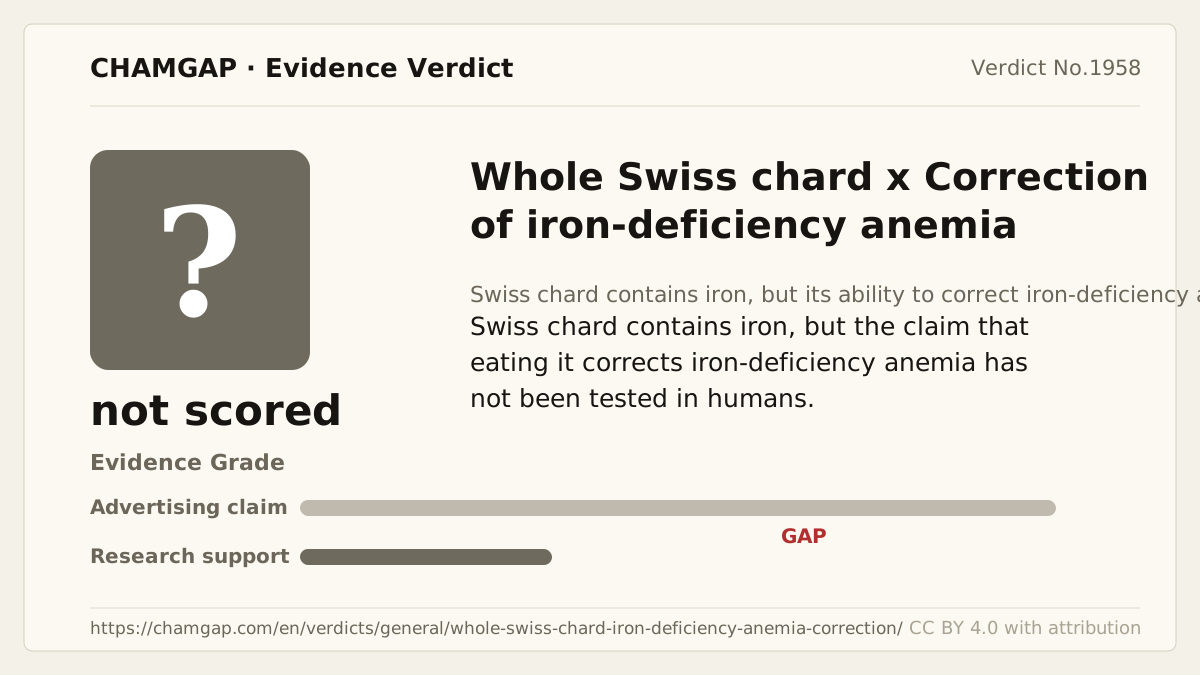
[Chamgap] Whole Swiss chard x correction of iron-deficiency anemia — Evidence Grade ?. 4 cited sources checked. Source: https://chamgap.com/en/verdicts/general/whole-swiss-chard-iron-deficiency-anemia-correction/ · CC BY 4.0CC BY 4.0 — free to use with attribution; do not distort grades, numbers, or verdict meaning.
What this document does and does not do
Chamgap is an information source. It reports what research has and has not confirmed; it does not tell readers what to take or buy. That decision belongs to readers and, when needed, medical or legal professionals. This verdict reflects literature available up to the search date and may change as new research appears. Nothing here is medical advice.