
WHO Surgical Safety Checklist,
does it really help with Reduced postoperative complications, surgical-site infection, and mortality?
research showsThe WHO Surgical Safety Checklist is rated C because signals for fewer postoperative complications and surgical-site infections coexist with limited randomized evidence and inconsistent replication. The initial eight-hospital before-after study reported reductions in complications from 11.0% to 7.0% and death from 1.5% to 0.8%. A study of 215,711 procedures in 101 Ontario hospitals, however, found no significant reduction in death or complications, and a key review judged study designs largely weak and results inconsistent. GRADE-based guideline reviews placed relevant outcomes in the low- or very-low-certainty range, imposing a C ceiling.
ads claimPromotion may turn checklist introduction into a universal guarantee of lower surgical mortality. The literature shows that fidelity and background safety systems matter, and this standardization procedure is distinct from individual infection-control techniques.
Useful facts when choosing a product
- The WHO checklist is a 19-item tool used before induction of anesthesia, before skin incision, and before the patient leaves the operating room.
- It combines patient, procedure, and site confirmation with antibiotic checks, anticipated-risk communication, and instrument and specimen checks.
- The checklist is neither a drug nor an invasive device, so no direct biological harm is established, but perfunctory completion and omissions can weaken process improvement.
- Effects of infection-control bundles, antibiotic prophylaxis, or individual surgical techniques cannot be assigned wholesale to the checklist.
Chamgap Semantic Classification Code
Candidate index · review held
P.who-surgical-safety-checklist.procedural.postoperative-complications-surgical-site-infection-and-mortality.reduce.baselineProcedures, devices and tests > WHO Surgical Safety Checklist > Procedural > postoperative complications, surgical-site infection, and mortality > Reduction claim > Within-group baseline comparison
An automated migration candidate, not an issued permanent code; exact claim scope remains under review. This machine-generated migration candidate helps retrieval but is not a permanent assignment. The original verdict ID and URL remain authoritative.
What the research actually shows
Haynes 2009 compared 7,688 patients before and after implementation at eight hospitals and reported major complications falling from 11.0% to 7.0% and inpatient death from 1.5% to 0.8%. Chaudhary 2015 reported lower complications and mortality in a single-center randomized trial of 700 patients. Haugen 2015 studied 4,475 patients in a stepped-wedge cluster trial, with nonadherence and implementation effects complicating interpretation. Urbach 2014 found no significant mortality or complication reduction across 101 hospitals. The de Jager 2016 review included only two randomized studies among 25 and concluded that outcomes were inconsistent.
Why this is classified as C (49)
Initial multicenter before-after and limited randomized evidence is positive, but a large routine-adoption study was null, the key review found inconsistency, and GRADE-based certainty is low to very low. The certainty ceiling gives C with 49 points.
Counterpoint. Time trends and concurrent safety programs may inflate observational effects, while poor adherence may dilute real effects.
Rejudgment record. New verdict — Accepted positive initial before-after and limited randomized signals, but applied the C ceiling for large null follow-up findings, inconsistency, and low-to-very-low GRADE certainty
Sub-claim grades by effect
This ingredient is marketed for several effects. A single overall grade blends strong and weak claims together, so each effect is graded separately here. The overall grade reflects the strongest disconfirming or core claim.
| Effect (sub-claim) | Grade | Basis |
|---|---|---|
| Reduced surgical-site infection | C | Positive signals exist, but concurrent infection-control changes are difficult to separate and certainty is low. |
| Reduced postoperative complications | C | Positive initial studies coexist with a large null study. |
| Reduced operative mortality | C | Observational positive signals exist, but randomized evidence has not established the effect. |
Cross-check — AI research and Codex final gate
Evidence Table
| Study | Design | Sample | Funding | Endpoint | Result | Weight |
|---|---|---|---|---|---|---|
| Haynes AB et al. 2009 | Prospective before-after study at eight hospitals | 7,688 patients | WHO patient-safety program and related support | Major inpatient complications and death | Complications fell from 11.0% to 7.0% and death from 1.5% to 0.8%. | Large initial positive observational evidence |
| Urbach DR et al. 2014 | Population-based before-after natural experiment | 101 hospitals and 215,711 procedures | Canadian Institutes of Health Research | Thirty-day operative death and complications | Results were null for death, OR 0.91 (0.80 to 1.03), and complications, OR 0.97 (0.90 to 1.03). | Large nonreplication evidence |
| de Jager E et al. 2016 | Systematic review of 25 studies | Two randomized, 13 prospective cohort, and 10 retrospective cohort studies | Academic research | Postoperative complications and death | Study quality was generally poor and results were inconsistent. | Key certainty and consistency assessment |
Receipt — 3 References
All 3 cited sources were verified for existence at the original page (as of 2026-07-23).
Final verification and publication gate: Codex · Evidence date: 2026-07-23 · Corrections: none
Cite this verdict
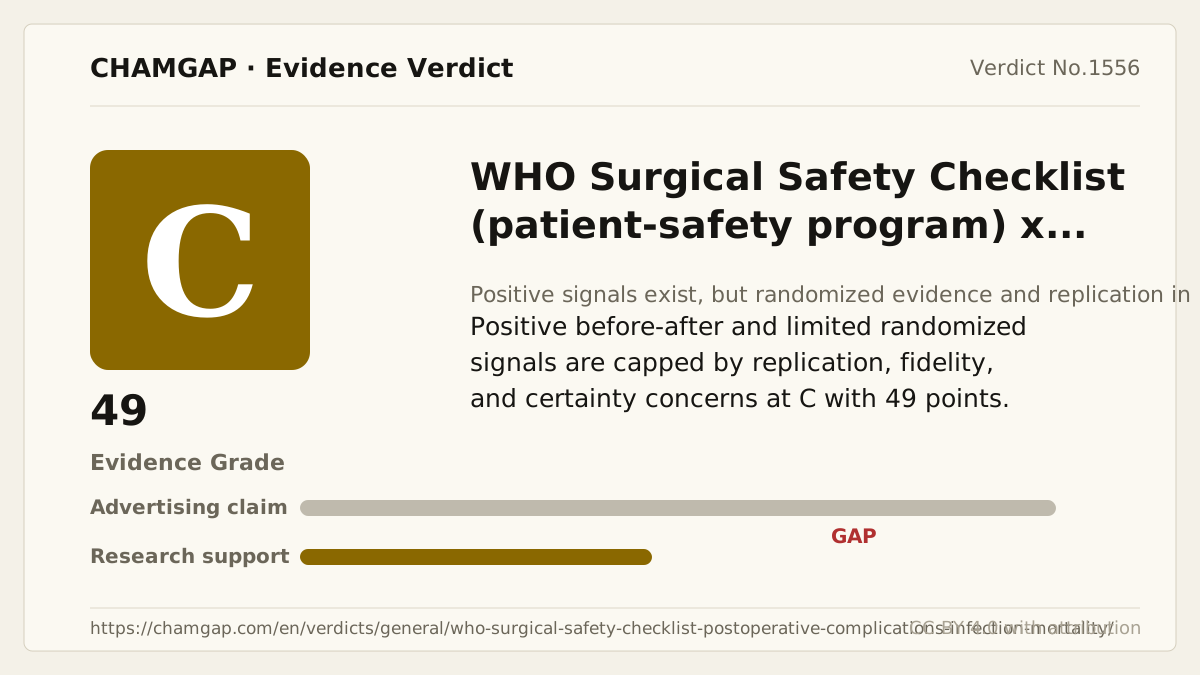
[Chamgap] WHO Surgical Safety Checklist x reduced postoperative complications, surgical-site infection, and mortality — Evidence Grade C·49. 3 cited sources checked. Source: https://chamgap.com/en/verdicts/general/who-surgical-safety-checklist-postoperative-complications-infection-mortality/ · CC BY 4.0CC BY 4.0 — free to use with attribution; do not distort grades, numbers, or verdict meaning.
What this document does and does not do
Chamgap is an information source. It reports what research has and has not confirmed; it does not tell readers what to take or buy. That decision belongs to readers and, when needed, medical or legal professionals. This verdict reflects literature available up to the search date and may change as new research appears. Nothing here is medical advice.